Trump, Xi Hold Beijing Summit Amid Global Crises and Rivalry

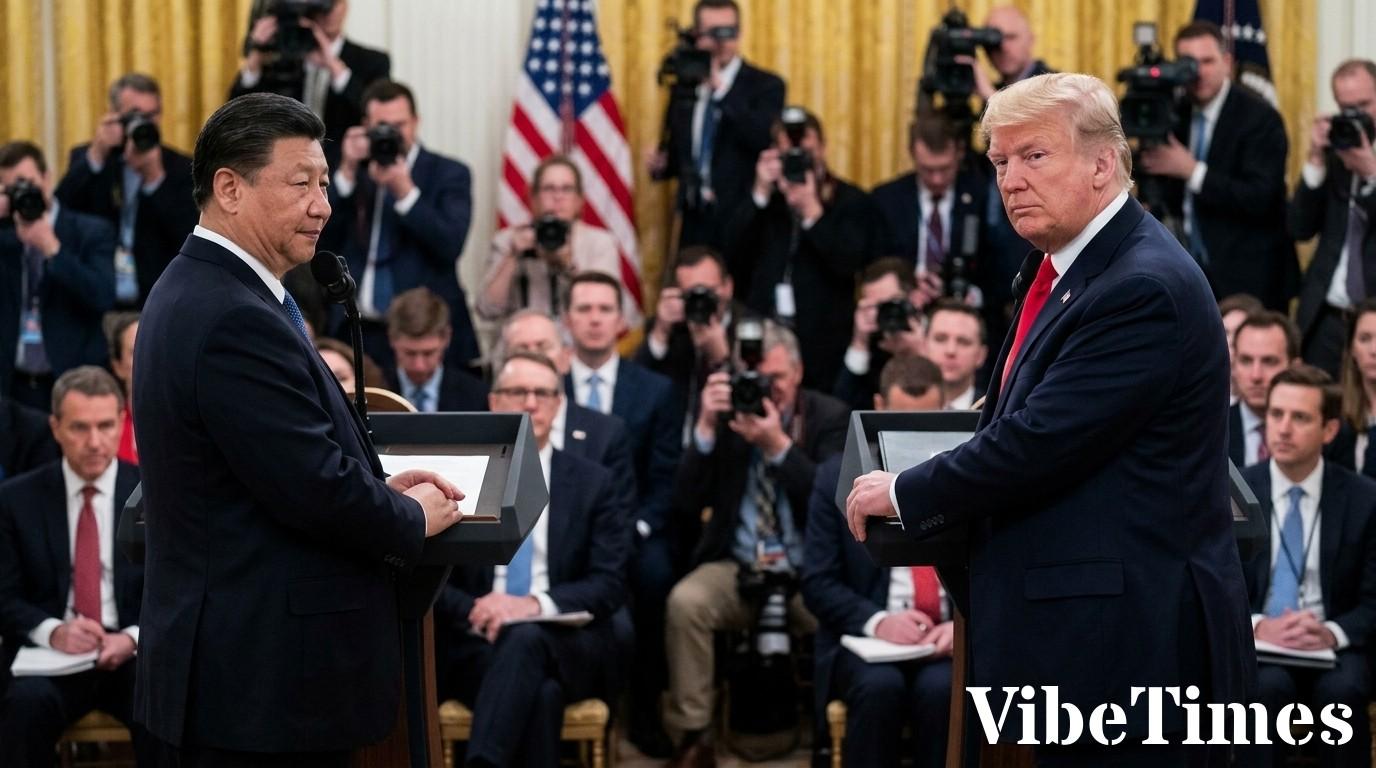
U.S. President Donald Trump arrived in Beijing late on the 13th (local time), commencing a 3-day state visit. The meeting between the two leaders has drawn significant attention regarding its potential impact on bilateral relations. President Trump is scheduled to meet with Chinese President Xi Jinping at the Great Hall of the People in Beijing on the morning of the 14th to discuss key issues such as economy and security.
The summit is being held amid a complex interplay of the global crisis of the Iran War and U.S.-China hegemonic competition. While last October's Asia-Pacific Economic Cooperation (APEC) summit in South Korea focused on preventing an escalation of the trade war, this meeting is seen as a venue for U.S.-China competition for leadership in the global order, centered around the global agenda of the Iran War.
The most urgent issue for both leaders is the Iran War, with no clear end in sight. President Trump had sought to end the Iran War early to concentrate on negotiations with China, but these efforts were thwarted, leading him to confront President Xi with a complicated Middle Eastern problem. China also recognizes the Iran War as a significant issue, given the potential for severe economic risks if the Strait of Hormuz, through which over 30% of China's imported crude oil passes, were to be blockaded long-term.
Just before his trip to China, President Trump initially stated he would have a lengthy discussion with President Xi on the Iran issue, but later amended his remarks to say Iran would not be among the topics for discussion. This is interpreted as a move to preempt the possibility of China using the Iran issue as a bargaining chip.
Another volatile issue is Taiwan. While the U.S. acknowledges the 'One China' principle, it has maintained strategic ambiguity regarding Taiwan's status. President Xi is expected to raise demands such as clarification of the U.S. stance on Taiwan, tariff reductions on Chinese goods, and partial easing of export controls on advanced technologies. Chinese state media, People's Daily, recently criticized the U.S. for unilaterally initiating trade and tariff wars, generalizing the concept of national security, and imposing strict controls in science and technology. Consequently, President Xi may seek to leverage President Trump's somewhat defensive position to extract substantive concessions on foreign policy and security issues, including Taiwan.
Furthermore, trade negotiations are a key agenda item. President Trump mentioned to reporters just before his trip that while he would discuss various matters with President Xi, trade would be the core issue. The two countries had engaged in a trade war shortly after the current administrations took office, involving a 145% tariff on Chinese goods, export controls on advanced technology, and rare earth export restrictions. However, they entered a state of 'trade truce' following the Busan APEC summit last October. President Trump has long touted the large-scale trade agreements he has struck as achievements of his 'MAGA' (Make America Great Again) policy. During this visit, he is expected to focus on eliciting promises of substantial investment or increased imports from China. He aims to use attracting large-scale U.S. investment and trade deal successes as momentum to overcome domestic political challenges. With the midterm elections approaching in November, he is in urgent need of tangible achievements, making it highly probable that he will demand quantifiable increases in purchases and improvements in market access.
The core agenda for this summit can be summarized as the U.S. side's desired '5Bs' (Boeing, beef, soybeans, investment committee, trade committee) and China's prioritized '3Ts' (Taiwan, tariffs, technology). Hong Kong's Sing Tao Daily analyzed that a primary goal would be to accurately define bilateral relations, reduce uncertainty, and control risks. There is potential for forming phased consensus on resuming bilateral communication mechanisms, deferring further tariff hikes, commodity purchases and market access, and stabilizing industrial supply chains.