Analysis of Top Performing Stocks in the US Market Over the Past 5 Years

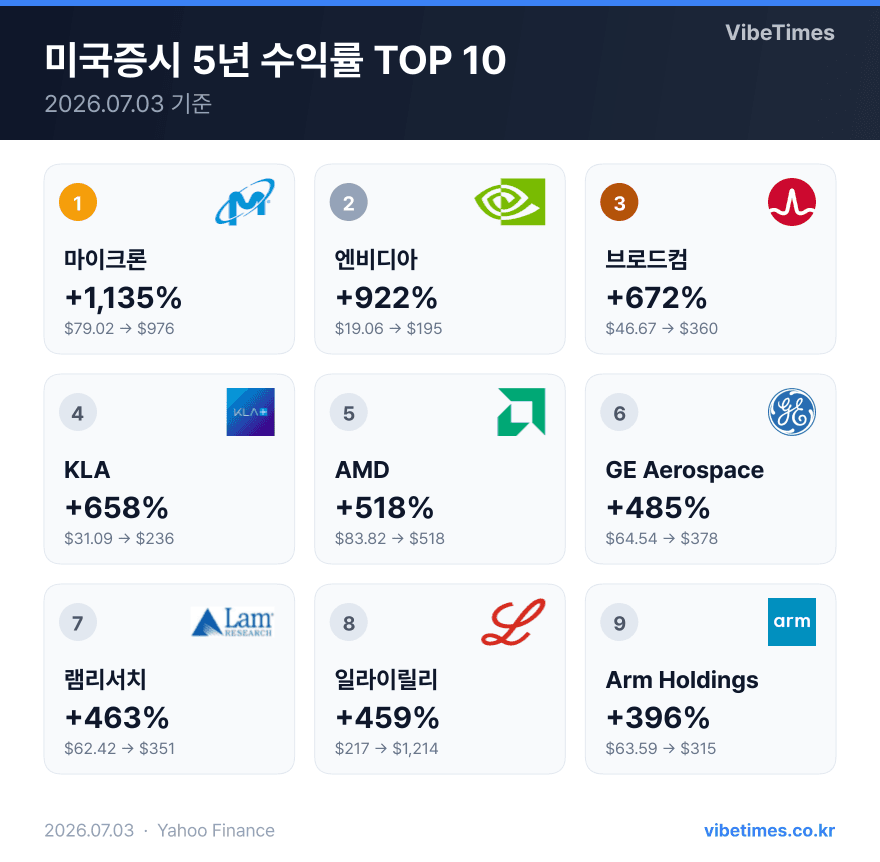
As of July 3, 2026, the companies that recorded the highest returns in the US stock market over the past five years were giants in the semiconductor and technology industries. Micron (MU), ranking first, achieved an astonishing 1,134.6% return over five years, with its stock price soaring from $79.02 to $976, currently boasting a market capitalization of $1.17 trillion. NVIDIA (NVDA), in second place, also delivered a 922.3% return, rising from $19.06 to $195 and establishing an overwhelming market capitalization of $4.79 trillion. Broadcom (AVGO) followed in third place with a 672.4% return and a market capitalization of $1.76 trillion. The performance of these top-tier stocks goes beyond mere stock price appreciation, clearly demonstrating the explosive growth and market dominance of specific industries.
Interestingly, among the top 10 stocks, memory semiconductor manufacturer Micron and AI chip design leader NVIDIA secured the first and second positions consecutively. Furthermore, the significant presence of semiconductor design and equipment-related companies such as Broadcom, KLA, AMD, Lam Research, and Applied Materials underscores the powerful structural growth drivers across the semiconductor industry over the past five years. The advancement of AI technology, coupled with increased demand from data centers and the proliferation of autonomous vehicles and high-performance computing, have been identified as key factors driving the performance and stock prices of these semiconductor companies.
Beyond semiconductor companies, the list also includes healthcare firm Eli Lilly (LLY), software company Arm Holdings (ARM), and aerospace/defense manufacturer GE Aerospace (GE), drawing attention. Eli Lilly recorded a 459.1% return and a market capitalization of $1.06 trillion, showcasing the potential of new drug development and the biotech industry. Arm Holdings achieved a 395.8% return and a market capitalization of $360.4 billion, confirming its continued influence in mobile and AI chip design. GE Aerospace also posted a strong 484.9% return with a market capitalization of $391.7 billion, indicating the recovery and growth of the aviation industry.
Dominance of the Semiconductor Sector and Root Causes of Growth
It is evident that a substantial number of the top-performing stocks in the US market over the past five years were semiconductor-related companies. The exceptional performance of Micron (1st) and NVIDIA (2nd), along with Broadcom (3rd), KLA (4th), AMD (5th), Lam Research (7th), and Applied Materials (10th), totaling seven companies, achieved high returns within the semiconductor ecosystem. This suggests not just individual company success, but a structural growth phase for the entire industry.
In particular, the growth of these companies is attributed to the explosive development of artificial intelligence (AI) technology and the subsequent surge in demand for high-performance computing. The skyrocketing demand for High Bandwidth Memory (HBM) and Graphics Processing Units (GPUs), essential for AI model training and inference, directly benefited market leaders Micron and NVIDIA. Micron's stock price surged 1,134.6% over five years, from $79.02 to $976, while NVIDIA's stock rose 922.3%, from $19.06 to $195. Their current market capitalizations of $1.17 trillion and $4.79 trillion, respectively, highlight their immense market influence.
The impressive performance of semiconductor equipment and design companies is also noteworthy. Broadcom's stock climbed to $360 with a 672.4% return, KLA reached $236 with a 657.7% return, AMD hit $518 with a 517.8% return, Lam Research rose to $351 with a 463.0% return, and Applied Materials reached $603 with a 345.0% return. These companies play a crucial role in enhancing the efficiency of semiconductor manufacturing processes and supporting the design of cutting-edge chips. The advent of the AI era has not only intensified chip design competition but also underscored the importance of advanced equipment and technologies for stable, high-quality semiconductor production, allowing these firms to benefit indirectly from AI trends and maintain strong growth.
Impact on the Market and Industries, and Investment Implications
The overwhelming returns posted by semiconductor companies in the US stock market over the past five years have had a profound impact across the entire related industry ecosystem. Notably, advancements in AI technology have exponentially increased semiconductor demand, dramatically boosting the performance of associated companies. This trend is expected to continue in 2026, with AI-related investments likely to grow further, potentially creating positive ripple effects not only for chip manufacturers but also for all industries connected to AI, including software, cloud services, and data analytics.
The surge in market capitalization of these top-tier companies signifies their strengthened position in the global economy. NVIDIA's market capitalization of $4.79 trillion, for instance, exceeds the annual GDP of many countries, clearly illustrating how dominant leading companies in specific technology sectors can become and their far-reaching influence. Investors should therefore closely monitor the technological development trends, market share shifts, and competitive landscapes of these key corporations.
However, the shadow of volatility accompanies high returns. The semiconductor industry is characterized by rapid technological changes and high cyclical sensitivity, warranting caution against excessive optimism. Nevertheless, considering its connection to future growth drivers such as AI, autonomous driving, and the metaverse, the semiconductor industry is anticipated to remain a significant investment theme in the long term. Investors should approach with prudence, comprehensively considering each company's financial health, technological competitiveness, and long-term market demand outlook.
Meanwhile, the cases of Eli Lilly and GE Aerospace, which stood out in sectors other than semiconductors, demonstrate how structural changes within specific industries can drive the growth of major corporations. Eli Lilly's 459.1% return highlights the potential of new drug development and the growth prospects of the bio-industry, while GE Aerospace's 484.9% return reflects the recovery and adoption of advanced technologies in the aviation sector. This suggests that when diversifying investment portfolios, the growth potential of essential industries should not be overlooked alongside tech stocks.
Future Outlook and Investment Strategy
Based on the record returns of the past five years, investments in related industries are expected to continue. The AI semiconductor market, in particular, is projected to see explosive demand growth through 2026, offering sustained growth opportunities for leading companies like Micron, NVIDIA, and AMD. Micron's 5-year return of 1,134.6% and NVIDIA's 922.3% numerically represent this market's potential, indicating that investments in AI semiconductor technology development and production capacity expansion will likely accelerate.
Furthermore, positive prospects are anticipated for the semiconductor manufacturing equipment and materials sectors as well. Companies like KLA (657.7% return), Lam Research (463.0% return), and Applied Materials (345.0% return) provide essential technologies for advanced semiconductor production. As efforts to strengthen the global semiconductor supply chain and competition in high-performance chip manufacturing intensify, the importance of these companies will grow. Therefore, investment across the entire semiconductor ecosystem is expected to remain viable.
Additionally, the achievements of companies in traditional sectors like healthcare and aerospace, driven by innovative technological advancements or market recovery, demonstrate that high returns are attainable. Eli Lilly's (459.1% return) case illustrates the substantial investment value created by successful new drug development, and GE Aerospace's (484.9% return) case highlights growth potential stemming from structural shifts in the industry. Consequently, investors need to establish a balanced investment strategy that considers fundamental demand shifts and innovation drivers within each industry, alongside rapidly evolving technological trends.
In conclusion, the data from the past five years clearly shows that AI innovation has propelled massive growth, centered around the semiconductor industry. These technological trends are likely to persist, and investments in the related market should be approached with a prudent yet proactive stance. However, as all investments carry risks, thorough fundamental analysis of individual companies and careful examination of market conditions must precede any decision.