AI Value Portfolio Achieves 56% Return… Investment Report


Lead
On August 16, 2026, Asian markets recorded a strong rebound, completely erasing traces of the recent tech stock correction in the U.S. While the KOSPI surged over 2.4% to retake the 7,000 mark, the **AI Value Portfolio** has been steadily climbing the ladder amidst this volatility, maintaining a high return in the 56% range. With initial assets of $10,000 now surpassing $15,000, this portfolio demonstrates remarkable defensive capability—turning market volatility into profit—by targeting undervalued companies and true AI beneficiaries rather than chasing overheated momentum.
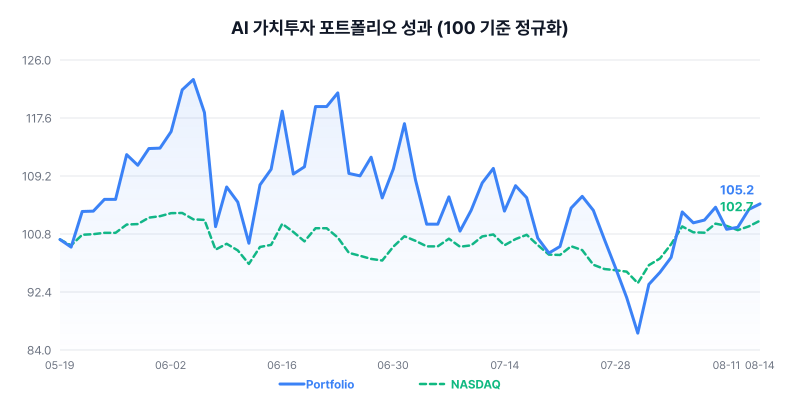
Performance Trend
Passing the most intense period of the semiconductor rivalry late last year, the portfolio's current asset value has reached $15,644. The gradual upward curve of the assets over the past week, peaking at $15,644 on August 14, is impressive. Proving this is no game of luck, the portfolio has reduced its cash balance to zero, maintaining strong long positions across all holdings. This signals a conviction in the 'full-fledged AI expansion' phase rather than anxiety about market downturns.
Holdings Diagnosis
The core of this strategy lies not in reckless betting but in a strict belief in the numbers. The semiconductor 'magnificent three'—Nvidia, Broadcom, and Micron—form the backbone of the portfolio, and it is worth noting how closely their price movements adhere to PEG (Price/Earnings-to-Growth) indicators.
Currently, Nvidia's PER stands at 34.5x. With an EPS of $6.53, the market still views this as undervalued relative to its growth potential. In particular, a PEG ratio in the 0.6 range suggests that the current stock price has not yet fully absorbed growth expected over the next 1-2 years. Broadcom also appears to have a high PER at 69.4x, but an overwhelming PEG of 0.47 indicates that the stock is still cheap relative to enterprise value. AMD's PER of 123.5x looks somewhat burdensome, but considering its PEG of 1.01 and EPS of $3.91, it appears that its superiority in the next-generation AI semiconductor competition is beginning to be reflected.
Conversely, the recent significant increase in Intel weighting is a point to watch. Despite a PER exceeding 100x and a negative EPS (-2.09), the decision to buy was driven by expectations of a turnaround following the recovery of the AI supply chain, rather than current financial statements. This represents proactive portfolio management that reads the shifting semiconductor landscape, going beyond simple value investing.
Review of Recent Trades
The portfolio's movements over the past few days demonstrate a delicate art of 'concentration and diversification.' Selling portions of SOXL and TQQQ on August 7 and 14 consecutively was intended to hedge volatility and realize profits from the surging semiconductor index. The move in late July to reduce TQQQ and shift funds to SOXL was a proactive sector rotation based on "semiconductor valuation superiority relative to the Nasdaq."
Of interest is the process of selling Meta (META) twice. With a clear view that ad revenue competition was intensifying and AI monetization was lagging, diverting funds to the higher-growth AI/semiconductor sector was a decision made with conviction. Finally, on August 14, using the accumulated liquidity to buy Intel brought the portfolio closer to its original purpose of 'AI Semiconductors.'
Market Outlook
The U.S. market has entered a lull, with the Nasdaq and S&P 500 seeing adjustments of around 0.2%. However, the VIX fear index falling to 14.25 and the U.S. 10-year Treasury yield rising to 4.696% reflect expectations of economic overheating rather than a shift to safety assets. The simultaneous rise in WTI crude oil and gold prices suggests not inflation worries but a recovery in real economic demand.
In conclusion, the structure of the current **AI Value Portfolio** is very solid. Holding core assets like Nvidia and Micron based on undervalued PEG indicators serves as a shield against downside risk, while the aggressive operation of reinvesting some realized profits into turnaround stocks like Intel acts as a window to raise the upper limit of returns. While the market remains on the jagged waves of the New Normal, the surfboard to ride these waves looks sufficiently sturdy.
Current Holdings
| Ticker | Quantity | Avg Price | Current Price | PER |
|---|---|---|---|---|
| AVGO (Broadcom) | 5.67 shares | $326.03 | $417.82 | 69.4 |
| AMD (AMD) | 7.17 shares | $198.62 | $483.01 | 123.5 |
| MU (Micron) | 0.25 shares | $996.00 | $949.83 | 20.6 |
| NVDA (Nvidia) | 25.76 shares | $183.15 | $225.30 | 34.5 |
| AMZN (Amazon) | 1.95 shares | $208.39 | $265.13 | 21.3 |
| META (Meta) | 0.64 shares | $653.56 | $594.97 | 22.4 |
| TQQQ (ProShares UltraPro QQQ) | 1.19 shares | $76.34 | $77.15 | 35.1 |
| SOXL (Direxion Daily Semi. Bull) | 17.09 shares | $71.22 | $145.36 | 51.2 |
| INTC (Intel) | 2.80 shares | $104.56 | $104.56 | N/A |
Transaction History
| Date | Type | Symbol | Qty | Price |
|---|---|---|---|---|
| 2026-08-14 | Buy | INTC | 2.80 shares | $104.56 |
| 2026-08-14 | Sell | SOXL | 0.90 shares | $145.36 |
| 2026-08-07 | Sell | SOXL | 0.95 shares | $132.33 |
| 2026-08-07 | Sell | TQQQ | 0.51 shares | $72.03 |
| 2026-07-31 | Buy | SOXL | 1.57 shares | $114.72 |
| 2026-07-31 | Sell | TQQQ | 0.30 shares | $63.30 |
| 2026-07-31 | Sell | META | 0.11 shares | $539.03 |
| 2026-07-31 | Sell | SOXL | 0.87 shares | $114.72 |
※ This report is an analysis of the simulation operation history of the AI Value Portfolio and is not investment advice. Actual investment should be made under your own judgment and responsibility.
Want to know the details of the portfolio?
Subscribe to the newsletter below to receive detailed daily investment reports.