Nvidia Tops List of US Stocks with Highest 10-Year Returns

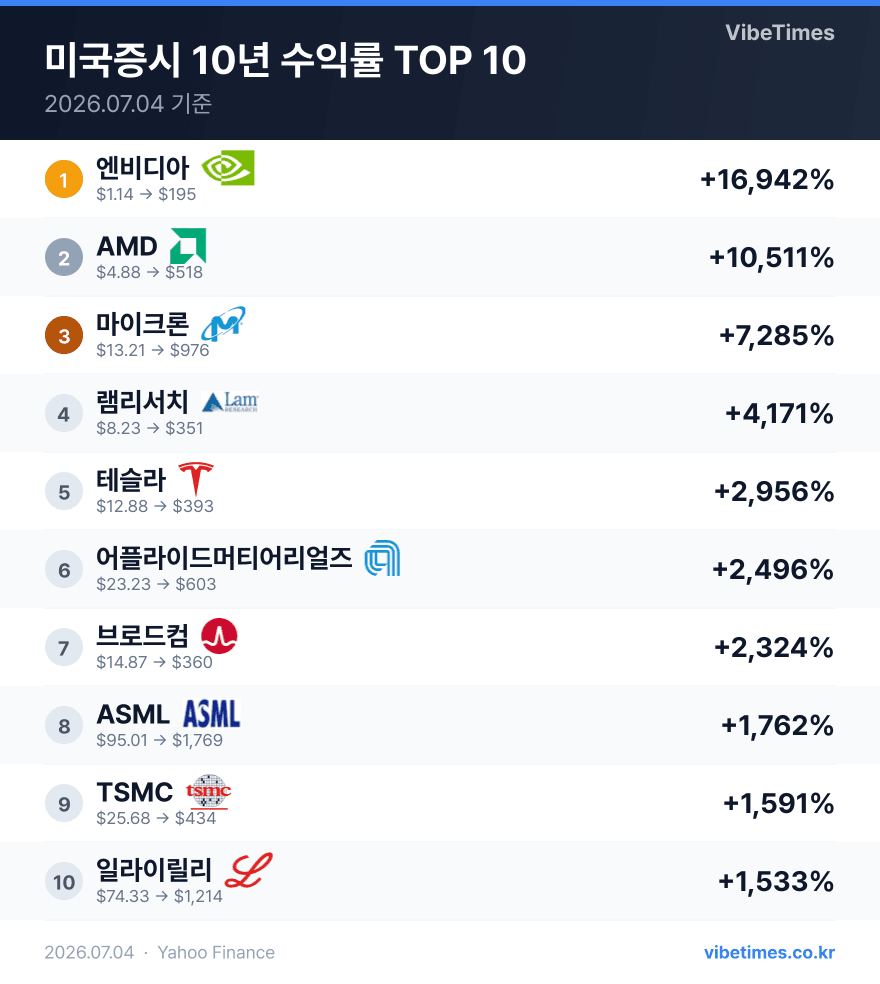
US Stock Market: Analysis of Top 10-Year Return Performers Reveals Clear Semiconductor Dominance
As of July 4, 2026, the lineup of U.S. companies that have delivered the highest returns over the past decade has been revealed. Notably, semiconductor-related companies have swept the top ranks, demonstrating the explosive growth of the sector. The ranking from 1st to 10th place serves as a crucial indicator of how market shifts, technological innovation, and investor choices have played out.
Nvidia Leads the AI Era with Over 10,000% 10-Year Return
The analysis results highlight Nvidia's (NVDA) outstanding performance, securing the top spot with an astonishing 16,941.8% return over ten years. The stock, which traded at $1.14 in July 2016, surged to $195 over the decade, propelling the company into a giant with a market capitalization of $4.72 trillion. This meteoric rise is attributed to its position as the biggest beneficiary of the artificial intelligence (AI) boom, having dominated the graphics processing unit (GPU) market essential for AI computations.
The second position is also held by semiconductor powerhouse AMD (AMD). AMD recorded a 10,511.1% return over the decade, with its stock climbing from $4.88 to $518, reaching a market capitalization of $844.4 billion. This success is a result of its continuous technological development and competition with Nvidia in the AI chip market. Third place goes to memory chip firm Micron (MU), which achieved a 7,285.0% return, with its stock rising from $13.21 to $976. Its market capitalization stands at $1.10 trillion, underscoring the immense scale these companies have attained.
Other notable semiconductor players include Lam Research (LRCX) in fourth place with a 4,170.9% return in the semiconductor manufacturing equipment sector, Applied Materials (AMAT) at sixth with 2,496.0%, and ASML (ASML), a key player in chip production, ranking eighth with 1,762.2%. The high returns from these companies signal robust growth momentum across the entire semiconductor industry ecosystem. TSMC (TSM) also secured the ninth position with a 1,590.7% return, reaffirming the importance of advanced foundry technology.
Interestingly, Tesla (TSLA) broke into the top five with a 2,955.5% return. As a leader in the electric vehicle and energy storage markets, Tesla's stock rose from $12.88 to $393, reaching a market capitalization of $1.48 trillion. This suggests that while the semiconductor industry is driving overall technological growth, emerging sectors like electric vehicles continue to hold significant investment appeal. Additionally, Eli Lilly (LLY) was the sole representative from the pharmaceutical and biotech sector in the top ten, achieving a 1,533.1% return. The company's stock grew from $74.33 to $1,214, with a market cap of $1.08 trillion, showcasing the healthcare industry's consistent growth potential.
Semiconductor Dominance Reshapes the Market
The most striking characteristic of this analysis of top 10-year return stocks is the overwhelming strength of semiconductor companies. A total of seven companies, ranking from 1st to 4th, 6th, 8th, and 9th, belong to the semiconductor industry or related equipment/foundry sectors. This indicates that the core drivers of the semiconductor industry over the past decade—such as AI, high-performance computing, and data center demand—have had a profound impact on market value creation.
Nvidia's ascent from $1.14 to $195 is more than just a stock price increase; it symbolizes how Nvidia has positioned itself as a leader in a new technological paradigm with the advent of the AI era. This is interpreted as the result of anticipating and proactively investing in the surge of demand for GPUs, which are indispensable for AI training and inference.
Other semiconductor-related firms, including AMD, Micron, Lam Research, Applied Materials, ASML, and TSMC, have continuously innovated in their respective fields, meeting market expectations. Micron in memory chips, AMD as a storage solution leader, Lam Research and Applied Materials in semiconductor manufacturing equipment, ASML with its unique position in advanced extreme ultraviolet (EUV) lithography equipment, and TSMC as the world's leading foundry all attest to the solid growth demonstrated by the entire semiconductor ecosystem.
This concentration in semiconductors starkly illustrates how focused investment and innovation in specific technological areas can create immense economic value. From an investor's perspective, it highlights the importance of understanding technological trends and adopting a long-term outlook for companies with innovative technologies.
Future Market Impact and Investment Implications
The data from the past decade strongly suggests that the semiconductor industry will continue to play a pivotal role in future markets. The advancement of AI technology, alongside next-generation technologies such as autonomous vehicles, the metaverse, and the Internet of Things (IoT), is expected to drive sustained growth in demand for high-performance semiconductors. Consequently, AI chip design firms like Nvidia and AMD, memory chip manufacturers like Micron, and production-related companies like ASML and TSMC are likely to remain focal points for the market.
However, caution is also warranted regarding high valuations. The market capitalization of current top-performing companies already ranges from hundreds of billions to trillions of dollars. For some firms, the rapid stock price increases may limit further upside potential. Therefore, investors should carefully analyze individual companies' technological capabilities, market dominance, and financial health, and avoid hasty decisions based solely on past returns.
Meanwhile, Tesla's strong performance underscores the enduring relevance of the broader shift towards electric vehicles and energy transition. Amidst carbon neutrality goals and increasing emphasis on energy security, the EV market and related technologies are poised for continued growth drivers. Furthermore, Eli Lilly's advancement indicates the stable growth potential of the healthcare industry in an aging society with intensifying competition in drug development, offering significant implications for investment portfolio diversification.
In conclusion, the U.S. stock market's performance over the past decade clearly demonstrates the significant value-creation capacity shown by specific technology sectors, particularly the semiconductor industry. While companies driving technological innovation will continue to lead the market, investors need a prudent approach, carefully analyzing these trends and considering associated risks.