AI Value Investment Portfolio: Investment Report Shows Returns Surpass 45%


[Daily Market Insight] "A Golden Ratio Gamble... 'AI Value Investment Portfolio' Breaks Through 45% Returns Amid Semiconductor Strength"
As volatility on Wall Street subsides and a gentle adjustment trend emerges, the semiconductor sector—led by Nvidia—is regaining momentum. Amid these market conditions, the AI Value Investment Portfolio, which emphasizes a balance between valuation and growth potential, is attracting attention for its steady upward trajectory. While the domestic stock market enjoyed a positive 'healing' mode today with the KOSPI surging over 3%, this portfolio maintained a robust trend, recording a return of 45.85% relative to the initial investment.
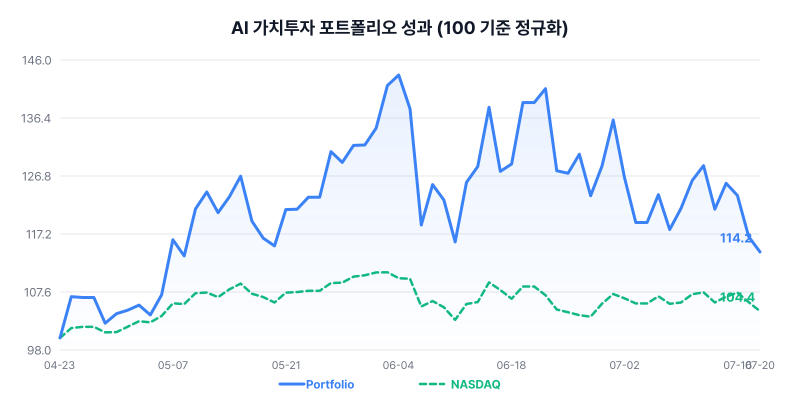
[Performance Trend: A Calm Response Following 'Frenetic' Gains]
Looking at asset movements over the last five days reveals an interesting pattern. From the 14th to the 16th, total portfolio assets rose sharply from the mid-$15,000 range to the early $16,000s. However, it appears to have entered a period of consolidation since then. On the 17th and 20th, asset value found stability through a minor correction, settling at the current level of $14,585. Considering that rapid price rallies always carry risk, the recent volatility in portfolio assets can be interpreted as a process of alleviating the burden of a steep climb and rebalancing positions. Having realized over 45% profit on an initial $10,000, the time has come to find a balance between 'defending' gains and 'growing' them further, rather than merely chasing a rally.
[Holdings Diagnosis: Valuation Basis and Proof of Growth]
The current composition of holdings confirms an investment philosophy that blends valuation with growth potential. The most prominent names are Micron (MU) and Nvidia (NVDA). Micron is showing earnings growth outpacing its stock price, with EPS approaching $44, resulting in a miraculous PEG ratio of 0.12, which places it in the undervalued territory. Nvidia also maintains a PER in the early 30s and a PEG ratio around 0.5, demonstrating that the explosive demand for AI chips sufficiently justifies its valuation.
On the other hand, Broadcom (AVGO) and Amazon (AMZN) present a somewhat different spectrum. Broadcom's PER of 61.7 may seem high, but its PEG ratio of 0.42 suggests that rather than being a sign of overheating, the current price may still be cheap relative to its growth prospects. Amazon shows a stable valuation with a PER of 29.6 and is expected to play a role in controlling portfolio volatility alongside high-growth stocks like AMD. However, the mix of 3x leveraged ETFs like TQQQ and SOXL remains a key challenge for managing the portfolio's overall volatility.
[Recent Trade Review: Intersection of 'Aggressive Profit' and 'Defensive Adjustment']
Trading records from June and July vividly demonstrate the strategy of being 'aggressive on growth, sensitive to risk.' Adding to Nvidia positions on June 26 and April 27 was a core alpha move, betting on the strength of AI semiconductors. The semiconductor leveraged ETF SOXL saw a 'net-fishing' style approach where partial profits were realized (sold on June 19 and July 10) during surges. This was an appropriate balance adjustment considering the inherent short-term volatility of leveraged products.
The moves regarding Meta (META) are also intriguing. In early July, a small amount was sold due to concerns over ad revenue profitability competition and increased daily volatility. This reads as an attempt to preemptively manage the volatility risk inherent in high-growth stocks. Conversely, the massive purchase of TQQQ on July 10 revealed a willingness to aggressively capture the Nasdaq-based bullish trend. Ultimately, the recent fluctuations in assets can be seen as a natural process following such aggressive expansion of positions.
[Market Outlook: Moving Beyond Rate Defense to Growth]
The variables moving the market right now are complex. While the U.S. 10-year Treasury yield has risen to 4.598%, resurrecting interest rate risks, the market sentiment—evidenced by S&P 500 futures logging +0.50%—appears to prioritize tech earnings growth over rising rates. It is positive that core portfolio holdings like Nvidia and Micron are offsetting rate variables with their overwhelming growth (low PEG).
The fact that the USD/KRW exchange rate has stabilized in the 1,476 won range and the VIX has dropped to 17.58 suggests global investor sentiment is not yet severely suppressed. However, the market divergence—where the Nasdaq stays strong while the Dow falls—implies that sector gaps will persist. At this juncture of 45% returns, the portfolio appears to be positioning itself to chase further upside led by core growth engines like semiconductors and AI, while adjusting risk through frequent split trades.
Major Holdings Status
| Ticker | Qty | Avg Price | Current Price | PER |
|---|---|---|---|---|
| AVGO (Broadcom) | 5.67 | $326.03 | $370.83 | 61.7 |
| AMD (Advanced Micro Devices) | 7.17 | $198.62 | $495.76 | 164.2 |
| MU (Micron) | 0.25 | $996.00 | $848.95 | 19.2 |
| NVDA (Nvidia) | 25.76 | $183.15 | $202.81 | 31.1 |
| AMZN (Amazon) | 1.95 | $208.39 | $247.23 | 29.6 |
| SOXL (Semiconductor 3x Leverage) | 16.30 | $61.36 | $135.47 | 23.0 |
| TQQQ (Nasdaq 100 3x Leverage) | 2.86 | $76.34 | $67.53 | 34.6 |
| META (Meta Platforms) | 0.89 | $653.56 | $646.01 | 23.5 |
Recent Major Transactions
| Date | Type | Symbol | Qty | Price |
|---|---|---|---|---|
| 2026-07-17 | SELL | META | 0.047 | $664.54 |
| 2026-07-10 | BUY | TQQQ | 2.865 | $76.34 |
| 2026-07-10 | SELL | SOXL | 0.858 | $192.45 |
| 2026-07-03 | SELL | AMZN | 0.103 | $242.67 |
| 2026-06-26 | BUY | NVDA | 1.288 | $195.74 |
| 2026-06-05 | BUY | MU | 0.251 | $996.00 |
※ This report analyzes the simulated operation history of the AI Value Investment Portfolio and is not a solicitation for investment. Actual investment should be undertaken at your own judgment and responsibility.
Want to see detailed portfolio records?
Subscribe to the newsletter below to receive detailed daily investment reports.