Recent Analysis of South Korea's Macroeconomic Indicators: Interest Rates, Inflation, Exchange Rates, and Treasury Bonds

The Intersection of Real Interest Rates and Inflation: Analyzing the Bank of Korea's Tightening Stance
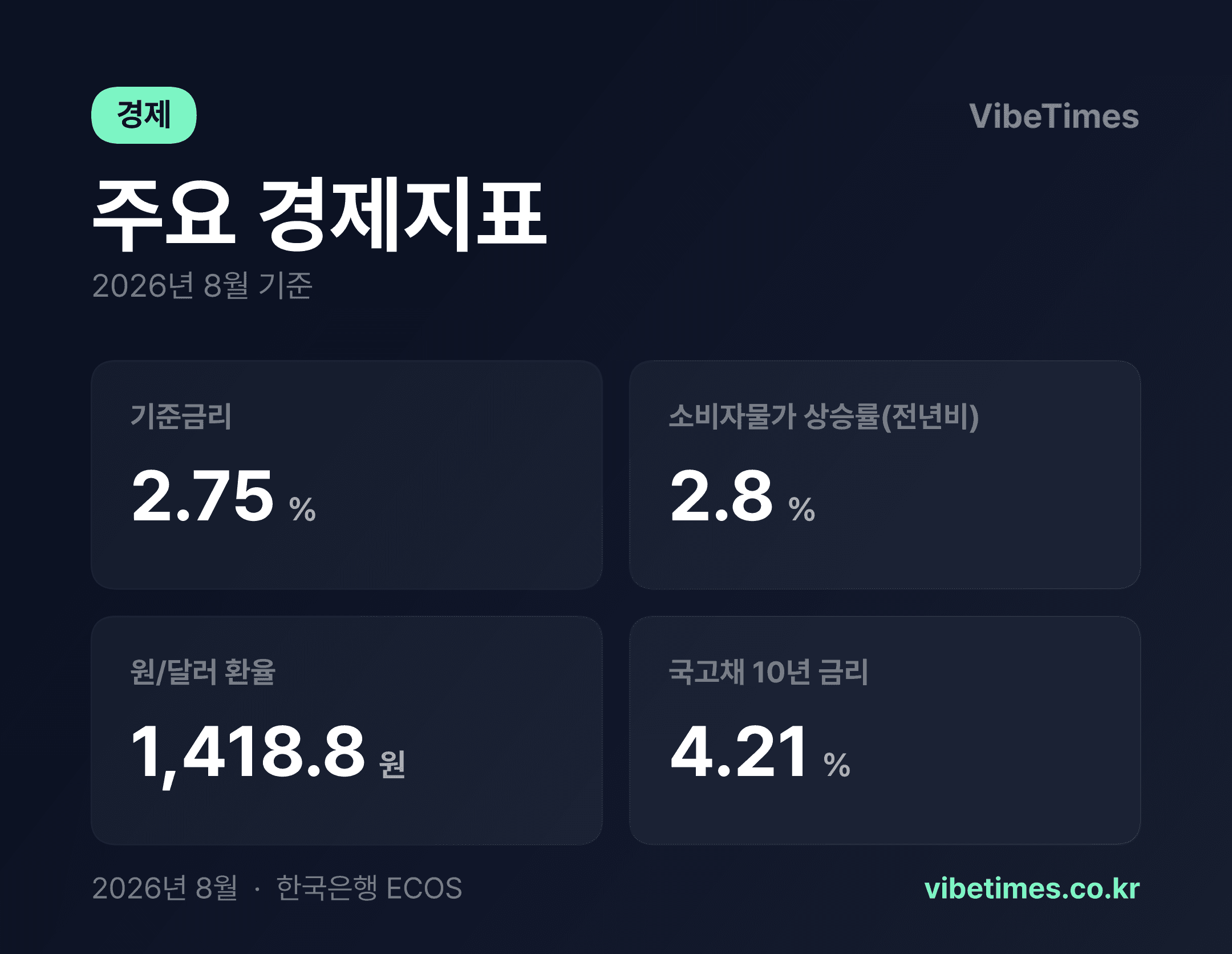
With the Bank of Korea's benchmark interest rate standing at 2.75% as of August 10, 2026, and the consumer price inflation rate recorded at 2.8%, real interest rates remain in negative territory. The fact that the gap between the benchmark rate and the consumer price inflation rate, which is above the Bank of Korea's price stability target of 2.0%, has narrowed to around 0.05 percentage points provides grounds for the monetary authority to maintain its tightening stance. Although inflation is showing signs of slowing, the inflation rate remaining higher than the interest rate level weakens households' real purchasing power and leads to a contraction in consumption.
The Bank of Korea faces a crossroads, needing to either maintain the current interest rate level or consider further tightening if necessary, until inflation stabilizes at its target. The inflation rate of 2.8% year-on-year suggests that fluctuations in international oil and raw material prices are continuously pressuring domestic supply chains. Particularly, with the slowdown in core inflation not yet visible, the benchmark interest rate of 2.75% serves as a minimum defense line to curb market liquidity.
Examining the transmission channels of monetary policy, it immediately impacts deposit and lending rates, increasing the interest burden on household debt. The 2.8% inflation rate is a key variable that offsets nominal income growth and slows down the pace of domestic economic recovery. In this macroeconomic environment, the Bank of Korea is tasked with carefully managing monetary policy between the conflicting goals of price stability and economic stimulus.
Import Price Pass-Through Effect Following the Won/Dollar Exchange Rate Entry into the 1,400 Won Range
The Won/Dollar exchange rate has risen to 1,418.8 Won, maximizing uncertainty in the foreign exchange market. The 1,400 Won per Dollar level is typically considered a psychological resistance point and a key measure of macroeconomic health. The current high exchange rate level is interpreted as a complex interplay of external interest rate differentials and a global dollar strengthening trend. A depreciation of the Korean Won leads to higher import prices, directly exerting upward pressure on domestic consumer prices.
The longer the Won/Dollar exchange rate remains above 1,400 Won, the higher the cost of importing energy and raw materials, which can lead to a vicious cycle of rising manufacturing costs and subsequent increases in final consumer prices.
While exporting companies may expect short-term gains from enhanced price competitiveness, industries with a high proportion of raw material imports face sharply increasing cost burdens, leading to a decline in operating profits. Specifically, the aviation, steel, and energy industries are experiencing a double blow from foreign exchange losses and increased financial costs. The exchange rate of 1,418.8 Won signifies more than just increased volatility, raising concerns about capital outflow.
The foreign exchange authorities are likely to engage in fine-tuning to alleviate market쏠림 (쏠림 - a tendency to flock or concentrate), but policy tools may be limited given the rapid changes in the external environment. Considering that the pass-through of import price increases due to the rising exchange rate to consumer prices occurs with a lag of approximately one to two quarters, it is not impossible for inflation figures to rebound in the future. This serves as a strong downward rigidity factor that makes it difficult for the Bank of Korea to lower its benchmark interest rate below 2.75%.
Treasury Bond Yields Reaching the 4% Range and Asset Redistribution in Capital Markets
The yield on 10-year Treasury bonds, a benchmark for market interest rates, has reached 4.21%, continuing the surge in long-term yields. The spread between this and the benchmark interest rate of 2.75%, widening to 1.46 percentage points, indicates that market participants anticipate a prolonged period of high inflation and increased fiscal burden. The rise in long-term yields increases the cost of financing for corporate facility investments and exerts upward pressure on mortgage rates, directly impacting household finances.
A 4.21% yield in the bond market acts as an incentive for capital to shift from risky assets to safe assets, accelerating this reallocation. If the expected rate of return in the stock market falls below bond yields, there is concern about a decline in the overall vitality of capital markets. Specifically, the rise in Treasury bond yields leads to a simultaneous increase in the issuance rates of commercial banks' bonds, fueling a chain reaction of rising lending rates. This ultimately leads to a contraction in domestic consumption by reducing households' disposable income.
Furthermore, a high yield of 4.21% places a significant burden on the government's fiscal operations. As interest costs on national debt increase, the capacity for fiscal spending to stimulate the economy diminishes. If monetary and fiscal policies become uncoordinated, macroeconomic volatility is expected to further increase. The market has reached a point where it must closely monitor any further rise in Treasury bond yields and consider portfolio duration adjustments.
Future Outlook and Macroeconomic Implications
Current economic indicators clearly show that the trilemma of high exchange rates, high interest rates, and high inflation continues to hinder the South Korean economy. Although the consumer price inflation rate has slowed to 2.8%, the exchange rate variable is offsetting downward price pressures, suggesting that the achievement of the price stability target will be delayed beyond initial expectations. The exchange rate of 1,418.8 Won and Treasury bond yields of 4.21% indicate that external soundness and financial market tensions are at their peak.
The South Korean economy is expected to become more sensitive to changes in the external environment going forward. The direction of domestic macroeconomic indicators is anticipated to be determined by the monetary policy direction of the U.S. Federal Reserve and the trends in global supply chain reorganization. While the benchmark interest rate of 2.75% is a necessary measure to defend against inflation and exchange rates, in a situation where long-term yields exceed 4.2%, the possibility of a real economy downturn must be guarded against. Investors need to establish defensive strategies focused on high-quality assets with stable cash flows and the ability to pass on costs, rather than assets highly sensitive to interest rate fluctuations.
In conclusion, a tight financial environment is expected to persist until inflation clearly enters the low 2% range and the exchange rate stabilizes. In the second half of 2026, the restructuring of marginal firms due to high interest rates and the risk of household debt defaults will remain potential threats. Coordinated and sophisticated policies between the government and the central bank are more crucial than ever, and market participants need to establish flexible response systems based on subtle changes in macroeconomic indicators.