Top 20% Earn Monthly Avg. Income of 12.37 Million Won, 10.6 Times That of Bottom 20%

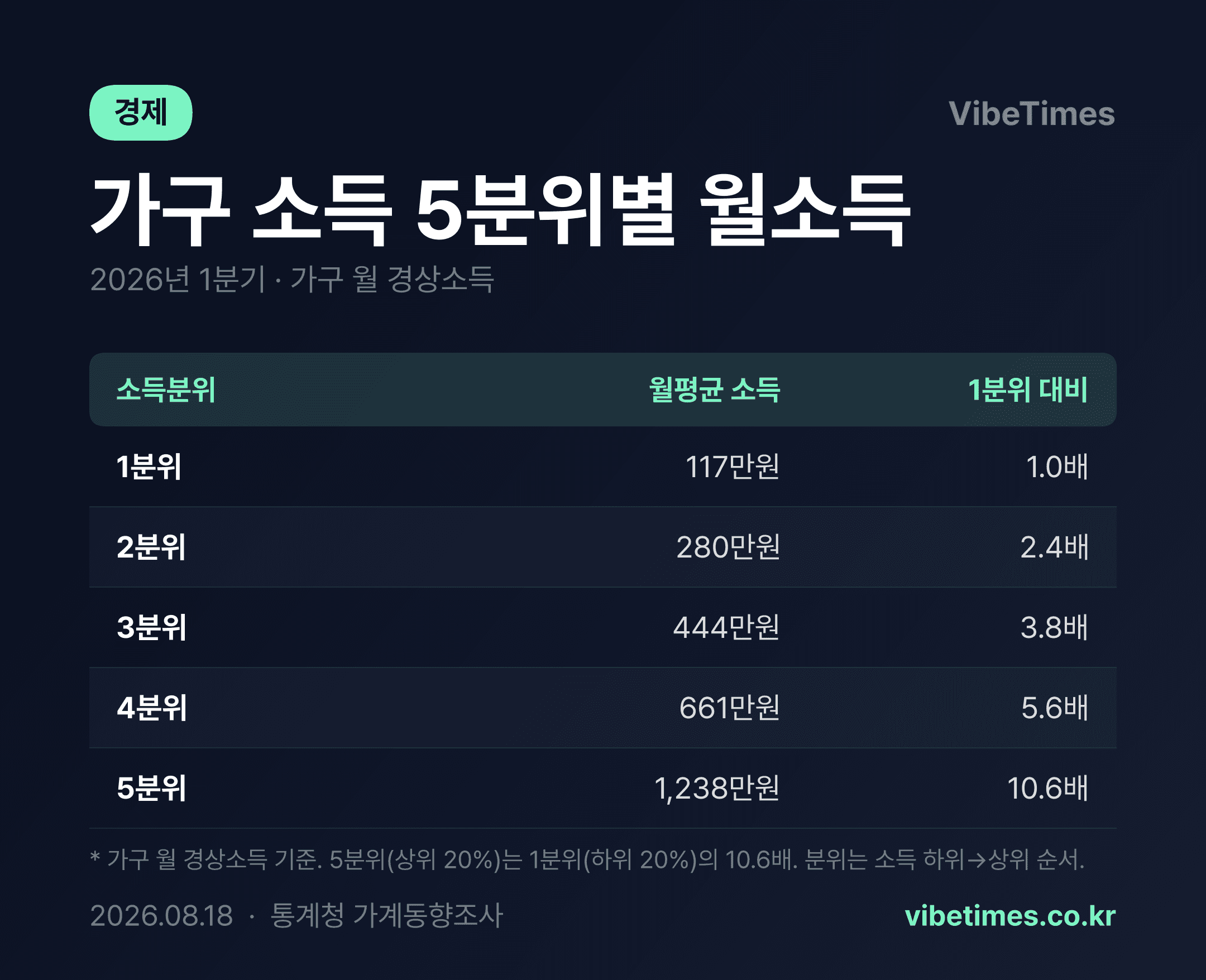
Based on average monthly household regular income, the top 20% (5th quintile) was calculated at 12,378,034 won. This is exactly 10.6 times the figure of 1,171,144 won for the bottom 20% (1st quintile). Through the quintile data, in which the National Statistical Office divides households into five income brackets, the reality of the income gap by class is numerically confirmed.
The Curve of Inequality Revealed in the Income Structure by Quintile
The average monthly regular income for 1st quintile households is 1,171,144 won. The 2nd quintile stands at 2,799,296 won, which is 2.4 times that of the 1st quintile. The 3rd quintile follows at 4,442,443 won, and the 4th at 6,619,955 won. The pattern shows that the income growth gradually widens with each step up in quintile.
Looking at the income differences between quintiles, the characteristics of the gap become distinct. The increase from the 1st to the 2nd quintile is about 1.62 million won, and between the 2nd and 3rd quintiles is about 1.64 million won. However, in the transition from the 4th to the 5th quintile, income rises by more than 5.76 million won. It is an asymmetric structure where income growth accelerates sharply toward the top. The income of the 5th quintile reaches 2.8 times that of the 3rd and 1.9 times that of the 4th.
What the 10.6-Fold Multiple Implies
The figure that the top 20% earn 10.6 times the income of the bottom 20% is based on household regular income—that is, total gross income before deducting taxes and social insurance premiums. Since higher-income households tend to bear larger burdens for taxes, insurance, and various transfer expenditures, and often have more family members, this ratio differs in nature from the ratio based on disposable income, which adjusts for household size.
The implication of this multiple is clear. The gap between classes is significantly wide in terms of total income, including earned income, business income, and asset income. In particular, the average monthly regular income of 1.17 million won for the 1st quintile is interpreted as a low figure resulting from the inclusion of many households with limited income sources, such as single-person elderly households. Conversely, the 5th quintile exceeded 12 million won due to the combination of dual-income households, high-wage labor, and asset income.
Remaining Tasks for Income Redistribution Policy and the Market
The 10.6-fold gap based on regular income reveals the starting point that taxation and welfare systems must practically address. Since this represents the disparity before progressive taxation and various benefit payments, the extent to which the multiple decreases after redistribution serves as a measure of policy effectiveness. The expansion of income support systems—such as old-age pensions and earned income tax credits—which raise the income base of low-income households, is expected to act as a variable in narrowing the gap in the future.
In terms of the market, the polarization of consumption structure is also anticipated. The fact that the average monthly regular income of 5th quintile households reaches 12.37 million won implies a stable demand base for the premium consumption and asset markets. Conversely, as the income of 1st and 2nd quintile households inevitably has a high proportion of essential expenditures, their dependence on value-oriented consumption and government support is expected to structurally increase.
A point to watch in the future is the rate of increase in low-income brackets. Given the demographic structure where the proportion of elderly households is growing, if 1st quintile income stagnates, the household income gap is unlikely to decrease easily. It is projected that a reduction in the multiple will become realistic only when work-linked income support and income compensation mechanisms for the elderly are activated.