National Assembly Data Analysis: The Averages of the Ruling and Opposition Are Closer Than You Think

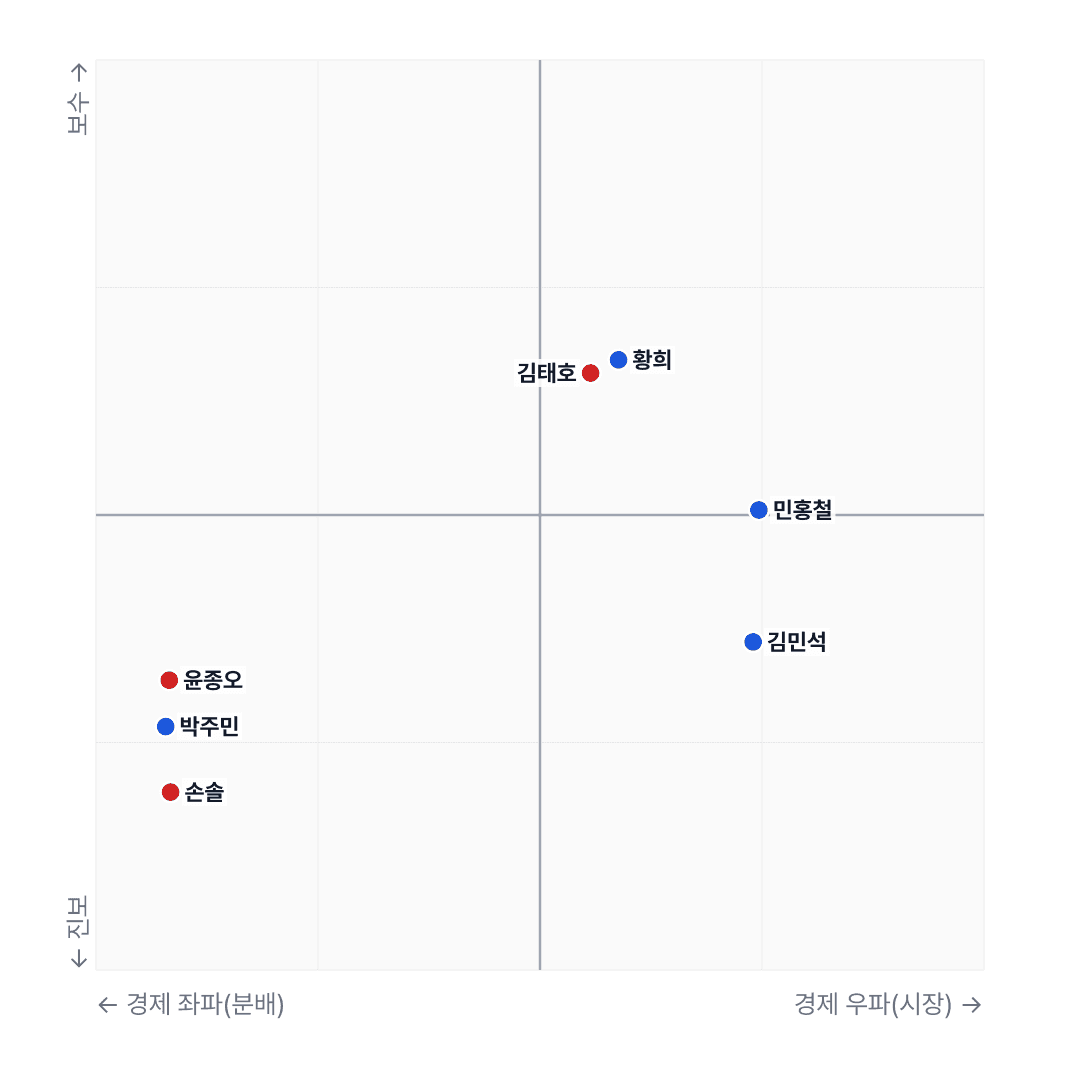
285 Coordinates, and a Hidden Landscape
When the bill sponsorship and voting records of 285 of the 300 members of the 22nd National Assembly were converted into coordinates, the political landscape itself was turned upside down. The average coordinates of the two major parties are closer than expected, while defectors within each party sit farther away. Descartes famously suggested doubting everything once — but this time, it was not doubt but data that called conventional wisdom into question.
This analysis used an LLM to assess each lawmaker's bill sponsorship content and voting behavior, then calibrated the result into a two-dimensional ideological coordinate system centered on the midpoints of the two major parties. The economic axis runs from left (redistribution, expanded regulation) to right (markets, liberalization), while the social axis runs from progressive to conservative. It is a method of reading the political terrain through distance and density rather than a simple left-right divide.
The Two Major Parties Are Closer Than Expected
The most striking finding is the gap between the ruling and opposition averages. The mean coordinates of the Democratic Party's 152 members and the People Power Party's 105 members cluster near the origin on both axes. The economic gap between the two parties was wider than the social gap. In other words, Korea's axis of political conflict is sharper on economic issues than on cultural and value issues.
This diverges from the conventional notion of "extreme progressive-versus-conservative showdowns in every general election." Because votes are largely bound by party lines, comparing averages inevitably compresses the differences. The real divide emerges not in party averages but in defection votes and sponsorship patterns.
The coordinates of the seven independents are proof. The average of the independent group lies clearly to the left of the Democratic Party average. Lawmakers who became independents after leaving or being expelled from their parties put their names on bills with stronger redistributive tendencies than either floor party. The 12 members of the Rebuilding Korea Party went further still, emerging as the most tightly clustered group on the far left of the entire analysis.
The Fault Lines Revealed by a Quadrant Map
Dividing the 285 members into quadrants yields 117 economic-left/progressive and 87 economic-right/conservative lawmakers, with the two major blocs accounting for 71%. But the remaining 81 are the interesting ones. The very existence of 46 economic-left/conservative and 35 economic-right/progressive members is what justifies a two-dimensional coordinate system.
The economic-left/conservative quadrant comprises members who back redistributive economic bills while continuing to vote conservatively on social issues. Some regional-leaning members of the ruling party and ideological defectors in the opposition fall into this group. Conversely, the 35 members in the economic-right/progressive quadrant — combining deregulation sponsorship with socially progressive votes — are a group that a one-dimensional left-right axis simply cannot capture.
The Limits and Uses of Quantitative Analysis
Of course, these coordinates are not a master key. Because they are based on legislative behavior — sponsorship and voting — some members may diverge from the public image they cultivate through TV debates and social media. A lawmaker whose name appears only on symbolic bills with little chance of passage and one focused on everyday-life legislation could end up with the same coordinates.
Even so, the value of this map is clear. Every time proposals to expand negotiating blocs or form coalitions resurface, the question "who could join hands with whom" can now be answered not by instinct but by distance on a coordinate plane. Which threshold the 46 members of the economic-left/conservative quadrant stand closer to will be a key to reading the landscape of the next National Assembly. If not hypocrisy itself, the coordinates speak — not on the sponsorship registry, but in the voting record.
Lawmakers Mentioned in This Article
| Lawmaker | Party | Ideological Leaning | Notes |
|---|---|---|---|
| Park Ju-min | Democratic Party | Economic left · Social progressive | Representative of both extremes |
| Yun Jong-oh | Progressive Party | Economic left · Social progressive | Representative of both extremes |
| Kim Min-seok | Democratic Party | Economic right · Social progressive | Representative of both extremes |
| Min Hong-chul | Democratic Party | Economic right · Social conservative | Representative of both extremes |
| Son Sol | Progressive Party | Economic left · Social progressive | Representative of both extremes |
| Kim Tae-ho | People Power Party | Economic right · Social conservative | Representative of both extremes |
| Hwang Hee | Democratic Party | Economic right · Social conservative | Representative of both extremes |