Samsung Electro-Mechanics Turns a Year Into Five — With a 547.5% Return

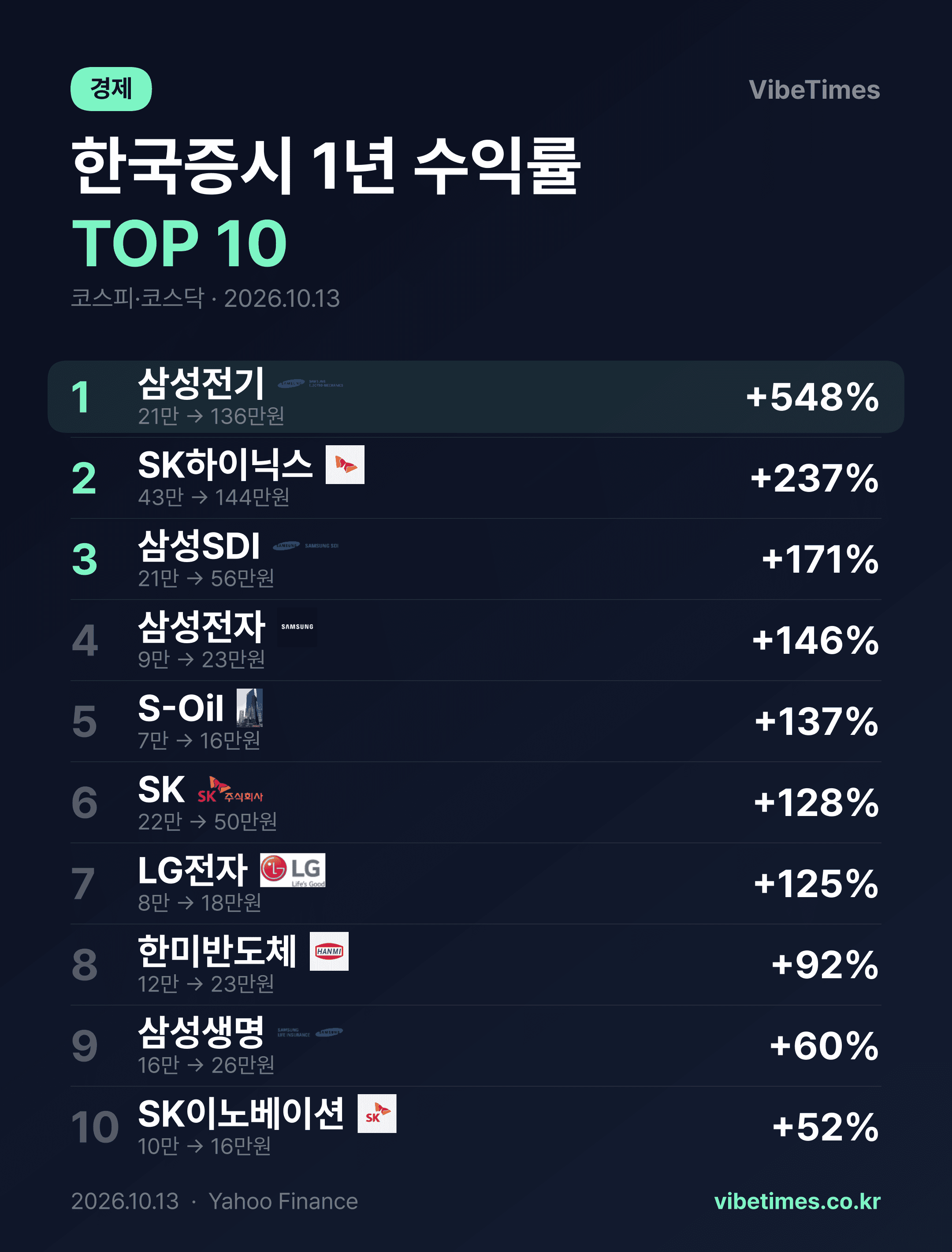
Samsung Electro-Mechanics saw its share price surge more than sixfold in a single year, claiming the top spot for returns on the Korean stock market.
According to a tally of the KOSPI's top 1-year performers as of October 13, 2026, Samsung Electro-Mechanics' share price rose from 210,000 won a year earlier to 1.36 million won, delivering a return of +547.5% — meaning an investor's principal grew more than fivefold in just one year. With a current market capitalization of 112.34 trillion won, the company's standing in the market has fundamentally changed compared with a year ago. The gap with SK Hynix (+237.1%), which ranked second over the same period, exceeds 300 percentage points, meaning any interpretation of this ranking must begin with an analysis of Samsung Electro-Mechanics itself.
What the Top Returns Reveal: a Rush Into Semiconductors and Electronics
The trend running through the entire ranking is the overwhelming strength of electronics and semiconductor stocks. Of the top 10, five are in the electronics and semiconductor space: Samsung Electro-Mechanics, SK Hynix, Samsung SDI, Samsung Electronics, and Hanmi Semiconductor. SK Hynix rose from 430,000 won to 1.44 million won for a gain of +237.1%, boasting the largest market cap on the list at 1,141.28 trillion won. Samsung Electronics also climbed from 90,000 won to 230,000 won, up +145.8%, for a market capitalization of 1,644.92 trillion won. That these mega-caps more than doubled despite their already enormous size is a telling sign that market capital has poured intensively into a specific industrial sector.
Particularly striking is the divergence between the top return and the top market cap. While Samsung Electro-Mechanics dominated on returns, Samsung Electronics and SK Hynix still hold the top ranks by market capitalization. Samsung Electro-Mechanics' 112.34 trillion won is roughly one-tenth of SK Hynix's. This points to a market that defied the conventional wisdom that mega-caps are hard to move, while also suggesting that among mid- and large-cap stocks, the greater the earnings improvement, the stronger the rally.
The Rebound in Refiners and Insurers, and What the Lower Ranks Mean
Outside the electronics cluster, refiners, holding companies, and insurers followed the trend. S-Oil jumped from 70,000 won to 160,000 won, up +137.0%, while SK gained +128.3% and SK Innovation +52.2%. LG Electronics (+125.3%) and Samsung SDI (+170.5%) showed that non-semiconductor businesses within the electronics group — auto components and batteries — were also re-rated. Samsung Life Insurance rose from 160,000 won to 260,000 won, up +60.0%, making it the only financial stock to crack the rankings.
The spread within the ranking, however, is wide. There is a more than tenfold gap in returns between top-ranked Samsung Electro-Mechanics (+547.5%) and tenth-ranked SK Innovation (+52.2%). Even within the top 10, this means capital preference was concentrated in semiconductors and electronics. Hanmi Semiconductor's +92.3% gain, as a back-end equipment maker, is further evidence that the semiconductor boom has spread to materials, parts, and equipment.
What to Watch Going Forward
A return of more than fivefold in a year inevitably invites questions about sustainability. Whether the share price gains at Samsung Electro-Mechanics and SK Hynix are backed by earnings improvement or merely by valuation expansion is a key variable in gauging their room for correction. In particular, Samsung Electro-Mechanics' +547.5% annual gain likely benefited from its low base price of 210,000 won, making a repeat of that pace from the current 1.36 million won level seem unlikely.
Even so, the fact that all top-10 stocks posted returns above +52% signals that the Korean market as a whole was in a bull phase, beyond individual stocks. If the market structure led by electronics and semiconductors holds, big tech earnings reports and demand outlooks are expected to be the deciding factors in future ranking shifts. Conversely, whether secondary indicator stocks such as refiners and insurers enter the rankings can serve as a barometer of whether market capital is broadening or narrowing.