National Assembly Data Analysis: Park Ju-min Was the Most Left-Wing on Economics

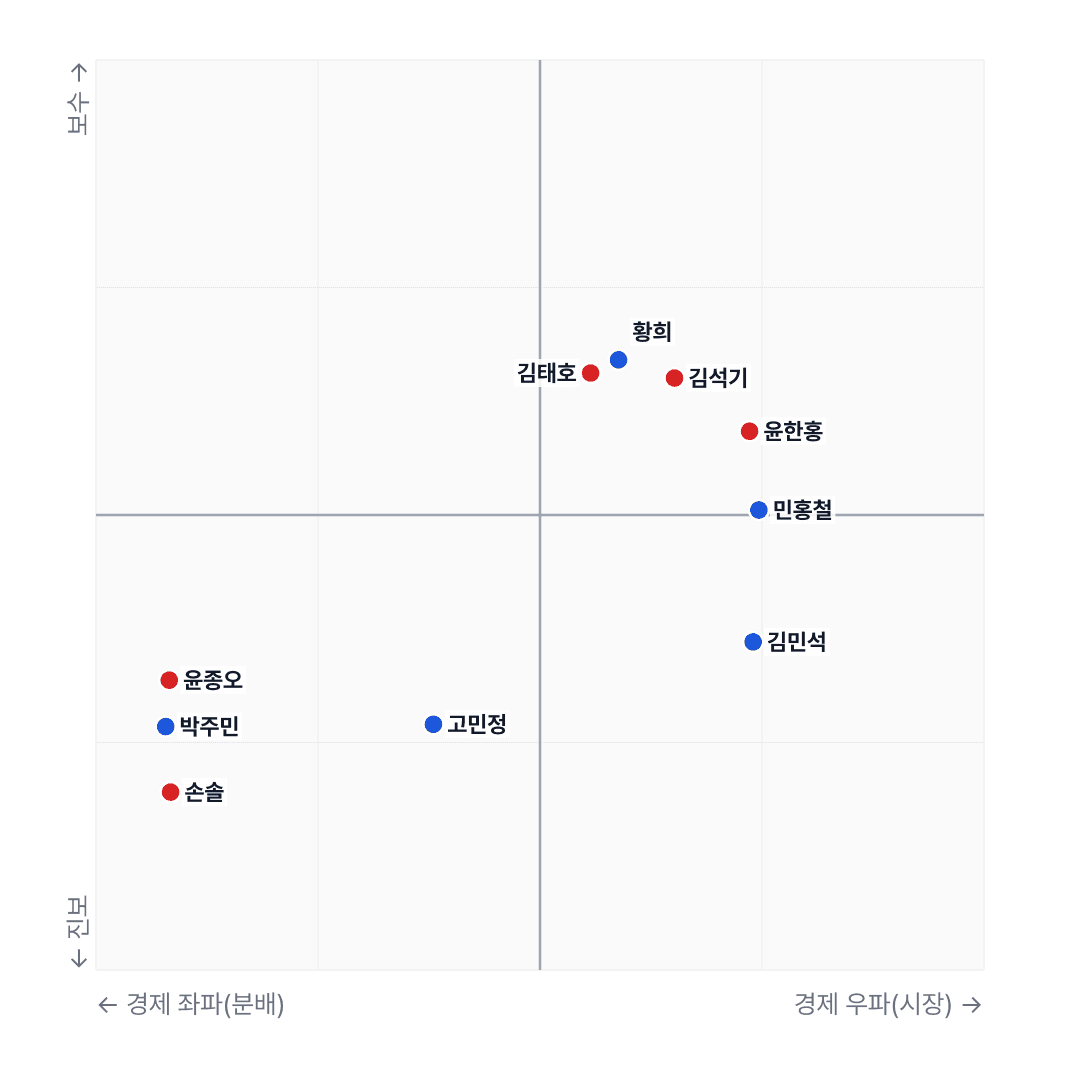
The lawmaker whose name appeared most often on the most progressive economic bills in the National Assembly was Park Ju-min of the Democratic Party.
According to a quantitative analysis that measured ideological orientation by compiling each lawmaker's bill sponsorship and voting records, the most left-wing figure on the economic axis was not from the Justice Party but Park Ju-min of the ruling party. This coordinate is a weighted average calculated by having a model assess the content of each bill, then centered on the midpoint of the two major parties. It suggests that even within the same ruling party, some lawmakers stand considerably to the left on economic issues while others do not.
Surprising Names at Both Ends of the Economic Axis
The five most left-wing lawmakers on the economic axis are Park Ju-min, Yoon Jong-oh (Justice Party), Son Sol (Justice Party), Jeon Jong-deok (Justice Party), and Jeong Hye-kyung (Justice Party). The fact that four of the five belong to the Justice Party is only half the answer — beyond it lies an interesting point. Because the coordinates are built from the sponsorship behavior of individual lawmakers rather than party leadership, a ruling-party member who aggressively sponsors labor, welfare, and redistribution bills ends up in the same range as Justice Party members. Park Ju-min is the prime example.
The opposite end is even more surprising. Two of the five most right-wing lawmakers on the economic axis belong to the Democratic Party. Min Hong-chul and Kim Min-seok share the top ranks with their fellow party member Park Ju-min. Viewed through the narrow window of sponsorship and voting records, a single party contains a spectrum stretching from Min Hong-chul to Park Ju-min. The data's interpretation is that lawmakers who frequently sign onto deregulation or industry-support bills drift to the right regardless of party color.
The remaining three seats went to People Power Party lawmakers Yoon Han-hong, Lee Chul-gyu, and Song Eon-seok. The opposition clustering on the right of the economic axis is consistent with conventional wisdom.
The Social Axis Shows Less Divergence
The two ends of the social and cultural axis tell a different story from the economic one. The five most progressive lawmakers — Son Sol, Park Ju-min, Ko Min-jung, Lee Yong-woo, and Kim Young-jin — mix Democrats and Justice Party members, but all are from progressive camps. The five most conservative are Hwang Hee (Democratic Party), Kim Tae-ho, Kim Seok-ki, Jin Jong-oh (all People Power Party), and independent Kim Byung-ki.
The biggest question posed by this data is that Hwang Hee, a Democrat, ranks as the most conservative on the social axis. That said, it should be noted that these coordinates reflect a weighted average of sponsorship and voting behavior overall, not any single issue. Individual lawmakers' deviations stand out on the social axis, but the gap between the two parties as a whole tends to be narrower on the social axis than on the economic one. Simply put, each individual bill choice moves the coordinates more than party affiliation does.
What the Numbers Say — and What They Don't
The power of this kind of analysis lies in testing conventional wisdom. The formula "ruling party is always progressive, opposition is always conservative" breaks down at the individual level in many places. Lawmakers under cross-pressures, or whose sponsorship behavior is shaped by the industrial structure of their districts, leave records that push them apart on the coordinate plane.
At the same time, the limits are clear. These coordinates reflect only institutional acts: bill sponsorship and voting. Statements outside the Assembly, media appearances, and public image are not included. So a voter's felt sense of a lawmaker's orientation can diverge from the measured coordinate. Lawmakers who stay off sponsorship lists and show presence only in votes also tend to cluster toward the center.
The data is, after all, a trace of past behavior. Reading the trace reveals the current position, and knowing the position helps gauge the direction of the next vote. Whether these lawmakers will hold the same spots in the next Assembly, or whether the spectrum will re-consolidate along party lines, the voting records will be the first to tell.
Lawmakers Mentioned in This Article
| Lawmaker | Party | Ideological Orientation | Notes |
|---|---|---|---|
| Park Ju-min | Democratic Party | Economic left · Social progressive | Most left-wing on economics |
| Yoon Jong-oh | Justice Party | Economic left · Social progressive | Most left-wing on economics |
| Son Sol | Justice Party | Economic left · Social progressive | Most left-wing on economics |
| Yoon Han-hong | People Power Party | Economic right · Social conservative | Most right-wing on economics |
| Kim Min-seok | Democratic Party | Economic right · Social progressive | Most right-wing on economics |
| Min Hong-chul | Democratic Party | Economic right · Social conservative | Most right-wing on economics |
| Ko Min-jung | Democratic Party | Economic left · Social progressive | Most progressive on social issues |
| Kim Seok-ki | People Power Party | Economic right · Social conservative | Most conservative on social issues |
| Kim Tae-ho | People Power Party | Economic right · Social conservative | Most conservative on social issues |
| Hwang Hee | Democratic Party | Economic right · Social conservative | Most conservative on social issues |