Won-Dollar Exchange Rate Falls 101 Won in Three Months

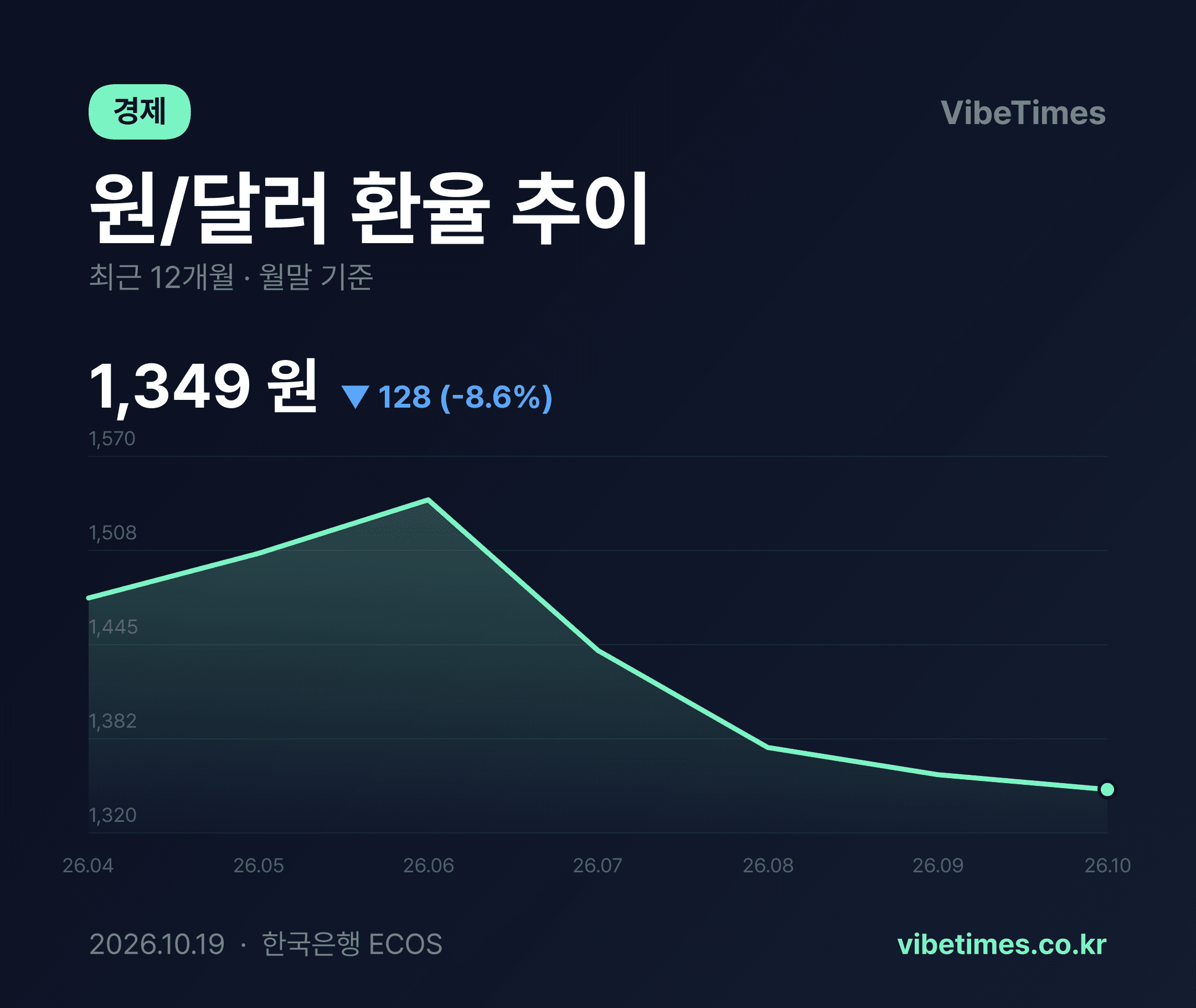
The won/dollar exchange rate fell 92 won over three months, from 1,441 won in late July to 1,349 won in late October.
The decline looks even larger when measured at month-end. Starting at 1,476 won in April, the rate climbed for two consecutive months to 1,506 won in May and 1,542 won in June, hitting its yearly high before turning around completely. After plunging 127 won in July, it fell by 64 won in August, 19 won in September, and 9 won in October — the declines are narrowing, but the downtrend continues. In total, the rate has dropped 128 won from late April, or about 8.7%.
Peak at 1,542 Won... July Was the Turning Point
The key to this trend lies at the crossroads between June and July. From April through June, the rate rose 66 won in just two months, breaking through the 1,500-won level. But in July alone, it dropped 101 won back to 1,441 won — a single-month decline exceeding the gains of the previous two months combined. With three straight months of declines since then, the downtrend has established itself as a sustained trend rather than a temporary correction.
That said, the pace of decline is clearly slowing. The monthly drop shrank from 64 won in August to 19 won in September and 9 won in October. This signals that the exchange rate has rapidly found stability and appears to be settling into a new equilibrium around the 1,350-won level.
What a Stronger Won Means and Its Market Impact
A falling exchange rate means the won has gained value against the dollar. From late June to late October, the won appreciated by about 12.5%. This trend eases cost pressures for import-reliant companies and the aviation and energy sectors. On the flip side, exporters face pressure on profitability when their dollar-denominated revenues are converted into won. In particular, exporters that set contract prices when the rate stood at 1,542 won in late June may face significant foreign exchange losses.
For investors, the effect is a reduced won value of foreign-currency assets. Domestic investors holding dollar deposits or U.S. equity products have seen returns trimmed on currency effects alone. Conversely, for overseas travelers and study-abroad students who had been holding off on exchanging won, the cost of buying dollars is now more than 100 won cheaper per dollar than in June.
Downward Momentum Fading... Outlook Ahead
The narrowing monthly declines — from 64 won to 19 won to 9 won — are a crucial clue to what lies ahead. If this pattern holds, the downtrend is likely to continue, but with a gradual decline or sideways movement rather than a sharp fall. Whether the 1,350-won level acts as a short-term floor or leaves room for further declines will depend on the trajectory of U.S. interest rates and trends in domestic exports and capital inflows.
From an investment standpoint, this is a stage where managing volatility matters more than betting on the direction of the exchange rate. If the four-month won-strength trend persists, it may be time to consider rebalancing toward exporters' valuation pressures and domestically oriented and energy sectors, which benefit from lower import costs. Conversely, if the rate rebounds, the current trend would reverse entirely — so the priority is to confirm whether support holds in the 1,340–1,360 won range.
