Kim Yo-jong Suggests North Korea May Resume Loudspeaker Broadcasts Toward South Amid Border Tensions

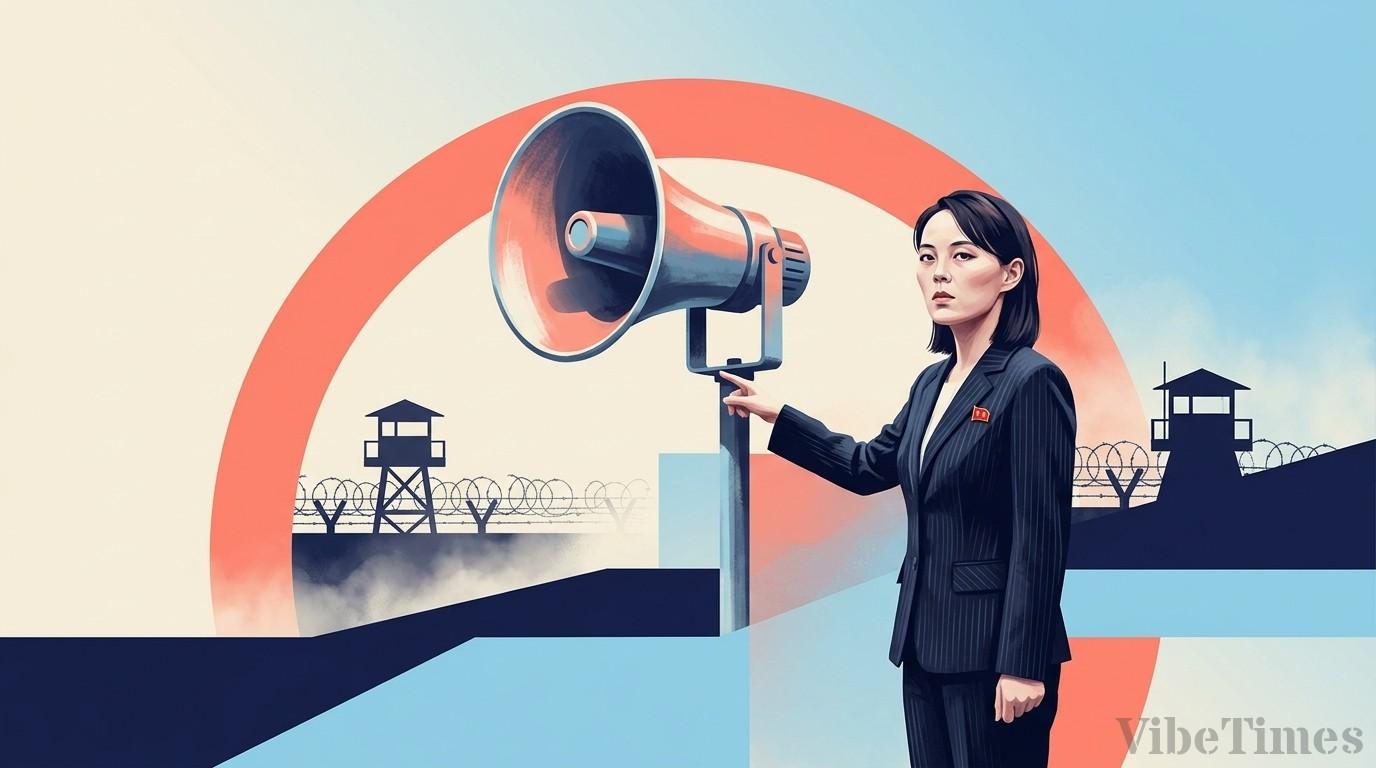
Kim Yo-jong, department director of North Korea's ruling Workers' Party, said on the 19th that North Korea is reviewing the reinforcement and deployment of military forces and the resumption of loudspeaker broadcasts toward the South, in response to warning shots fired by the South Korean military over an incursion across the Military Demarcation Line (the inter-Korean boundary). On October 19, Kim released a statement titled "We Do Not Defend Sovereignty With Words" through the Korean Central News Agency. She claimed that "a tense situation is unfolding along the southern border line due to the reckless bravado of the South Korean military thugs." She also accused the South Korean military of threatening the safety of North Korean soldiers, saying that personnel mobilized for the construction of southern border barriers had crossed the Military Demarcation Line, prompting warning shots fired with assault rifles and heavy machine guns (machine guns with thick barrels that deliver greater firepower).
Behind these claims lies the fact that the two Koreas hold differing standards regarding the Military Demarcation Line. The South Korean military, the UN Command, and the North Korean military each maintain different demarcation lines, leading to conflicting interpretations of North Korean troop movements southward. The South Korean military issues warning broadcasts when North Korean soldiers approach the Military Demarcation Line, and fires warning shots to order withdrawal if they cross to the south. The "warning loudspeaker broadcast" in question is not a psychological warfare broadcast aimed at North Korea. It is a broadcast from guard posts in the Demilitarized Zone warning North Korean soldiers of the possibility of crossing the line, intended to prevent military clashes. The South Korean military issues warning broadcasts when North Korean soldiers come within 100 meters north of the Military Demarcation Line, and fires warning shots if they cross it.
Nevertheless, Kim Yo-jong stated, "Our military command is reviewing, as preemptive and overwhelming measures to prepare for contingencies, the issue of reinforcing and deploying tactical strike assets near the entire southern border line, as well as the issue of resuming loudspeaker broadcasts toward the Republic of Korea, and is also considering other measures deemed necessary and appropriate." North Korea had previously halted its noise broadcasts toward the South when the Lee Jae-myung administration suspended loudspeaker broadcasts targeting the North early in its tenure. Now it is seeking to reverse that decision, citing the South Korean military's response to crossings of the Military Demarcation Line as a pretext.
Experts see the true intent of the statement as an attempt to deter the South Korean military's response and to keep the border fortification construction going. Hong Min, a senior researcher at the Korea Institute for National Unification, analyzed: "Since the landmine explosion incident, the South Korean military has become more sensitive to North Korean troops crossing the line and has shown moves to reinforce its defensive positions. North Korea appears concerned that its 'border-ization' construction could be delayed or that clashes could occur. It is a warning that they too have means of response." Lim Eul-chul, a professor at Kyungnam University's Institute for Far Eastern Studies, pointed out: "The aim is to neutralize the South Korean military's border response so the 'physical fortification of the southern border line' can be completed without a hitch, and to cement a 'permanent border between two states' on the Korean Peninsula as a fait accompli."
Meanwhile, as of the afternoon of the 19th, no signs had been detected of North Korea resuming its loudspeaker broadcasts toward the South along the front lines.