After 9-Hour Operation, 'Bookangi' the Shark Finally Returns to the Sea

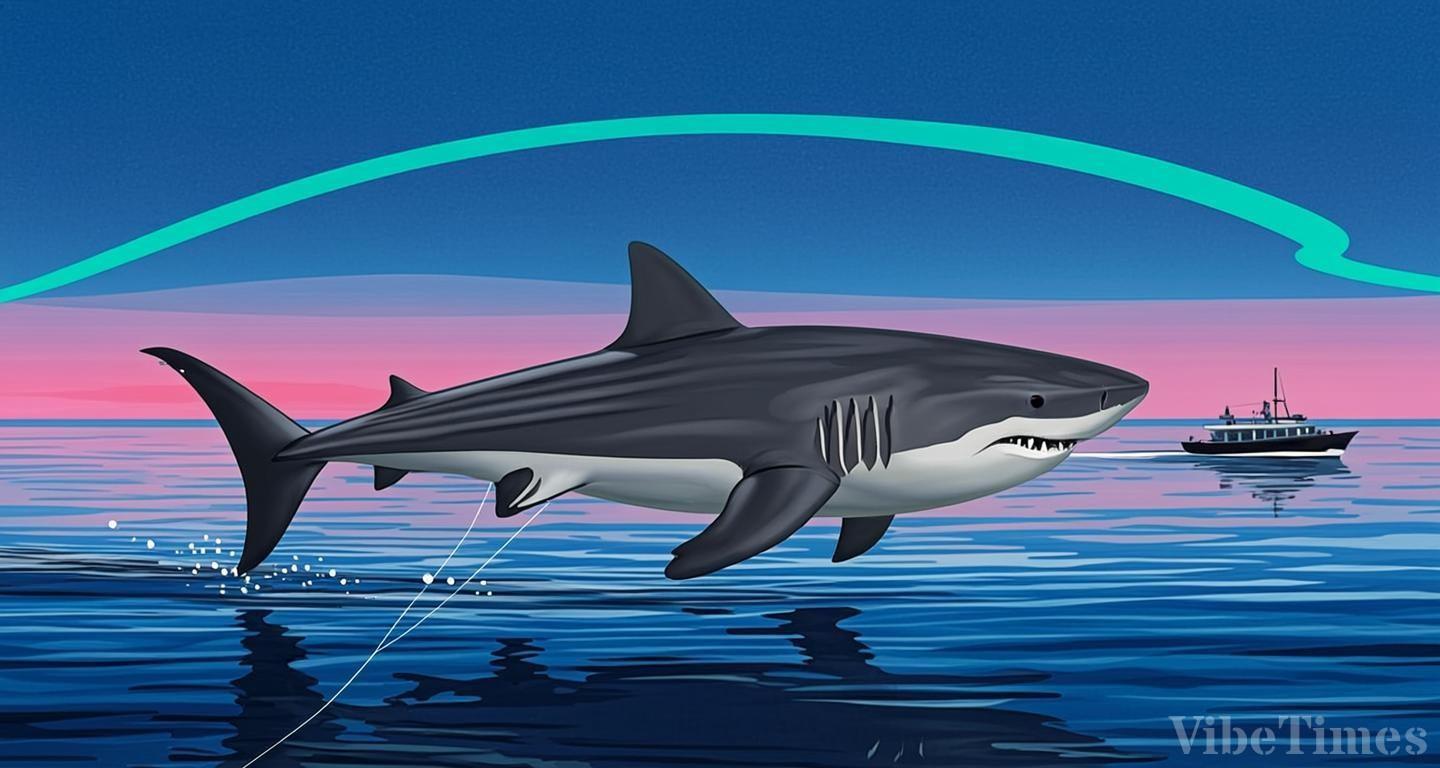
"Bookangi," the basking shark that had been trapped in an artificial waterway at Busan's Bukhang port, safely returned to the sea after a nine-hour guiding operation. The Ministry of Oceans and Fisheries, Busan city, and other relevant agencies sent the shark out of the waterway toward Busan Port's Pier 1 before 6 p.m. on the 21st at the artificial waterway in the Bukhang waterfront park in Dong-gu, Busan.
The Ministry of Oceans and Fisheries, the National Marine Biodiversity Institute of Korea, the National Institute of Fisheries Science, Busan city, and the Busan Facility Corporation began the third open-sea guiding operation with a meeting at 6 a.m. on the 21st, and at 9:30 a.m. deployed pontoons and a large 50-meter net to guide Bookangi. Busan Aquarium and Ilsan Aqua Planet also joined the operation. The effort built on the first and second attempts, fixing the 50-meter net to pontoons and deploying divers, and reversing the direction of the guidance.
The operation began at 9:30 a.m. as ropes attached to the pontoons were pulled from both sides of the waterway. Bookangi moved little by little, passing from the fifth footbridge to the third and approaching the end of the waterway. However, rather than heading out to sea, it circled around the pontoon and net, and kept wandering past 5 p.m. When it tried to re-enter the waterway, the rescue team blocked it with several long poles. Just before 6 p.m., Bookangi appeared on the Busan Port Pier 1 side and was effectively swimming outside the waterway, at which point the Ministry of Oceans and Fisheries wrapped up the planned operation.
"We succeeded in guiding it outside the waterway. The divers thoroughly examined the underwater terrain and identified obstructions, so this was the result of trying a new approach," said Kim Hyun-sung, director of the Marine Ecosystem Division at the Ministry of Oceans and Fisheries. He added, "Bookangi has not gone completely out to the open sea, so we will continue to monitor it."
Experts say there is no need to rush. Shark expert Choi Yoon, professor emeritus of marine bio-resources science at Kunsan National University, said in a phone interview, "It could stay in the area for a day or two at the shortest, or up to a week at the longest. Since its strength is depleted, it may take time to gradually adjust." Choi pointed out that the shark should be continuously observed to keep it from getting caught in gillnets and other fishing gear set by fishermen outside the waterway.
Citizens who came to watch gave the shark a farewell round of applause. Jeong, 64, who said it was his third time at the scene, said, "It may not want to go, but it has to return home. It has given us so much joy, and I am grateful. I hope it gets back safely." Jo Myeong-wan, 73, who came down from Seoul with his wife, also said, "Now that it's going out, I hope it doesn't think of coming back in and lives out in the sea."
Bookangi, listed as Endangered (EN) on the IUCN Red List, was first spotted in the Bukhang waterway on the 18th of last month and drew more than 1.6 million visitors, becoming a Busan attraction to the point that President Lee Jae-myung visited the site. However, side effects of its prolonged stay emerged, including injuries to its snout after being startled by lantern light, and with no feeding activity confirmed, the rescue operation was expedited.
