Democratic Party tops voting cohesion at 99.8%, PPP ranks third
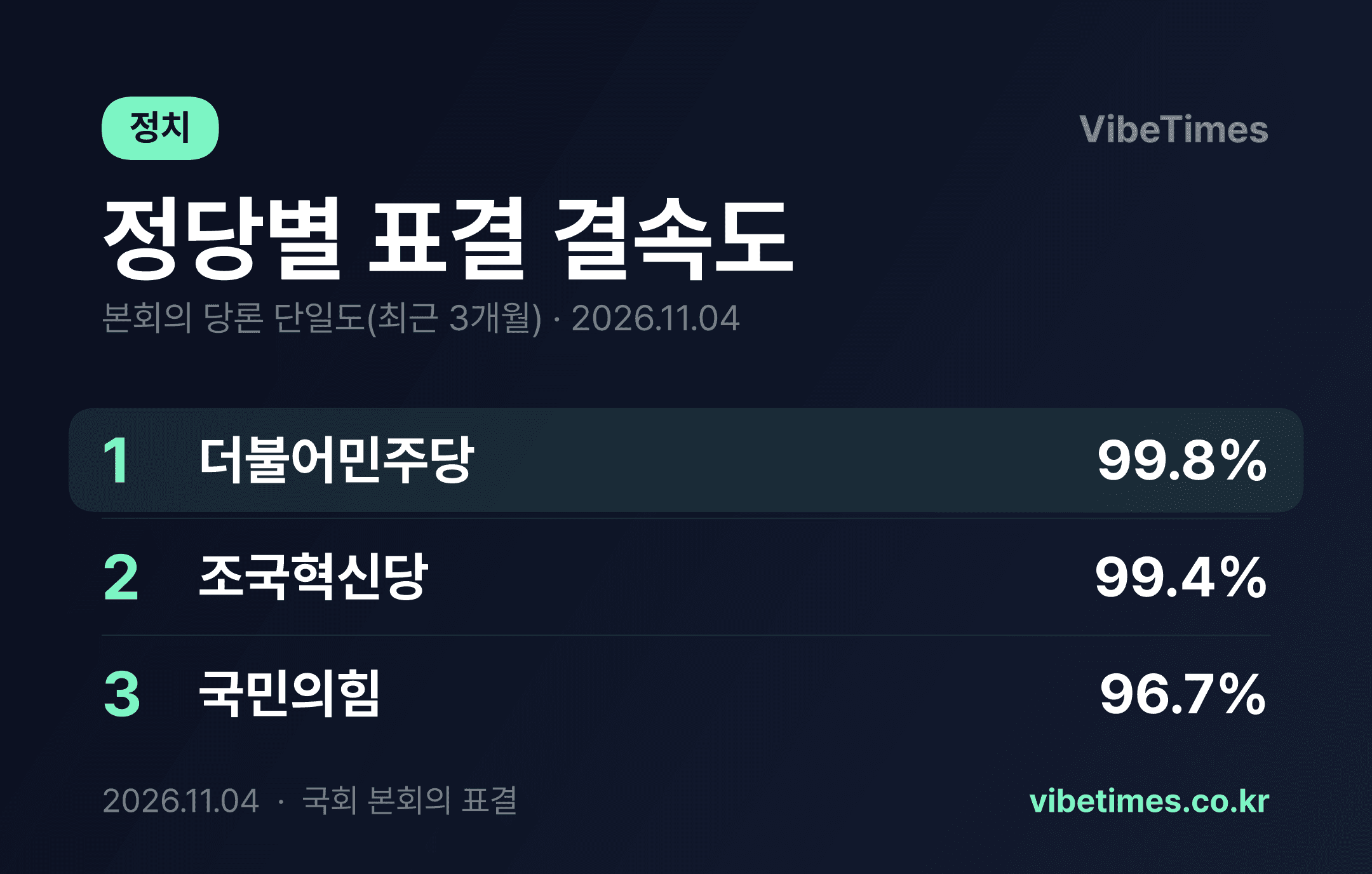
The Democratic Party topped the rankings for floor voting cohesion at 99.8%. The lowest figure across both ruling and opposition parties was the People Power Party's 96.7%, a gap of 3.1 percentage points. While it may seem like a marginal difference, it is by no means insignificant as an indicator of the internal dynamics within a party.
What Cohesion Tells Us
Voting cohesion is a metric that shows, in percentage terms, the degree to which all members of a party vote uniformly in a single direction. The closer to 100%, the more it means the party maintains perfect unity without any members straying from the leadership's line. Conversely, a declining figure signals accumulating opposition, abstentions, or absences in individual votes, and is used to detect signs of internal dissent or a breakdown in party discipline.
By the rankings, the Democratic Party is maintaining a virtually perfect lineup at 99.8%. At this level, the defection of just one or two lawmakers could cause a 0.2-percentage-point drop, demonstrating that the leadership's voting line is being enforced regardless of faction. The second-ranked Rebuilding Korea Party, at 99.4%, also displayed cohesive organizational strength with few defections relative to its size in the National Assembly.
PPP in Third Place: What 96.7% Means
The People Power Party's 96.7% is a high figure on the surface, but its gap from first place is the largest among the three parties. The 96.7% figure suggests either that individual votes differing from the party line occurred in a relatively large number of roll calls, or that strategic absences and abstentions by some members were repeated. The fact that the gap with the majority party is wider even than that with the minority Rebuilding Korea Party suggests that the cohesion problem stems not from the size of a party's seats but from its internal integration.
A drop in cohesion does not immediately mean a political crisis. However, this indicator is read as an early warning signal that the leadership's mobilization power may weaken when handling contentious bills. If roll-call defections repeatedly occur on a particular bill, that bill itself becomes a map of intra-party conflict.
Implications and Outlook
The key message of these figures is clear. The Democratic Party and the Rebuilding Korea Party have demonstrated proven stability in managing voting discipline, while the People Power Party has been left with visible cracks in its numbers. Given that a party's competitiveness is rooted in organizational unity, the 3.1-percentage-point gap leaves open the possibility of a kingmaker-style defection in the next contentious vote.
The point to watch going forward is the trajectory of the People Power Party's cohesion. If its figures remain in the 96% range in future votes, it should be seen as a structural defection problem; a return to the 99% range would confirm it was merely a temporary disagreement. Cohesion is ultimately only an outcome-based metric, but precisely because it most candidly shows how capable a party is of speaking with one voice, its swings are worth monitoring.