K-RadCube Successfully Launched into Space via NASA Rocket

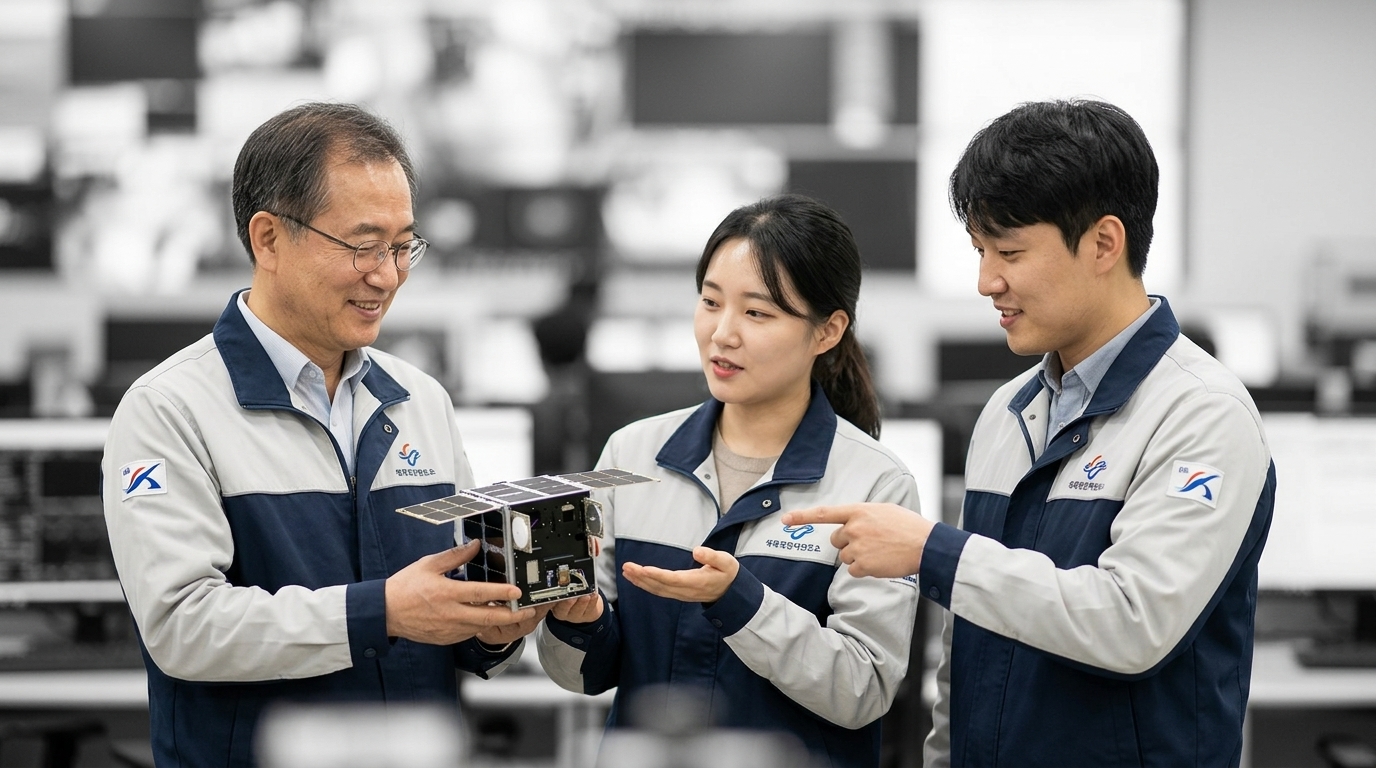
South Korea's miniature satellite 'K-RadCube' has successfully been deployed into a high Earth orbit. Confirmed on the 2nd, it was deployed from an altitude of approximately 40,000 km aboard NASA's Space Launch System (SLS). K-RadCube was launched as part of the Artemis 2 mission, separating immediately after the SLS's second stage, the Interim Cryogenic Propulsion Stage (ICPS), completed its maneuvers for disposal orbit insertion following the separation of the Orion spacecraft.
The K-RadCube mission operations center is attempting to communicate with the satellite. To verify its power generation status and transmitter operation, it will utilize a network of four cooperative ground stations worldwide, located in Punta Arenas, Chile; Hawaii, USA; Maspalomas, Spain; and Singapore.
K-RadCube's primary mission is to precisely analyze the radiation environment of the Van Allen belts, where high-energy particles are trapped within Earth's magnetic field. After deployment from the SLS, it will use its own propulsion system to adjust its orbit and enter an elliptical trajectory that repeatedly passes through the Van Allen belts. This propulsion system operates using a 'steam propulsion method,' heating liquid water and expelling steam to adjust the orbit.
The Low Earth Orbit Radiation Measurement Device (LEO-DOS), independently developed by the Korea Astronomy and Space Science Institute (KASI), is designed to go beyond simple radiation dose measurement to precisely assess the biological effects on human tissues. The satellite also carries Samsung Electronics' next-generation Multi-Chip Module (MCM) and SK Hynix's high-reliability memory, allowing for real-time analysis of the impact of the extreme space radiation environment on semiconductors.
Moon Hong-kyu, a senior researcher at KASI's Space Science and Exploration Division, explained the technical significance by comparing K-RadCube to NASA's Van Allen Probes launched in 2012. He stated, "While the Van Allen Probes were the size of a washing machine and weighed as much as a compact car, K-RadCube is the size of a shoebox and weighs as much as a packed travel suitcase." He added, "Thanks to semiconductor integration technology, we can obtain essential data for manned exploration with a weight that is 1/35th of the probes."
This project is led by the Korea Astronomy and Space Science Institute with support from the Ministry of Science and ICT, while Nara Space Technology manufactured the satellite body, and KT SAT is responsible for ground station control.