KIGAM Develops Debris Flow Risk Analysis Technology for Wildfire-Affected Areas

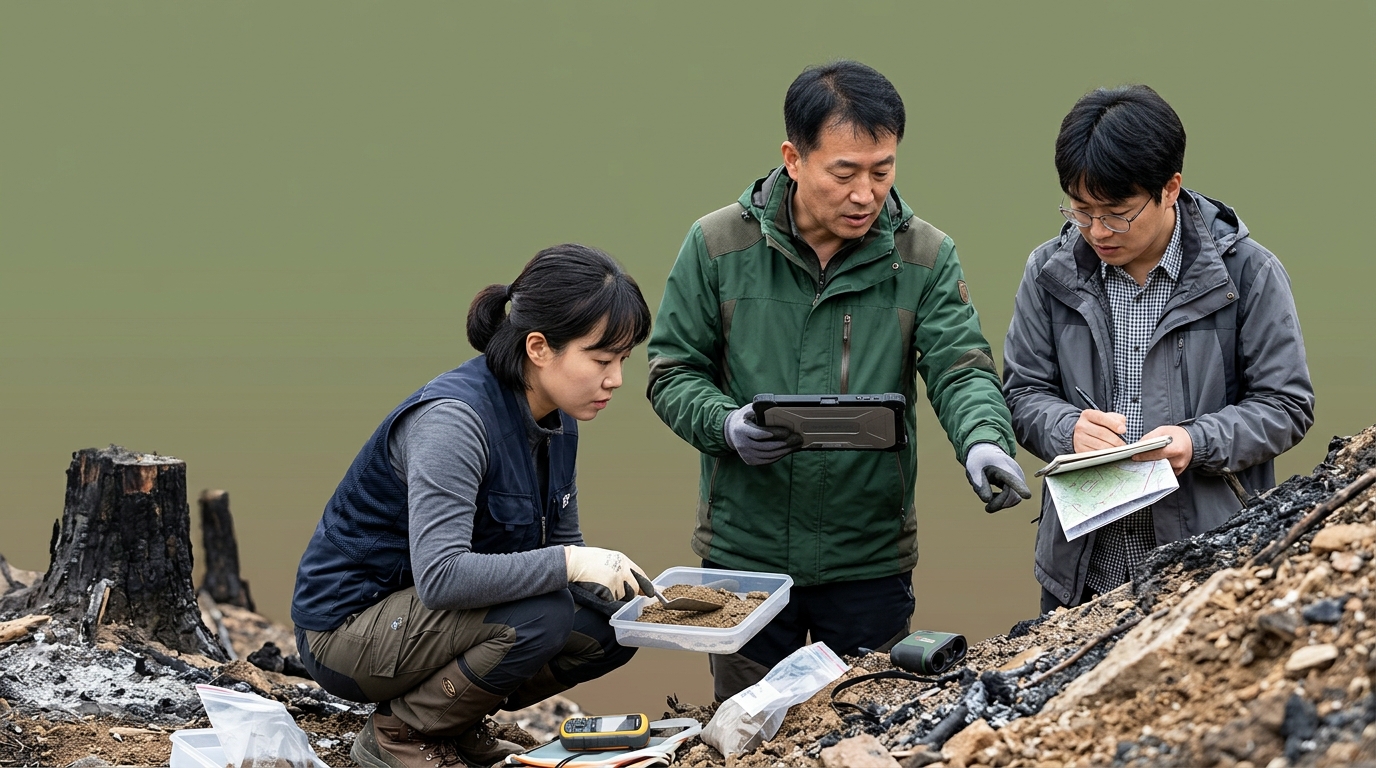
A research team from the Korea Institute of Geoscience and Mineral Resources (KIGAM) has developed a new technology that precisely analyzes the risk of debris flows (the phenomenon of soil and rocks flowing down) in wildfire-affected areas and assists in the design of disaster prevention facilities.
Areas damaged by wildfires lack vegetation, weakening soil stability and increasing the risk of landslides during extreme rainfall. When soil, rocks, and uprooted trees generated during this process move with water and transition into debris flows, the scale of damage can be amplified. However, physical analysis that simultaneously reflects these complex behaviors has had limitations.
The 'KIGAM-DF (KIGAM 2D Debris Flow Model)' developed by the research team is a technology that simulates not only the fluid characteristics during debris flow occurrence but also the impact from soil, rocks, and trees. It enables damage prediction and response scenario planning with minimal input data, and it integrates and analyzes the entire process from debris flow initiation to movement and deposition, even reflecting the movement and accumulation process of uprooted trees.
When applied to the 2011 Umyeon Mountain landslide site and the 2023 Yecheon County, Gyeongsangbuk-do area, KIGAM-DF showed a high prediction accuracy of approximately 85-90%. The research team is currently applying this technology to the Yeongnam region, which experienced a large-scale wildfire last year, and to the Sancheong County, Gyeongsangnam-do area, where casualties occurred, to assess debris flow risks.
Kim Min-seok, head of the Geological Disaster Research Division, stated that this technology can quantitatively predict the risk range of complex disasters that transition from landslides to debris flows.