Generative AI: Latest Trends and Future Outlook

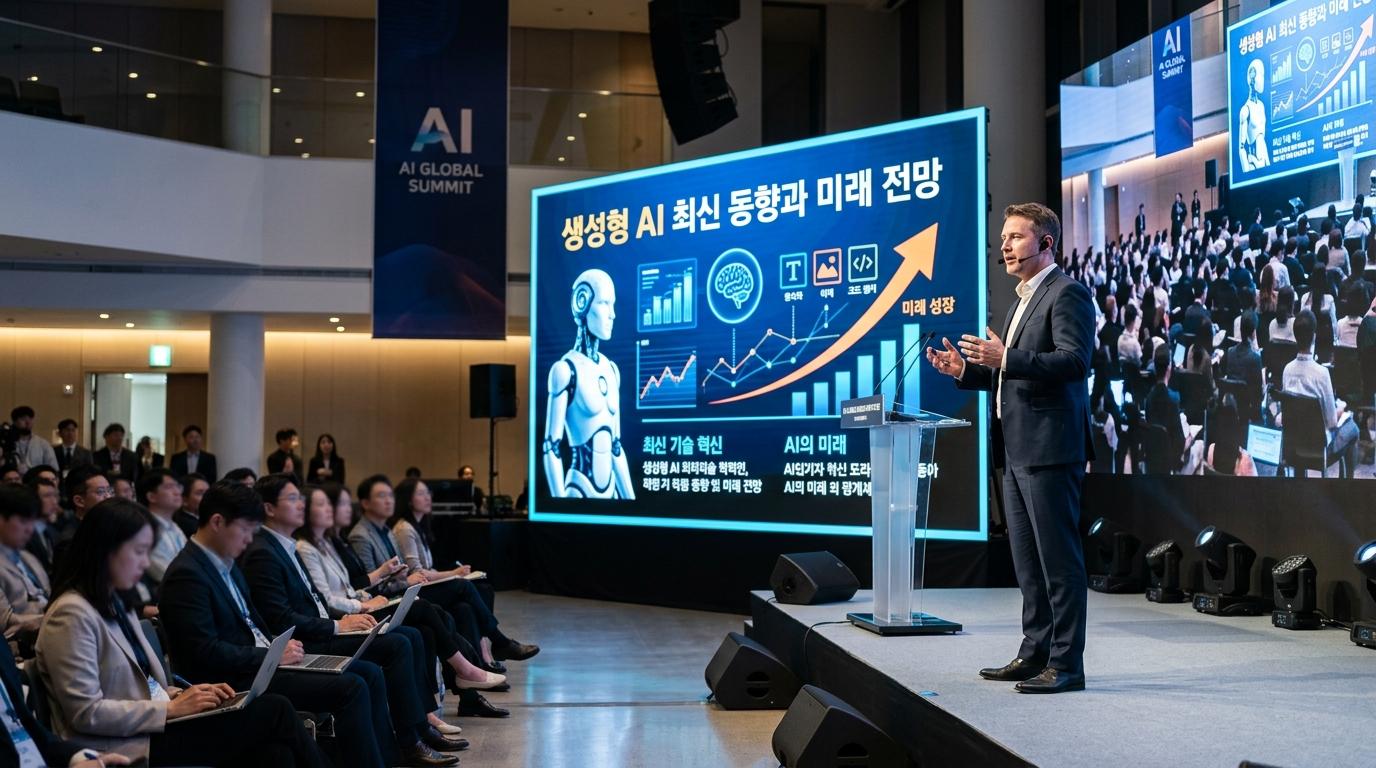
Generative AI Emerges as a Catalyst for Industrial Innovation
Since gaining widespread public recognition in late 2022, Generative Artificial Intelligence (Generative AI) has moved beyond simple content creation to become a key driver of innovation across industries. This technology, which learns from vast amounts of data to produce outputs that mimic human creativity in areas such as text, images, code, and voice, is now deeply penetrating our economic and social structures.
The Core of Next-Generation AI: Generative AI's Technological Evolution and Present State
Innovations in deep learning, the Transformer architecture, and the rise of large language models have laid the foundation for generative AI to produce content at a level that surpasses human creativity, unlike previous AI which focused on data analysis and classification. In particular, thanks to the groundbreaking advancements in the Transformer architecture, large language models (LLMs) such as the GPT (Generative Pre-trained Transformer) series exhibit remarkable performance after pre-training on vast amounts of text and images found on the internet, followed by fine-tuning for specific tasks. This enables unprecedented levels of accuracy and fluency in Natural Language Processing (NLP), ushering in an era where machines can communicate and create in ways similar to humans.
These models possess billions, even trillions, of parameters, which form the basis for learning complex patterns and relationships and generating highly personalized or creative outputs. For instance, the ability to produce draft papers, poems, novels, or even specific styles of art from simple prompts demonstrates the immense potential of generative AI.
The surge in data and the exponential increase in computing power, acting as the spark for innovation, have also fueled the explosive growth of generative AI. First, the widespread adoption of the internet and digital devices has led to an exponential increase in the volume of data that AI models can learn from, including text, images, and video. As of 2023, the total volume of data generated globally reaches hundreds of exabytes (EB), and this vast data serves as a crucial resource determining the performance of AI models. Second, the remarkable advancements in computing power, particularly centered on Graphics Processing Units (GPUs), have made it practically possible to train complex deep learning models with billions or trillions of parameters. This increase in computational capability has dramatically accelerated the pace of AI model development.
The convergence of these technological and environmental factors, coupled with the advent of ChatGPT in late 2022, propelled generative AI into public consciousness and recorded explosive growth. According to a PwC report, AI (including generative AI) has the potential to increase global GDP by $15.7 trillion by 2030, with generative AI expected to drive a significant portion of this growth. The generative AI market size already reached tens of billions of dollars in 2023 and is growing rapidly, with annual growth rates of 30-40% or more projected for the future.
Generative AI's Diverse Applications Implemented in the Industrial Field
New horizons are opening in writing, design, coding, and music creation through innovations in content production. Generative AI is supporting creative text generation as a writing assistant, going beyond simple typo correction and grammar checks to assist with marketing copy, press release drafts, and technical document creation. Image generation AIs like DALL-E, Midjourney, and Stable Diffusion create original and realistic images based on user text descriptions, revolutionizing how visual content is produced in fields such as design, advertising, and publishing.
Code generation AIs like GitHub Copilot significantly reduce the time developers spend writing code and lower error rates, while music generation AIs like Suno AI enable individuals without professional expertise to create their own music. These tools maximize productivity by reducing content creation costs, offering personalized experiences, and making it faster and easier to obtain professional-level outputs.
Significant strides are also being made in maximizing productivity in business and research and development (R&D). Companies are actively leveraging generative AI not just for automating repetitive tasks, but also for enhancing the efficiency of core business processes. Generative AI is being employed for tasks such as creating personalized marketing campaign copy, drafting reports based on extensive market research data, detecting bugs and improving code during software development, and generating new hypotheses through complex research data analysis.
Particularly in pharmaceuticals, chemistry, and material science, it is contributing to a dramatic acceleration of R&D, such as the discovery of new drug candidates and the design of novel materials. By simulating numerous virtual experiments and predicting optimal outcomes, AI can significantly reduce the time and cost associated with physical experimentation. This plays a critical role in expediting the market launch of new technologies or products and securing a competitive edge.
Furthermore, the expansion of education and personalized services is accelerating. Generative AI is emerging as a powerful tool in education, offering personalized learning experiences. Students can receive summaries of learning materials or explanations of complex concepts tailored to their level. AI tutors can also provide immediate responses to student questions and help create personalized learning plans aligned with their progress.
This personalized approach to education maximizes learning effectiveness and has the potential to help bridge educational disparities. Moreover, it is being utilized to provide customized services optimized for individual preferences and needs across various sectors, including customer service, entertainment, and personal assistance. For example, it is becoming possible to offer personalized movie recommendations, travel planning, and even customized health consultations by understanding user preferences.
Challenges of the Generative AI Era and Future Development Directions
Ethical issues, along with regulations and technological countermeasures for safe utilization, are critical challenges that must be addressed alongside technological advancement. The rapid development of generative AI presents urgent challenges such as copyright infringement issues, the spread of misinformation and fake news using technologies like deepfakes, the problem of AI models generating discriminatory outputs by reflecting biases in their training data, and the risk of personal information leakage during the processing of vast amounts of data.
To address these issues, the development of ethical guidelines for AI development and utilization, technologies that can clearly trace and verify content origins, and research into algorithms to mitigate model bias and ensure fairness must proceed in parallel. Governments worldwide are also focusing on establishing appropriate legal and institutional frameworks to manage the potential risks of AI technology and enhance social acceptance.
In the future, collaboration between humans and AI is expected to deepen through multimodal AI and enhanced autonomy. Generative AI will evolve into multimodal AI, capable of simultaneously understanding and processing various types of data beyond just text, including images, voice, and video. This will further enhance AI's comprehension and expressive capabilities, making interactions with humans more natural and rich. For instance, it will become possible for AI to understand voice commands, generate relevant images, and provide text descriptions of those images.
Furthermore, as the concept of AI Agents becomes a reality, AI is expected to exhibit higher levels of autonomy, setting its own goals, planning, and executing tasks. These AIs will strengthen their role as 'intelligent assistants' capable of undertaking creative and complex tasks through collaboration with humans.
Finally, the realization of industry-specific customized AI and hyper-personalized experiences will be the ultimate goal of generative AI. Generative AI will evolve to provide solutions optimized for specific fields by deeply learning domain-specific knowledge and data. This will enable services that meet the unique needs of each industry, such as disease diagnosis in healthcare, investment analysis in finance, and case analysis in law.
The combination of these industry-specific specialized AIs and multimodal AI technologies will enable hyper-personalized experiences across all domains at an unprecedented level by accurately understanding an individual's unique needs and preferences. Ultimately, generative AI will bring about fundamental changes to our lives and society as a whole, and adapting to these changes and seizing opportunities will be key to future competitiveness.