KF-21 First Production Aircraft Flies, Prospects Bright for Indigenous Armament Integration

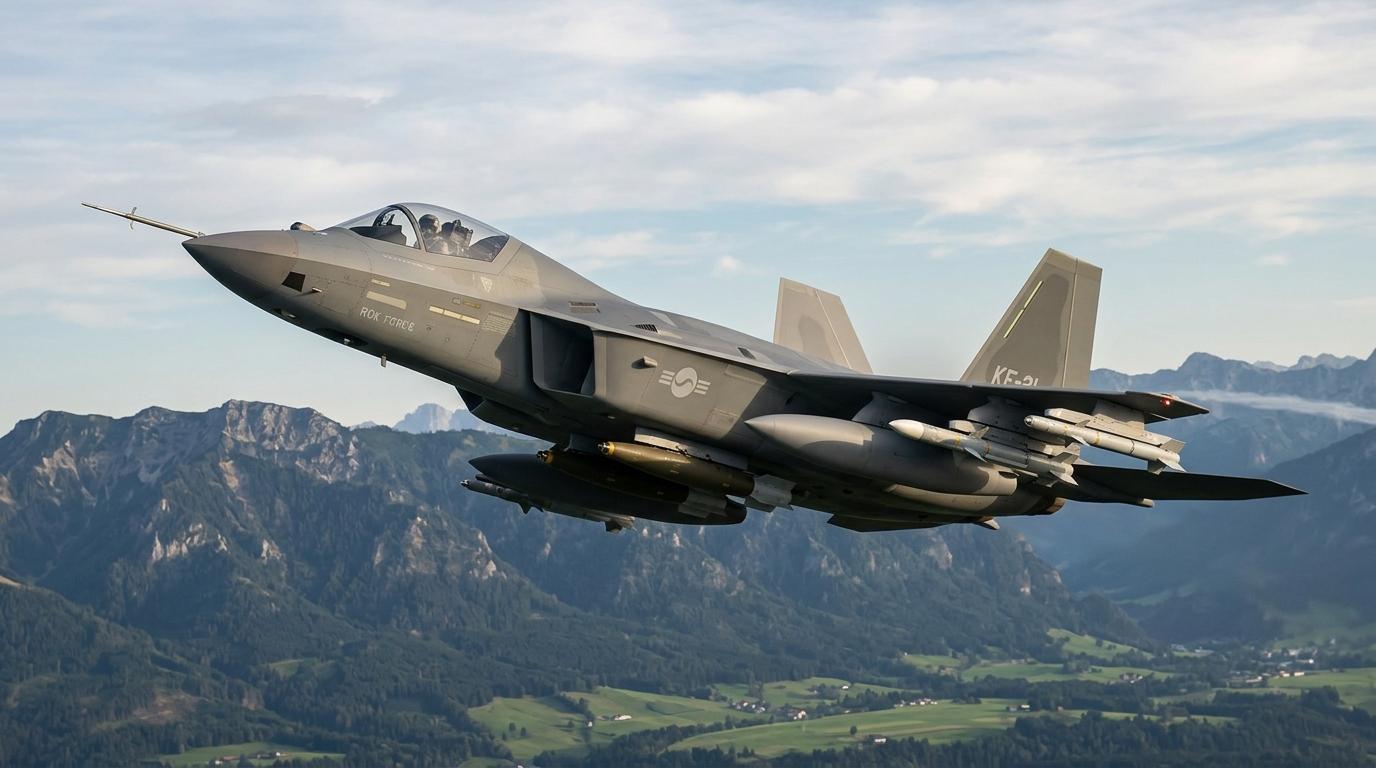
The successful flight of the KF-21 Boramae's first production aircraft marks a significant milestone for the Korean advanced fighter jet program, raising expectations for enhanced next-generation defense capabilities. Notably, the successful integration of indigenous armament systems onto this fighter is emerging as a critical challenge for achieving technological self-reliance and self-reliant defense in the nation's defense industry. This flight is more than just a prototype test; it is an important signal for the establishment of a full-scale production system and the potential for operational deployment.
Technical Achievements and Significance of the KF-21 First Production Aircraft's Flight
The KF-21 Boramae's exit from the production line and successful flight demonstrated its symbolic entry into the 'mass production' phase, moving beyond its status as a 'prototype.' The development of the KF-21 Boramae focused on verifying its designed performance through numerous test flights and overcoming technical challenges. However, the fact that the first production aircraft successfully flew after leaving the production line clearly proves the completion of the development phase and the stable establishment of the actual production system. This result demonstrates the acquisition of comprehensive capabilities encompassing design, production, and test evaluation, suggesting that the foundation for mass-producing the planned quantities has been laid.
This flight of the first production aircraft signifies that the KF-21 program has moved beyond a mere research and development stage and taken its first substantial step towards becoming a future asset for the Republic of Korea Air Force. It can be assessed that a stable foundation has been established for the sequential production of the planned 40 units in the first phase, 40 in the second phase, totaling 120 units (with potential expansion to 160 units later).
Furthermore, this flight is an important signal heralding the practical operational readiness of a 4.5-generation fighter. Although developed as a 4.5-generation fighter, the KF-21 is designed for easy future upgrades, including 5th-generation stealth capabilities. The flight of the first production aircraft lays the groundwork for these future expansion possibilities, while also demonstrating its readiness to replace aging aircraft in the ROK Air Force as a current 4.5-generation fighter and elevate its operational capabilities. Supersonic flight capability, the integration of an indigenous AESA radar, and aerial refueling systems prove that the KF-21 possesses the core operational capabilities required in modern warfare.
In particular, the aerial refueling test successfully completed in November 2023 confirmed the KF-21's potential to significantly expand its operational radius. This is expected to play a crucial role not only in air defense missions but also in securing operational capabilities over a wider area.
Indigenous Armament System Integration: KF-21's Core Competitiveness
Examining the status of indigenous guided weapon systems to be mounted on the KF-21 reveals that integration with various domestically developed systems, in addition to foreign-acquired weapons, is paramount. The goal is to enhance operational autonomy and convenience in maintenance and parts procurement. Key indigenous armament systems currently under development and integration include the Active Electronically Scanned Array (AESA) radar developed by the Agency for Defense Development (ADD), and various guided weapons being jointly developed by Korea Aerospace Industries (KAI), LIG Nex1, and others.
In particular, the 'Cheongeom (K-SAAM)' medium-range air-to-air guided missile, under development by LIG Nex1, is highly anticipated as a crucial indigenous armament to enhance the KF-21's air-to-air combat capabilities. It can compete with or complement foreign missiles like the European Meteor and the American AMRAAM, which have undergone test evaluations. Additionally, the integration of air-to-ground guided weapons and precision-guided bombs currently under development by ADD is expected to be a significant focus during the Block II development phase.
The practical feasibility through armament integration testing and development roadmaps is also becoming increasingly visible. During the KF-21 development process, aerodynamic characteristics of various external stores, launch tests, and interface tests with avionics systems have already been conducted using prototypes. The successful flight of the first production aircraft indirectly suggests that these integration processes can be applied without issue to actual production aircraft. Specific armament integration test schedules and development roadmaps are slated for future release, and the technical completeness achieved during this process will determine the KF-21's actual operational capabilities.
The success of integrating indigenous armament systems will not only demonstrate the KF-21's independent performance but also serve as a key indicator of South Korea's technological contribution to the joint development project with Indonesia. This can contribute to securing a favorable position in future international defense industry cooperation.
Potential and Challenges of Indigenous Armament System Integration
Securing operational efficiency and price competitiveness through the use of indigenous armaments is the path to maximizing the KF-21 program's potential. Integrating indigenous armament systems onto the KF-21 goes beyond mere technological self-reliance, offering tangible operational advantages. By reducing reliance on foreign armaments, parts procurement stability is enhanced, and rapid response is possible even in emergencies. Furthermore, efficient support is available based on domestic technological capabilities during periodic armament system inspections, repairs, and performance upgrades, leading to long-term operational cost savings. Optimized indigenous armament integration also contributes to improving the price competitiveness of the KF-21 airframe itself, becoming a factor that enhances its potential for success in export markets.
For example, the successful integration and performance of an indigenous AESA radar can elevate the KF-21's detection and tracking capabilities to meet the demands of modern battlefields. Similarly, domestically developed air-to-air and air-to-ground missile systems can broaden the KF-21's mission scope and provide optimized operational capabilities for specific battlefield environments. The completion of this indigenous armament ecosystem will position the KF-21 not just as a platform but as a core asset with independent defense capabilities.
Addressing technical challenges and finding a balance in international cooperation are also tasks that must be resolved for successful operational deployment. Perfectly interfacing various indigenous armaments with differing performance and characteristics to the KF-21's integrated avionics, software, and flight control systems requires high-level technological expertise. In particular, complex software development and verification are essential to ensure stable and rapid armament operation in the real-time changing battlefield environment.
Moreover, international cooperation and coordination with Indonesia, the joint development partner of the KF-21 program, regarding the scope of armament system integration, technology transfer, and potential indigenous armament exports, are important variables. Even within the framework of strengthened defense cooperation between the South Korean government and the U.S. administration, enhancing the KF-21's indigenous armament integration capabilities will be an essential factor in achieving the national goal of self-reliance for the Korean defense industry.
Future Development Direction and Outlook for the KF-21
The KF-21 is poised to become a key player in future battlefields based on phased performance improvements and the scenario of acquiring 5th-generation stealth capabilities. Building on the success of the Block I phase as a 4.5-generation fighter, it is designed with future evolution to a 5th-generation fighter in mind, including enhanced air-to-ground capabilities through the subsequent Block II development. The mass production process, which will fully commence with the flight of the first production aircraft, is expected to involve not only airframe production but also phased performance improvements such as the application of internal weapon bays, development and application of stealth coatings, and airframe shape enhancements.
In particular, the planned enhancement of stealth capabilities in the Block II phase will dramatically improve the KF-21's survivability and operational efficiency. This is expected to maximize its ability to penetrate enemy territory with minimal radar detection and deliver precision strikes. Furthermore, the Block II is expected to see the integration of a wider array of advanced armament systems, including air-to-ground precision-guided munitions and cruise missiles, significantly expanding its operational radius and mission capabilities.
The KF-21's role is also crucial for enhancing competitiveness in the export market and contributing to the development of the domestic defense industry ecosystem. Successful integration of indigenous armaments and continuous performance improvements will significantly enhance the KF-21's international competitiveness. Armed with advanced technology and competitive pricing, the KF-21 is expected to secure a strong position in potential export markets such as Southeast Asia and the Middle East. This will not only lead to fighter jet sales but also promote South Korea's defense industry on a global scale, creating a virtuous cycle that fosters technological accumulation and the development of specialized personnel.
The KF-21 program is serving as an opportunity to elevate core technological capabilities across the defense industry, including domestic aircraft design, production, test evaluation, and armament integration. Successful mass production, continuous performance improvements, and the successful integration of indigenous armament systems will serve as a crucial stepping stone for South Korea to emerge as a global aerospace and defense powerhouse.