22nd National Assembly Accelerates Legislation for State Agenda This Year

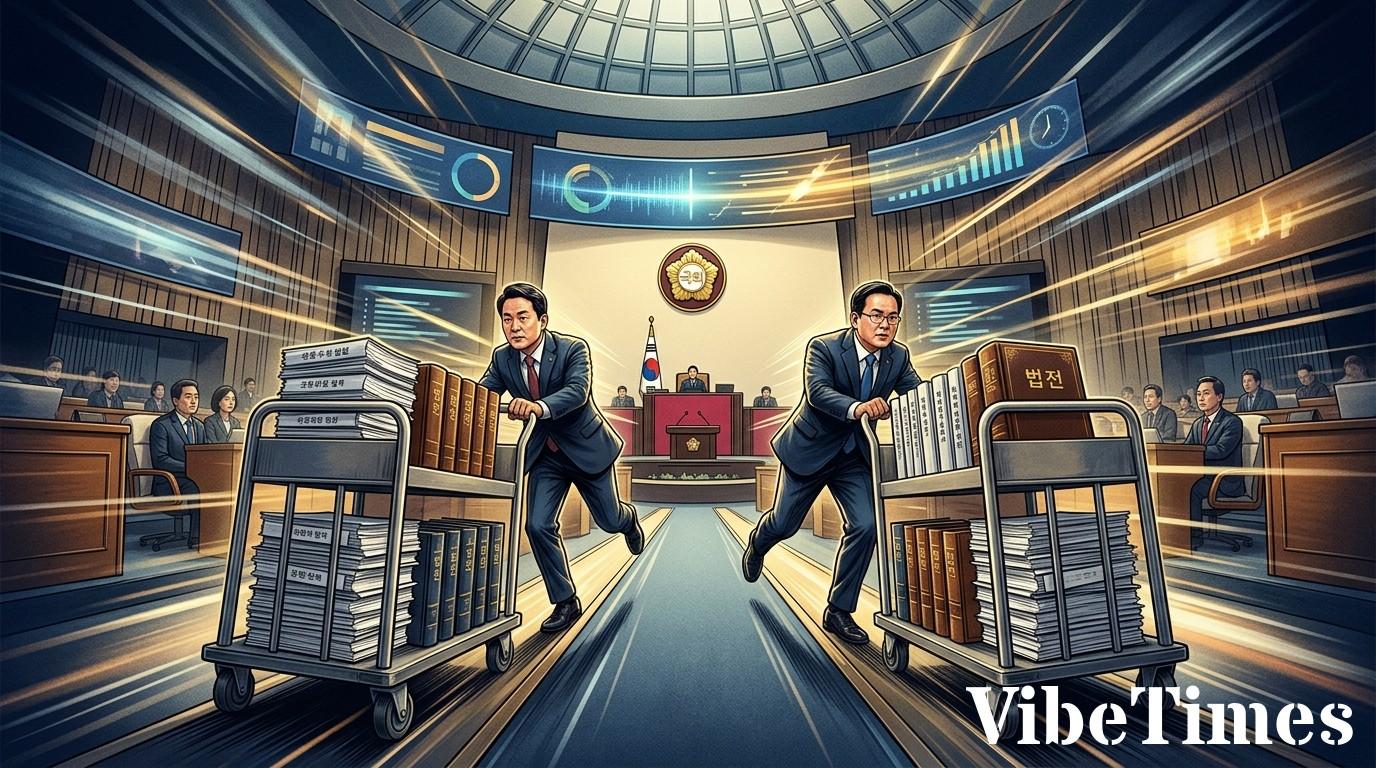
State Agenda Legislation to Be Rushed for Year-End Completion; National Assembly to Enter 'Legislative Speed Battle' After Forming Second-Half Leadership
With the formation of the National Assembly's leadership for the latter half of the 22nd term approaching, the ruling and opposition parties are expected to pick up the pace in processing legislation crucial for the state agenda. Assemblyman Cho Jeong-sik, who is virtually confirmed as the National Assembly Speaker representing the Democratic Party of Korea, has stated his intention to lead the Assembly, emphasizing the goal of completing state agenda legislation within the year. Prime Minister Kim Boo-kyum is also focusing on securing momentum for livelihood-related legislation through cooperation with the National Assembly. This indicates a heightened interest in the legislative schedule, intertwined with the handling of contentious bills such as the 'Special Prosecutor Act on Manipulated Indictments,' which has emerged as a key political flashpoint following the June 3 local elections.
With both parties expressing their will to process state agenda legislation, the 22nd National Assembly is poised to launch full-scale legislative procedures once the leadership lineup for the latter half of the term is finalized. The plan is to complete the leadership formation by June and vigorously pursue legislation for public welfare and the legal foundation for implementing the state agenda. In this process, how and when highly contentious issues, such as the 'Special Prosecutor Act on Manipulated Indictments,' will be addressed is expected to be a major focus.
Goal to Complete State Agenda Legislation Within the Year: Rationale and Background
The objective of completing state agenda legislation within the year is interpreted as a strategy to secure governing momentum for the current administration and enhance the stability of its operations. Assemblyman Cho Jeong-sik has clearly stated his intent to contribute to the successful governance of the current administration by swiftly finalizing the leadership formation within June and processing all state agenda legislation by year-end. This is seen as an expression of the will to achieve policy goals through close cooperation with the National Assembly.
Prime Minister Kim Boo-kyum is also making significant efforts to strengthen cooperation with the National Assembly. He is reportedly enhancing communication channels not only with lawmakers on parliamentary standing committees but also through dinners with the Democratic Party's new floor leadership, seeking their cooperation for the legislative speed battle. This move by the Prime Minister demonstrates that building smooth communication channels with the National Assembly could be a critical variable for the success or failure of processing state agenda legislation.
Meanwhile, Assemblyman Cho Jeong-sik, who is virtually confirmed as the candidate for the latter half of the 22nd National Assembly's speakership, is seen as likely to gain traction in pushing the state agenda for the 'Lee Jae-myung administration.' In particular, his role in specific bills that have drawn attention since the June 3 local elections, such as the 'abolition of prosecutors' supplementary investigation rights,' could become a focal point. This highlights the National Assembly's role and significance not just in processing public welfare bills but also in addressing legislation that has become a current political issue.
Controversial Bills Like 'Special Prosecutor Act on Manipulated Indictments' Emerge as Political Flashpoints
The crossfire between the ruling and opposition parties over the 'Special Prosecutor Act on Manipulated Indictments' has emerged as a major point of contention leading up to the June 3 local elections. Grand National Party candidates for metropolitan mayor positions in Daejeon and South Chungcheong Province are using this bill to attack the Democratic Party. A recent opinion poll conducted by Korea Research for News1 showed that a portion of respondents found the 'Special Prosecutor Act on Manipulated Indictments' 'inappropriate.' This indicates the potential impact the bill could have on voters during the election period.
This bill is also indirectly linked to the issue of processing 'bills agreed upon by the National Assembly,' as mentioned by President Lee Jae-myung. President Lee has previously commented on situations where filibusters are used to pass a single law in the National Assembly, urging that 'wherever possible, use executive orders.' This reflects dissatisfaction with delays and stalemates in the legislative process, underscoring the significant differences in the positions of the ruling and opposition parties regarding contentious bills.
Notably, eight of the twelve cases targeted for investigation by this bill, also referred to as the 'Prosecutor Discontinuation Special Prosecutor Act,' are reportedly related to President Lee Jae-myung, including the Daejang-dong, Baekhyun-dong, and Ssangbangul North Korea remittance cases. Shin Yul, a professor of Political Science and International Relations at Myongji University, analyzed in an interview with iNews24 that the 'Prosecutor Discontinuation Special Prosecutor Act could become a variable for undecided middle-ground voters who might otherwise not go to the polls,' predicting the bill's impact on local election sentiment. Furthermore, in the Busan, Daegu, and Gyeongnam regions, 47% to 54% of respondents expressed opposition to the 'Special Prosecutor Act on Manipulated Indictments,' showing differing voter perceptions of the bill across regions.
Future Outlook: Legislative Process and Impact on Markets and Industries
The processing of state agenda legislation within the year is expected to gain momentum after the formation of the 22nd National Assembly's leadership for the latter half of the term. The ruling and opposition parties are expected to finalize their leadership lineup by June and accelerate legislative work to fulfill the state agenda. However, contentious bills like the 'Special Prosecutor Act on Manipulated Indictments' are likely to face significant hurdles in the legislative process. Sharp confrontations between the parties are anticipated, which could lead to delays in the National Assembly's schedule.
These shifts in the legislative environment could subtly affect related markets and industries. For instance, depending on the content of the bills, they could lead to deregulation or increased regulation in specific sectors, or create new investment opportunities or stifle existing ones. In particular, legislative delays or stalemates in the National Assembly can increase uncertainty for economic actors. Conversely, if major state agenda items are concretely legislated, it could be interpreted as a positive investment signal for related industrial fields.
Moving forward, the National Assembly will continue to engage in in-depth discussions not only on bills for public welfare stabilization but also on contentious issues that could have a broad impact on society. The legislative achievements of the 22nd National Assembly and the direction they will set for our society and economy are aspects that warrant close observation during the future course of parliamentary operations.