22nd National Assembly Records All-Time Low Legislative Performance at 7.5%

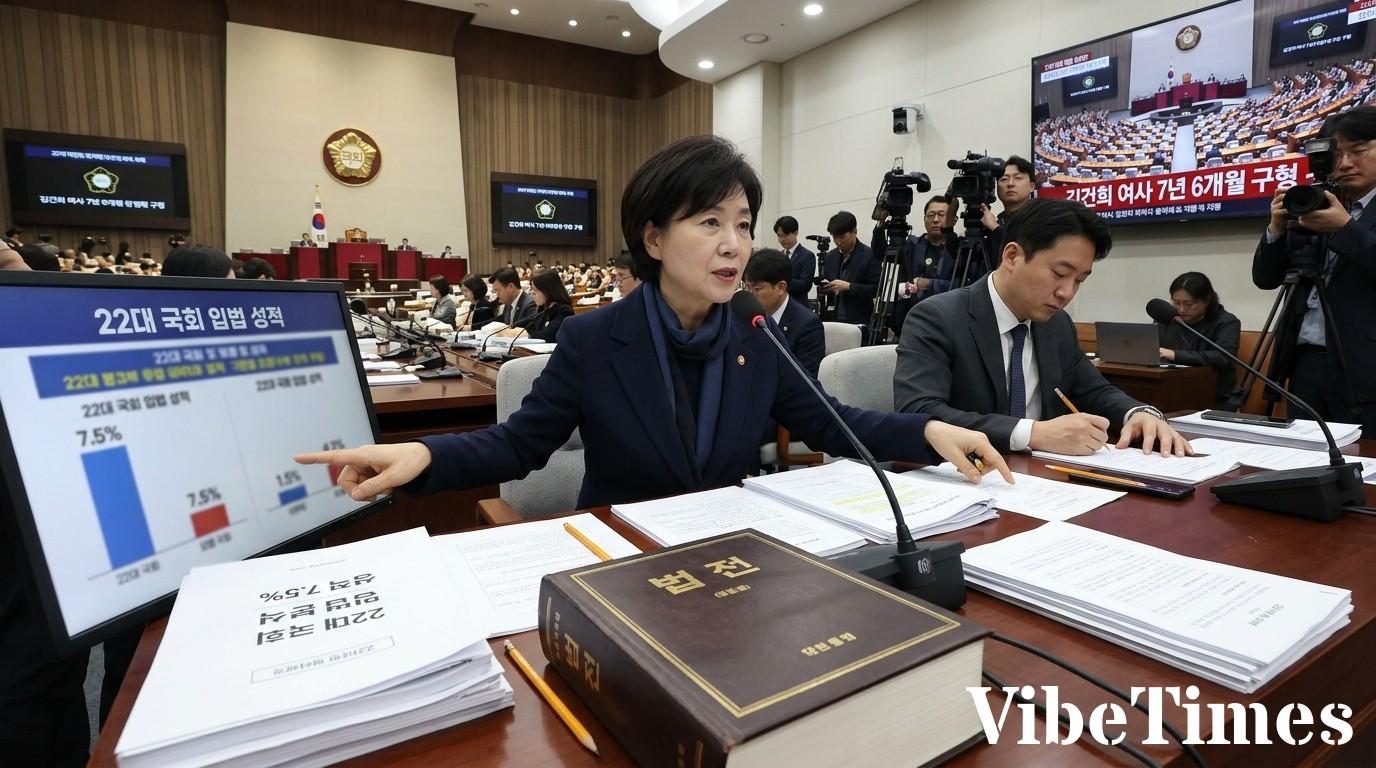
22nd National Assembly's Legislative Performance a Failing Grade at 7.5%… Record Low Amidst Turmoil
As the first half of the 22nd National Assembly's term approaches its wrap-up on the 29th of this month, it has received a shocking report card, with a bill passage rate of just 7.5%, marking an all-time low. This figure is significantly lower than that of the 21st National Assembly, and analysts point to the legislative delays as a result of navigating turbulent political and social upheaval, including the December 3rd state of emergency and the impeachment proceedings against former President Yoon Suk-yeol. The exceptionally low rate of bills passed through plenary sessions, out of the numerous bills submitted since the 22nd National Assembly's inauguration in May 2024, raises serious concerns about the normalization of the Assembly's functions, according to the National Assembly's Bill Information System.
The sharp confrontation between the ruling and opposition parties is analyzed as a primary cause for this sluggish legislative performance. The 22nd National Assembly began with an opposition-majority structure during the Yoon Suk-yeol administration in 2024, but it was reorganized into a ruling-majority structure with the inauguration of the Lee Jae-myung administration following the state of emergency and impeachment process. It is widely assessed that the momentum for processing bills directly related to people's livelihoods has been lost due to escalating political infighting and deepening mutual distrust during this period. Analyses suggest that the situation has devolved into a 'stalemate,' where neither side can achieve satisfactory legislative outcomes, as the dominant ruling party attempts legislative dominance and the opposition engages in desperate counter-maneuvers.
Meanwhile, alongside the delays in bill processing, judicial decisions have also drawn significant attention in the 22nd National Assembly. Specifically, the prosecution's request for a seven-year and six-month prison sentence for First Lady Kim Keon-hee, who has been on trial for alleged bribery, serves as a prime example of the ongoing judicial process. During the trial presided over by the Seoul Central District Court's Criminal Division 21 (Presiding Judge Jo Soon-pyo), the special prosecution team sought a heavy sentence for charges that Ms. Kim allegedly received money in exchange for public appointments. This starkly illustrates the procedures and judgments involved in the nation's judicial system when handling significant social incidents.
Bill Passage Rate at 7.5%… Livelihood Bills Lost Amidst 'Turbulence'
The 7.5% bill passage rate for the first half of the 22nd National Assembly is an extremely serious figure. This is even more pronounced when compared to the first half of the 21st National Assembly. While there was confrontation between the ruling and opposition parties during the 21st National Assembly, political extremism has intensified in the 22nd National Assembly following unprecedented events in constitutional history, such as the December 3rd state of emergency and the impeachment of former President Yoon Suk-yeol. Such extreme confrontation is analyzed to have severely hindered the legislative review and decision-making process, which is the essential function of the legislature. Critics argue that the delay of urgent livelihood bills, aimed at economic recovery and strengthening the social safety net, which have become entangled in political disputes, ultimately harms the public.
Rep. Min Joong-ki (Justice Party) emphasized the need for special legislation to resolve difficulties in the education field, urging the passage of the 'Teacher's Rights Protection Five Bills.' This highlights the urgency of institutional improvements for protecting teachers' rights and ensuring students' right to learn. Additionally, Rep. Park (Justice Party) presented the normalization of public education and reduction of reliance on private education through education reform as key policy tasks, while Rep. Hwang Chang-yeon (Justice Party) identified the resolution of care gaps in education and the mitigation of educational disparities as major policy objectives. This suggests that numerous urgent issues within the education sector are piling up.
Meanwhile, Rep. Hwang Suk-young (Justice Party) clarified a prosecutorial reform stance by proposing a reduction in the scope of direct prosecution by the prosecution and a restoration of public trust through institutional improvements. Rep. Hwang also presented 'Future Generation Support' as a core policy direction, emphasizing measures to support asset formation for youth. Rep. Park Myung-sung (Justice Party) stated his major policy goals include realizing a labor-respecting society and completing political and judicial reforms. While numerous lawmakers have expressed their aspirations to pursue various policies and legislation for livelihood stability, future generation support, and the completion of reform tasks, the current low bill passage rate is expected to be a major obstacle to realizing these ambitions.
Judicial Decisions and Outlook for Future Legislative Procedures
Rep. Jeong Myung-ki's (Justice Party) aspiration, declared shortly after the opening of the 22nd National Assembly, to create 'Laws that Change People's Lives' can be interpreted as a message reaffirming the purpose and role of the legislature. However, the 7.5% bill passage rate clearly demonstrates a significant impediment to realizing such aspirations. Looking at legislative pre-announcements by government ministries, the Ministry of Land, Infrastructure and Transport has pre-announced a bill for 'Direct Punishment of Illegal Subcontracting,' including direct penalties for construction companies' illegal acts and mitigation measures for voluntary reporting. This can be seen as an attempt by the government to establish legal measures to ensure the integrity of the construction industry, a vital pillar of the people's economy. However, the current situation in the National Assembly, where such bills must pass the legislative hurdles to take effect, adds to the frustration.
Judicial decisions can also influence future legislative procedures and social discourse. The special prosecution's request for a seven-year and six-month prison sentence for First Lady Kim Keon-hee not only demonstrates the strictness of relevant laws and judicial procedures but also has the potential to create ripples in political responses and legislative discussions. Furthermore, public opinion poll results on granting 'prosecutorial cancellation rights' to the 'manipulative prosecution' (44% against, 27% in favor) show how intricately social trust in the judicial system and discussions for institutional improvement are intertwined. Meanwhile, in the United States, the Senate Banking Committee's commencement of discussions on cryptocurrency market structure legislation signals active legislative moves related to financial markets and technological advancements on an international scale. This hints that similar legislative discussions could be triggered in South Korea in the future, underscoring the urgent need for the 22nd National Assembly to normalize its legislative functions.
In conclusion, the legislative performance of the 22nd National Assembly in its first half is close to a 'failing grade.' The record-low bill passage rate indicates that livelihood bills have been sidelined amidst extreme confrontation between the major parties and a period of political upheaval. If this situation persists, legislative activities aimed at bringing about tangible changes that the public can feel are likely to further contract. The significant task ahead is whether the political sphere can achieve a broad consensus and focus on processing livelihood bills during the remainder of the Assembly's term, and resume productive legislative activities that reflect judicial decisions and societal demands. In particular, for policy demands raised in various fields such as education, economy, labor, and prosecutorial reform to materialize into actual bills and be passed, decisive action from politicians and efforts to reach national consensus are desperately needed.
