Democratic Party Leads 22nd National Assembly with 10,000 Bills Sponsored, Taking Sole First Place

Democratic Party’s Dominance and Gaps Among Parties as Legislative Initiative Secured
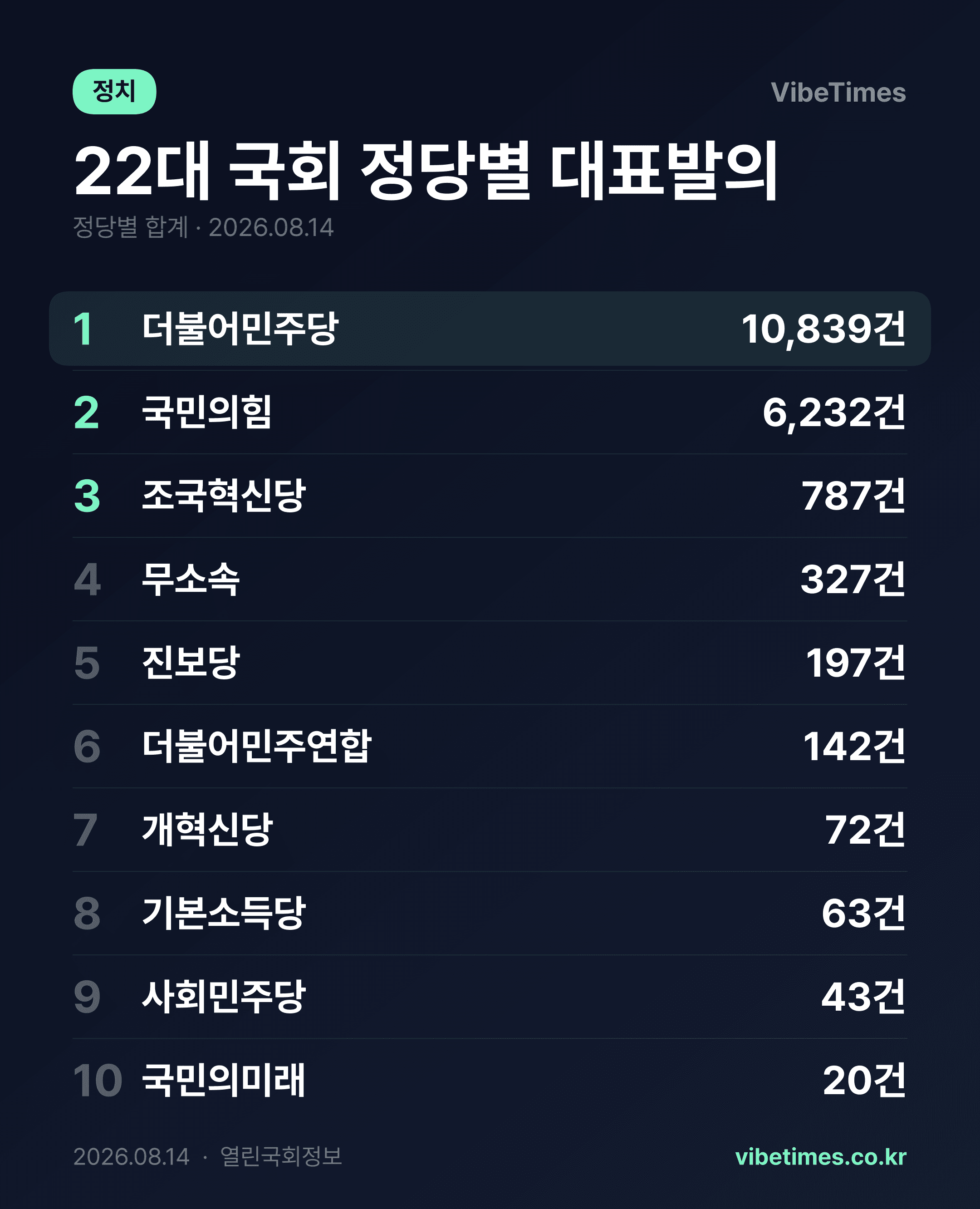
As of August 14, 2026, the Democratic Party of Korea (DP) has taken a commanding lead in legislative activity in the 22nd National Assembly, serving as the primary sponsor for a total of 10,839 bills. An analysis of data from the National Assembly Legislative Information System reveals that the DP's bill count is more than 74% higher than that of the People Power Party (PPP), which recorded 6,232 bills in second place. This figure is interpreted as the result of the opposition party's strategic stance to pre-empt legislative initiative as the largest party in the National Assembly. The combined total of bills sponsored by the two major parties exceeds 17,000, accounting for the absolute majority of all legislative activity.
Movements within the third bloc are notably led by the Rebuilding Korea Party. Having sponsored a total of 787 bills, the party has numerically proven its presence as the third-largest party in the Assembly. This is more than double the 327 bills sponsored by independent lawmakers. Meanwhile, the Progressive Party recorded 197 bills and the United Democratic Party 142, forming a mid-tier group. While there is a clear trend that the number of sponsored bills corresponds to the number of seats held, certain parties exhibited a higher density of bill proposals relative to their seat count.
The Democratic Party surpassing 10,000 bills suggests an enhancement of the opposition bloc's influence in setting policy agendas, going beyond simple numerical superiority.
The quantitative expansion of legislative activity serves as a factor increasing volatility in the policy landscape. In particular, with the DP's count significantly surpassing that of the PPP, there is a high likelihood of continued legislative offensives from the opposition on key economic issues such as corporate regulation and welfare policy. The PPP, with 6,232 sponsored bills, appears to be focusing on policy execution and legislative efficiency as the governing party; however, in terms of statistical legislative competitiveness, it is being overshadowed by the sheer volume of opposition bills.
Legislative Efforts of Small Parties and Strategies for Policy Differentiation
Examining the legislative landscape of non-parliamentary negotiating bodies and minor parties reveals clear disparities in activity based on party characteristics. The Reform Party sponsored 72 bills, and the Basic Income Party 63, emphasizing policy clarity. In particular, the Social Democratic Party (43 bills) and the People's Future Party (20 bills) recorded relatively low numbers; however, considering their party size, this is interpreted as an elite legislative strategy concentrating on specific core agendas.
Bills from these minor parties often serve as swing votes within the confrontation structure of the major parties or act as a catalyst for new social issues. The Basic Income Party concentrates on specialized bills related to universal welfare, seeking to secure policy symbolism beyond mere numbers. The Reform Party similarly embeds its policy identity within its 72 bills through legislation on economic deregulation and future industries that differentiates it from the existing conservative bloc.
The activity level of independent lawmakers is also worth noting. The 327 sponsored bills are the result of efforts solely by individual lawmaker offices without party-level support. This implies that a significant number of these bills address district-specific issues or institutional improvements of a neutral nature, unrestricted by specific party lines. The Progressive Party, with 197 bills, showed results reflecting its core support base by concentrating legislative efforts in labor and human rights fields.
Economic Implications of the Era of Legislative Flooding and Impact on Industry
The quantitative increase in legislative activity by political parties simultaneously presents opportunities and crises for the industrial sector. A significant portion of the 10,000-plus bills led by the Democratic Party is likely to contain regulatory provisions that directly affect corporate management, such as environment, labor, and fair trade regulations. Statistically, as the number of sponsored bills increases, bottlenecks may occur during the review process, which can hinder policy predictability for businesses.
Conversely, the 6,232 bills sponsored by the People Power Party are analyzed to focus mainly on economic revitalization and regulatory deregulation in support of the administration's state agenda. With the gap in sponsored bills between the two parties reaching 4,607, fierce negotiations and confrontation between the ruling and opposition parties during the parliamentary passage process appear inevitable. For investors, such legislative data serves as foundational material for judging which industrial sectors face regulatory risks or anticipate benefits.
Quantitative expansion of bills does not necessarily lead to qualitative superiority. However, the number of sponsored bills is an activity indicator showing how actively a party intends to intervene in national governance. The structure, where the top three forces among the top 10 parties and groups hold over 90% of all sponsored bills, may deepen the oligopoly phenomenon in the policy decision process. This suggests that industry associations and interest groups need to concentrate their lobbying firepower and policy proposals sequentially on the Democratic Party, the People Power Party, and the Rebuilding Korea Party.
Outlook for the Legislative Market and the Task of Securing Policy Stability
The number of sponsored bills is expected to increase further as the 22nd National Assembly moves into its latter half. The speed of the Democratic Party's legislative drive is notably fast even compared to previous assemblies. If this trend continues, the total number of sponsored bills is expected to reach tens of thousands by the end of the term, raising concerns of overload for the legislature. In particular, the addition of a strong third party like the Rebuilding Korea Party (787 bills) is expected to further complicate bill processing.
Moving forward, market attention must focus not only on the trend of sponsored bills but also on actual passage rates. Even if the Democratic Party introduces over 10,000 bills, there remains a possibility of frustration during the actual legislative stage without agreement with the ruling party. Consequently, businesses require a strategy to identify intersection agendas—issues both parties commonly care for—rather than reacting vacillatingly to the trends of the party with the most bills.
In conclusion, current data clearly indicates the formation of an opposition-led legislative market. The spectrum stretching from the People's Future Party (20 bills) to the Democratic Party (10,839 bills) reflects the polarization of Korean politics and the intensity of legislative competition. Economic actors seeking policy stability must construct proactive response systems by constantly monitoring these legislative activity indicators by party to grasp mid- to long-term regulatory changes and support policy flows.