National Assembly Data Analysis: Lawmakers Who Diverged from Party Averages and Charted Their Own Course

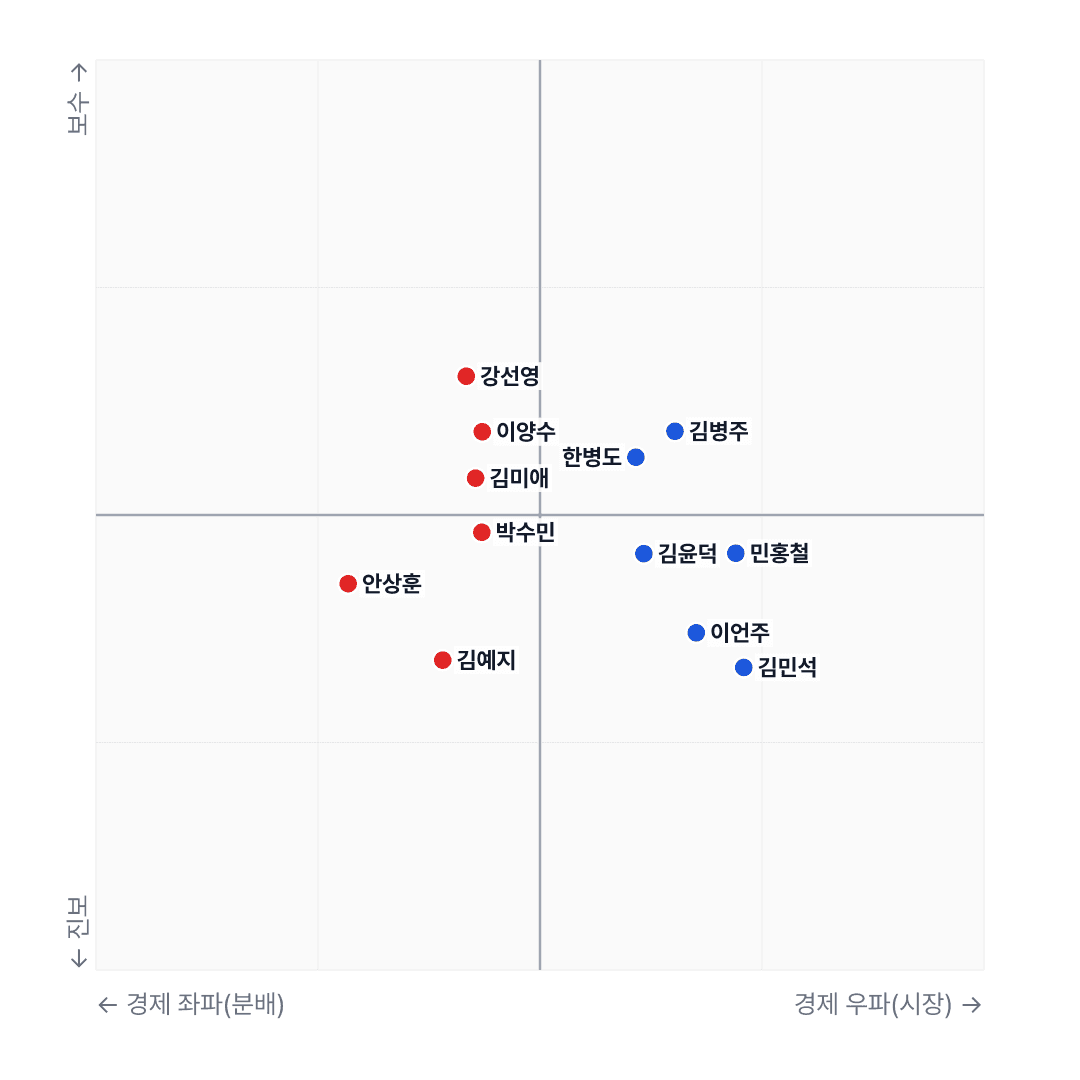
Independent Stances Diverging from Party Averages: A Cross-Analysis of National Assembly Members' Ideological Leanings
Quantitative analysis of the legislative activities of National Assembly members has revealed a significant number of lawmakers holding independent political stances that differ from the average ideological leanings of their respective parties. This finding is based on data from bill sponsorship and voting records. The ‘ideological coordinates’ were derived from a weighted average of an LLM’s (Large Language Model) judgment on the content of each lawmaker's sponsored bills. When the two major parties, the Democratic Party of Korea and the People Power Party, are normalized to the origin (0,0), the coordinate values observed in economic and social sectors suggest that these lawmakers maintain independent policy stances beyond the confines of their party. Their actions sometimes exert ‘cross-pressure,’ and at other times reveal unexpected figures or phenomena that defy conventional wisdom.
Ideological Spectrum of Individual Lawmakers Beyond Two-Party Averages
This analysis focused on quantifying the ideological leanings of National Assembly members in their actual legislative activities and identifying ideological outliers by comparing them to the average values of their respective parties. The ‘ideological coordinates’ represent each lawmaker's economic policy orientation (left-right) and social policy orientation (progressive-conservative) on a scale from -1 to +1. Because these numerical values alone can be difficult for the general public to intuitively grasp, this article explains the political implications of these figures and the resulting lawmaker stances in concrete natural language, such as ‘nearly centrist,’ ‘distinctly left-leaning,’ or ‘markedly to the left of the Democratic Party average.’
A noteworthy point is the existence of lawmakers exhibiting ideological characteristics that run counter to the average leanings of their affiliated parties. Several Democratic Party members, for instance, have shown strong right-leaning economic tendencies. Lawmaker Kim Min-seok recorded coordinates of +0.46 in economics and -0.34 in social issues, demonstrating a position differentiated from the Democratic Party's economic policy direction. Lawmakers Min Hong-cheol (+0.44, -0.08), Lee Eon-ju (+0.35, -0.26), Kim Byung-ju (+0.30, +0.18), Kim Yoon-duk (+0.23, -0.09), and Han Byung-do (+0.22, +0.13) also displayed centrist to right-leaning economic tendencies, playing a role in broadening the economic policy spectrum within their party. This suggests the presence of voices within the Democratic Party supporting economic deregulation and market-friendly policies.
Conversely, individuals within the People Power Party were also found to exhibit left-leaning economic tendencies. Lawmaker Ahn Sang-hoon, with coordinates of -0.43 in economics and -0.15 in social issues, charted a course different from the People Power Party's traditional economic policy direction. Lawmakers Kim Ye-ji (-0.22, -0.32), Kang Sun-young (-0.17, +0.30), Kim Mi-ae (-0.14, +0.08), Park Soo-min (-0.13, -0.04), and Lee Yang-su (-0.13, +0.18) also showed centrist to left-leaning economic stances, indicating considerations within the People Power Party for protecting the economically disadvantaged or redistributing income. Such phenomena demonstrate that diverse economic philosophies can coexist within the framework of a single party, reflecting individual lawmakers' principled actions in their legislative activities.
Unexpected Figures and the Meaning of Cross-Pressure
This phenomenon of ‘cross-pressure’ illustrates the complexity that makes it difficult to divide the political spectrum into simple dichotomies. For example, the existence of lawmakers who hold conservative social views yet support progressive economic policies, or vice versa, suggests that the party images conventionally expected by the public are insufficient to explain their entire legislative activities. This indicates that lawmakers' legislative actions are influenced not just by mechanically following party lines but also by various factors such as their constituency characteristics, personal beliefs, areas of expertise, and the interests of relevant industrial sectors. Notably, if a lawmaker holds stocks in an industry overseen by their affiliated standing committee or has received substantial donations from a particular professional group, this can be a point for critical examination regarding potential conflicts of interest in their legislative work. Of course, these facts alone do not constitute proof of illegality, and it is important to present only objective facts based on publicly available data.
The individual ideological coordinates of lawmakers revealed in this analysis, derived from concrete actions such as bill sponsorship and voting, may therefore differ from their publicly perceived images or conventional wisdom. For instance, a lawmaker might not strongly express a particular ideological stance in media interviews or public statements, yet their actual bill sponsorship and voting records might reveal a different inclination. It is important to recognize the limitations of these quantitative indicators.
Market and Industry Impact of Analysis Results and Future Outlook
The independent legislative activities of individual lawmakers, which extend beyond their party's average ideological leanings, can exert subtle but significant influences on specific industries or overall economic policy. For example, if a lawmaker from the Democratic Party with a right-leaning economic stance votes in favor of deregulation or market opening bills in their standing committee, this could signal a positive development for the relevant industry. Conversely, if a lawmaker from the People Power Party with a left-leaning economic tendency supports bills strengthening labor rights or reforming large conglomerates, this could present new challenges for companies in those sectors.
This ‘cross-pressure’ among lawmakers can enable unexpected alliances in the legislative process or increase the complexity of policy decisions. Stakeholders in specific industrial sectors need to look beyond mere party logic and refer to the individual ideological data of lawmakers serving on relevant standing committees to predict policy changes and formulate response strategies.
Going forward, the ideological leanings of National Assembly members are expected to become even more diverse and complex. As new economic and social issues emerge with technological advancements and societal changes, policy demands that cannot be explained by existing ideological frameworks will arise. In this environment, continuous quantitative analysis of individual lawmakers' principled legislative activities and their outcomes is anticipated to provide crucial insights for understanding policy-making processes and forecasting future market shifts.
Lawmakers Mentioned in the Article
| Lawmaker | Party | Ideological Stance | Notes |
|---|---|---|---|
| Kim Min-seok | Democratic Party of Korea | Economically Right-Leaning · Socially Progressive | Opposite Party Line |
| Min Hong-cheol | Democratic Party of Korea | Economically Right-Leaning · Socially Progressive | Opposite Party Line |
| Lee Eon-ju | Democratic Party of Korea | Economically Right-Leaning · Socially Progressive | Opposite Party Line |
| Kim Byung-ju | Democratic Party of Korea | Economically Right-Leaning · Socially Conservative | Opposite Party Line |
| Kim Yoon-duk | Democratic Party of Korea | Economically Right-Leaning · Socially Progressive | Opposite Party Line |
| Han Byung-do | Democratic Party of Korea | Economically Right-Leaning · Socially Conservative | Opposite Party Line |
| Ahn Sang-hoon | People Power Party | Economically Left-Leaning · Socially Progressive | Opposite Party Line |
| Kim Ye-ji | People Power Party | Economically Left-Leaning · Socially Progressive | Opposite Party Line |
| Kang Sun-young | People Power Party | Economically Left-Leaning · Socially Conservative | Opposite Party Line |
| Kim Mi-ae | People Power Party | Economically Left-Leaning · Socially Conservative | Opposite Party Line |
| Park Soo-min | People Power Party | Economically Left-Leaning · Socially Progressive | Opposite Party Line |
| Lee Yang-su | People Power Party | Economically Left-Leaning · Socially Conservative | Opposite Party Line |