National Assembly Lawmakers Deviating from Party Line: Kim Ki-hyun at 2.8%
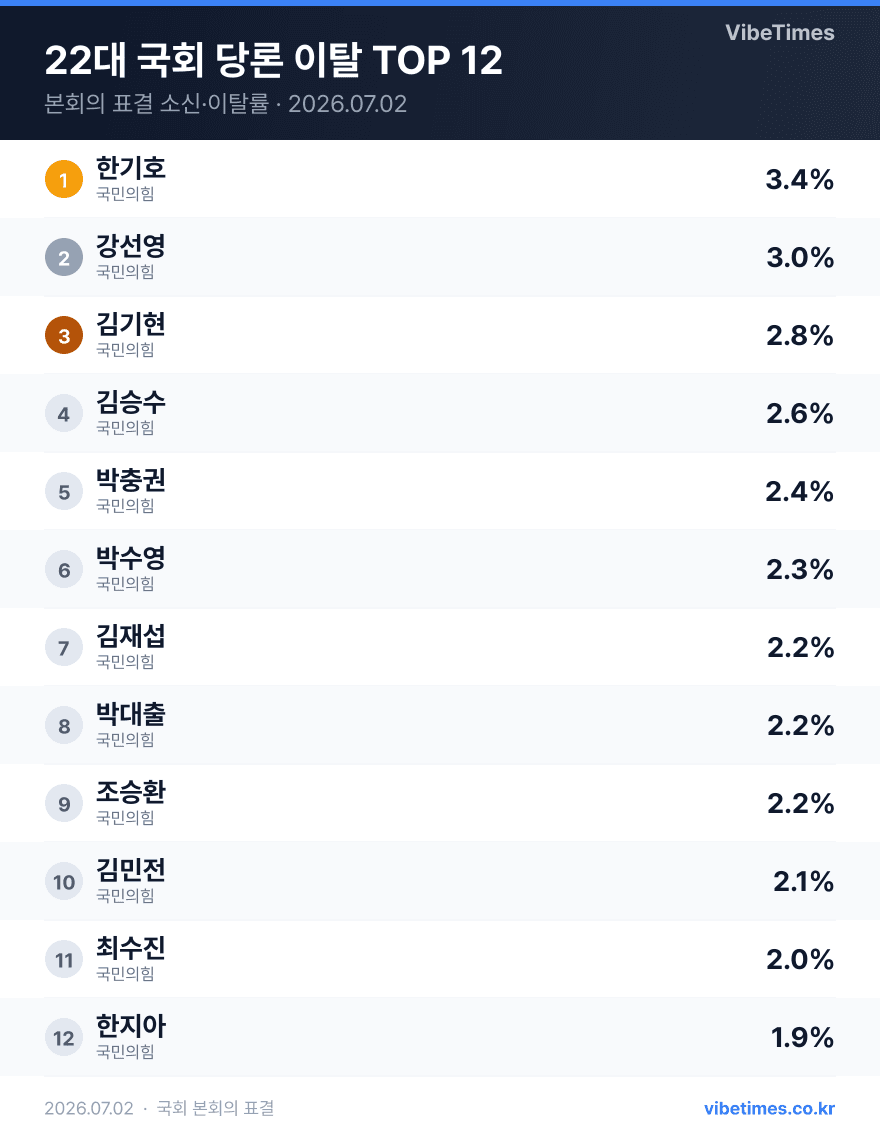
Analysis of National Assembly Party Line Deviations: Lawmakers' Political Tendencies Through Conscientious Voting Metrics
As of July 2, 2026, analysis results on the rate of deviation from the party line during National Assembly plenary session votes – meaning voting differently from the majority stance of their affiliated party – are drawing attention. Due to the strong party discipline characteristic of Korean politics, the overall party line deviation rate is not high. However, relative rankings are interpreted as important indicators offering insight into lawmakers' individual political tendencies and convictions. Particularly among the members of the People Power Party included in the analysis, the deviation rates of top-ranked lawmakers are distributed in the low 2% range, revealing subtle differences even within these low figures.
Analysis of Top-Ranked Lawmakers Deviating from Party Line and Their Figures
Representative Han Ki-ho (People Power Party) recorded the highest party line deviation rate at 3.4%, ranking first. This is the highest figure among the analyzed lawmakers, signifying that he has most frequently made choices contrary to the party's official stance. Following him, Representative Kang Sun-young (People Power Party) ranked second with a 3.0% deviation rate, and Representative Kim Ki-hyun (People Power Party) ranked third with 2.8%. While the absolute figures for these top-ranked lawmakers are low, they are analyzed as being relatively more likely to voice opinions differing from the party's overall direction.
From 4th to 10th place, Representatives Kim Seung-soo, Park Choong-kwon, Park Soo-young, Kim Jae-sup, Park Dae-chul, Jo Seung-hwan, and Kim Min-jeon (all People Power Party) followed, recording deviation rates between 2.0% and 2.6%. Notably, Representatives Kim Jae-sup, Park Dae-chul, and Jo Seung-hwan tied at 2.2% for 7th to 9th place, while Representative Kim Min-jeon registered 2.1% for 10th place, showing very close figures. These numbers suggest that a significant number of lawmakers largely agree with the party line but make individual decisions on certain issues.
Subsequently, Representative Choi Soo-jin (People Power Party) recorded a 2.0% deviation rate at 11th place, and Representative Han Ji-ah (People Power Party) registered 1.9% at 12th place, showing low deviation rates in the late 1% to early 2% range. These lawmakers belong to the group with the smallest divergence from the party line, indicating a tendency to relatively faithfully follow the party's decisions.
Political Meaning and Implications of Party Line Deviation Rates
These party line deviation rate data hold meanings beyond mere numbers. First, they serve a significant role as 'conscientious voting indicators.' In the Korean political system, where parties have strong hierarchies and discipline, actions that go against the party line can impose political burdens on individual lawmakers. Nevertheless, the rate at which they make choices different from the party line serves as a clue showing whether that lawmaker prioritizes their political beliefs, their constituency's interests, or their policy judgment more highly.
In particular, lawmakers who placed high on this survey can be interpreted as those within the People Power Party who are relatively unafraid to voice their opinions or who often hold different views from the party's stance on specific issues. For example, Representative Kim Ki-hyun has a history of strongly asserting his convictions in major party debates, suggesting that this result aligns with his political trajectory.
Furthermore, the fact that the party line deviation rates are low itself testifies to the rigidity of Korean politics. It demonstrates how much individual judgment is reserved in the face of the party's 'collective decision,' paradoxically highlighting the power of the party-centric decision-making structure. Consequently, even a 0.1 percentage point difference gains significance within the low deviation rates of 1-2%.
Such analysis can be usefully applied in understanding the political standing of each lawmaker in major election campaigns like general or presidential elections. Lawmakers who frequently deviate from the party line may be perceived as 'principled politicians' by their supporters, but they can also be seen as 'discordant elements' by party leadership or mainstream lawmakers. Conversely, lawmakers who strictly adhere to the party line can solidify their internal party base but also risk being evaluated as insensitive to change.
Market and Industry Impact, and Future Outlook
The direct, immediate impact of party line deviation data on economic markets or specific industries may be limited. However, it can be indirectly linked to political stability and predictability. High adherence to party lines enhances policy implementation consistency, acting as a factor that provides predictability to market participants. Conversely, frequent party line deviations increase uncertainty in the policy-making process, which can negatively affect investment sentiment.
That said, this analysis focuses on individual lawmakers' deviation rates and may not be directly related to the passage of major legislation. Nevertheless, understanding individual lawmakers' political tendencies serves as an important clue for predicting shifts in the political landscape and policy directions in the long term. For instance, it is necessary to pay close attention to how the individual stances of lawmakers with high party line deviation rates might influence future policy discussions concerning specific industry regulations or support policies.
Going forward, lawmakers' choices surrounding party lines in the National Assembly are expected to become more diverse. Beyond simple party loyalty, individual convictions, constituency specificities, and policy expertise will likely act in complex combination. This party line deviation ranking is anticipated to be utilized as a useful tool for understanding these complex political dynamics and evaluating the political influence of individual lawmakers. In particular, the possibility of 'conscientious voting' by these lawmakers acting as unexpected variables in the deliberation process of major economic policies or public welfare bills, where sharp confrontations between ruling and opposition parties are expected, cannot be ruled out.