Party Voting Cohesion Ranking: Democratic Party at 99.8%
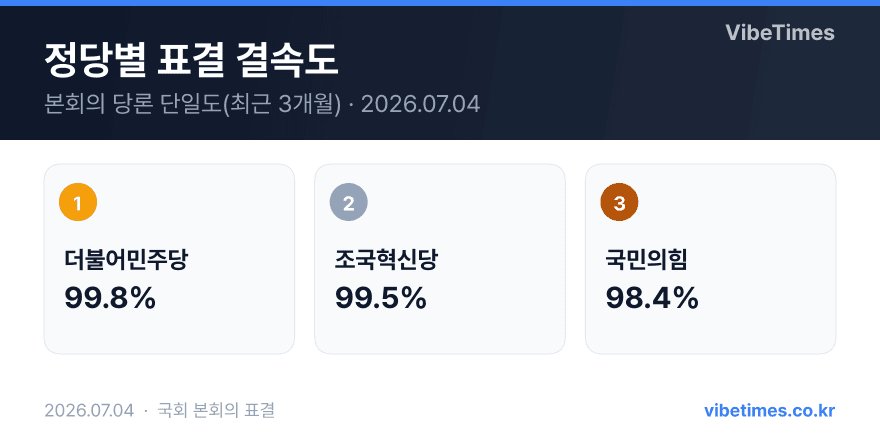
Analysis of National Assembly Voting Cohesion by Party: Democratic Party Maintains Lead at 99.8%
According to National Assembly voting cohesion data released on July 4, 2026, a clear uniformity in decision-making was evident among major political parties. This indicator, which measures how consistently members vote in the same direction during plenary sessions, considers 100% as complete unity, and is used to detect signs of division or dissent within a party. In this survey, the Democratic Party of Korea recorded an overwhelming voting cohesion of 99.8%, securing the top spot. This suggests that party lines are being firmly maintained amidst sharp inter-party confrontation.
The Democratic Party's 99.8% cohesion means its lawmakers largely acted in accordance with the party line on virtually all votes. This high figure is interpreted as a result of strong leadership from the party's central command and systematic management of its parliamentary bloc. It serves as proof that internal party disagreements have been minimized, enabling unified responses to complex legislation or sensitive political issues. This indicates that the Democratic Party's will can exert significant influence in future legislative activities or its offensives against the government in the National Assembly.
Jonguk Innovation Party Ranks Second at 99.5%... New Party Shows Solid Unity
Following closely, the Jonguk Innovation Party ranked second with a voting cohesion of 99.5%, demonstrating a remarkably high level of internal party unity despite being a newly established party. For a party with a relatively short history as of 2026, maintaining such high cohesion is a notable achievement. It shows that members' strong sense of shared identity and support for the party's vision and policies, along with the value of 'unity' emphasized since its inception, are effectively being implemented in its decision-making processes.
The Jonguk Innovation Party's 99.5% cohesion can be seen as a result of effective organizational management and parliamentary control, based on its core support base. In particular, it occupies an advantageous position for strengthening the party's identity and consistently pursuing specific policy directions. This can serve as a driving force to articulate a clear voice on specific issues within the legislature and further solidify support base cohesion. However, it is also possible that such high cohesion could at times pose limitations in embracing diverse opinions. Continuous efforts to reflect the voices of various demographics will also be required.
People Power Party at 98.4% Cohesion... Internal Dynamics and Potential for Disagreement
The People Power Party ranked third with a voting cohesion of 98.4%. While still a very high figure, it is slightly lower compared to the top two parties. The 98.4% figure signifies adherence to the party line on most votes, but the 1.6% difference suggests the existence of internal dynamics and potential disagreements that are unavoidable for a major party based on a broad spectrum of voters. This indicates that the party leadership may need to invest relatively more effort in coordinating various factions and opinions.
The People Power Party's 98.4% cohesion could reflect policy flexibility aimed at winning over centrist voters and attempts to integrate diverse voices within the party. As the ruling party responsible for national administration, individual lawmakers may have more leeway to express personal convictions that differ from the party line. This situation could positively contribute to improving policy completeness and reflecting diverse public demands in the long term. However, it also implies a potential for slowing down rapid decision-making or resolute implementation of party directives.
Voting Cohesion Data Implies Implications for National Assembly Operations and Political Landscape
This voting cohesion data offers significant insights into each party's current operational methods and future political trajectories. The high cohesion exceeding 99% for the Democratic Party of Korea and the Jonguk Innovation Party signifies that these parties possess strong centralized decision-making systems or a very strong internal unity towards common goals. This increases the likelihood of their positions appearing more firm and consistent during National Assembly deliberations. They are expected to exhibit rapid and decisive movements, centered on party lines, in passing specific legislation or pursuing policies.
In contrast, the People Power Party's 98.4% cohesion reflects the complexities of managing national administrative responsibilities and a broad support base as the ruling party. The minor rifts that inevitably arise during the process of gathering diverse opinions could also be interpreted as an emphasis on democratic procedures and debate. However, it is noteworthy to observe how these relative differences in cohesion will play out in future negotiations or voting processes within the National Assembly. The level of cohesion displayed by each party provides voters with important criteria for judging a party's stability, leadership effectiveness, and democratic decision-making processes. Close observation of the trend in each party's cohesion level moving forward will be essential for understanding political dynamics.