Reps. Yoon Jun-byeong, Min Hyoung-bae, Lee Soo-jin Lead 22nd National Assembly Bill Proposals

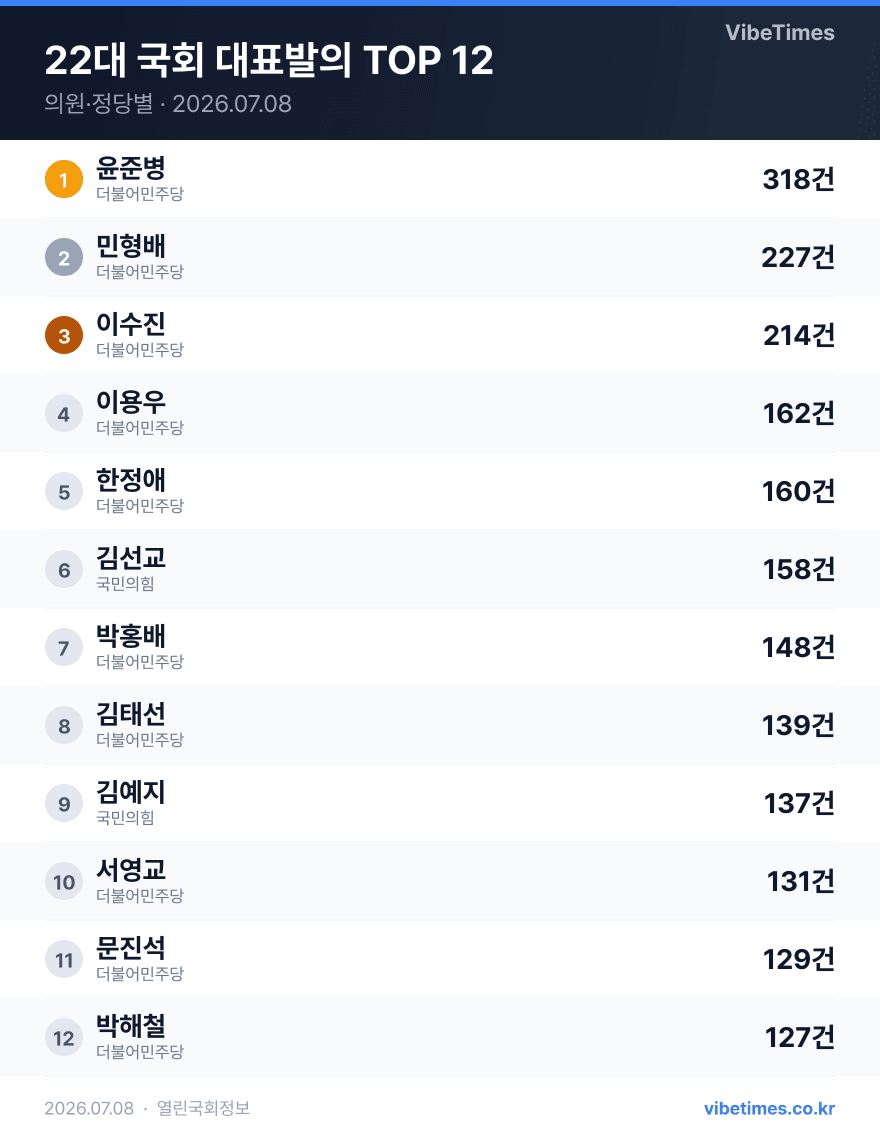
Democratic Party Dominates Legislative Activity in Top Ranks of 22nd National Assembly
As of July 8, 2026, Rep. Yoon Jun-byeong of the Democratic Party claimed the top spot in the 22nd National Assembly by sponsoring 318 bills. He was followed by fellow party member Rep. Min Hyoung-bae with 227 bills, and Rep. Lee Soo-jin recorded 214 bills to take third place. Among the top 12, only two were from the People Power Party: Reps. Kim Seon-kyo and Kim Ye-ji. The remaining 10 seats were occupied entirely by Democratic Party members, demonstrating an overwhelming volume of legislative initiatives. Ranks four through nine were tallied as follows: Rep. Lee Yong-woo (162 bills), Rep. Han Jeong-ae (160 bills), Rep. Kim Seon-kyo (158 bills), Rep. Park Hong-bae (148 bills), and Rep. Kim Tae-seon (139 bills). In the lower tier, ranks 10 to 12 saw Seo Young-kyo (131 bills), Moon Jin-shik (129 bills), and Park Hae-chul (127 bills), respectively.
Political Implications of Bill Proposals Based on Ranking Data
The most distinct feature of the statistical data is the disparity in legislative volume between the ruling and opposition parties. The opposition Democratic Party holds an 83% share of the top 12 spots, firmly grasping the initiative in bill proposals. The 318 bills proposed by top-ranking Rep. Yoon Jun-byeong mark a significant gap of 91 bills compared to the second-place finisher. For the ruling People Power Party, Rep. Kim Seon-kyo achieved the highest ranking at 6th place with 158 sponsored bills. Analysis of the figures suggests that rather than mere political propaganda by specific parties or individuals, these moves represent strategic steps intended to drive institutional change.
An analysis of the bills sponsored by top-ranking lawmakers indicates a primary focus on economic democracy, livelihood stability, and fair competition. Economic regulation bills and market restructuring laws, often proposed by opposition lawmakers, alter corporate business environments and sector-specific investment sentiment in the stock market. Even before passage, the market uses these legislative attempts as investment indicators. In particular, key deregulation or tax reform laws intended by top-ranking lawmakers serve as catalysts to boost valuations in relevant industries.
Impact of Majority Party's Bill Proposals on Industry and Capital Markets
Bill proposals by the main opposition party serve as a leading indicator for gauging the flow of investment capital. Since the first opposition party holds a majority of seats, the flood of economic bills directly impacts corporate earnings. Even before these bills are referred to the plenary session, stock market participants analyze the vast legislative roadmap—exceeding 300 proposals—to reallocate their investment portfolios.
When bills proposing tighter regulations or labor changes are introduced, capital flees quickly due to concerns over rising operating costs. Conversely, bills focusing on government subsidies or tax benefits induce immediate capital inflows. The bills sponsored by Reps. Yoon Jun-byeong, Min Hyoung-bae, and Lee Soo-jin, who hold the top three spots, possess the potential to reshape the real economy. Lawmakers who actively design economic sector bills wield proportionally greater influence over capital markets.
Legislative Stability and Market Outlook Based on Regular Assembly Schedule
For a sponsored bill to become law, deliberation by the relevant National Assembly committee and political consensus between the ruling and opposition parties are essential. Nevertheless, the fact that a single lawmaker has sponsored over 300 bills serves as an important metric for gauging the future level of regulatory relaxation facing the industry. In particular, the processing speed of bills regarding key industries with high economic weight—such as semiconductors and secondary batteries—will determine the stock valuations of relevant companies.
The legislative trajectory of the Democratic Party, to which most top-ranking lawmakers belong, will be a key factor in determining core investment themes for the latter half of the parliamentary session. As legislative competition led by the main opposition party continues, the capital market must meticulously analyze the weekly stream of bills to identify promising industrial sectors. As bills become more refined to reduce corporate investment risk, the momentum for stock price gains in related industries is expected to strengthen.