National Assembly Data Analysis: Political Spectrum of Seven Defectors and Voting Behavior by Legislative Stage

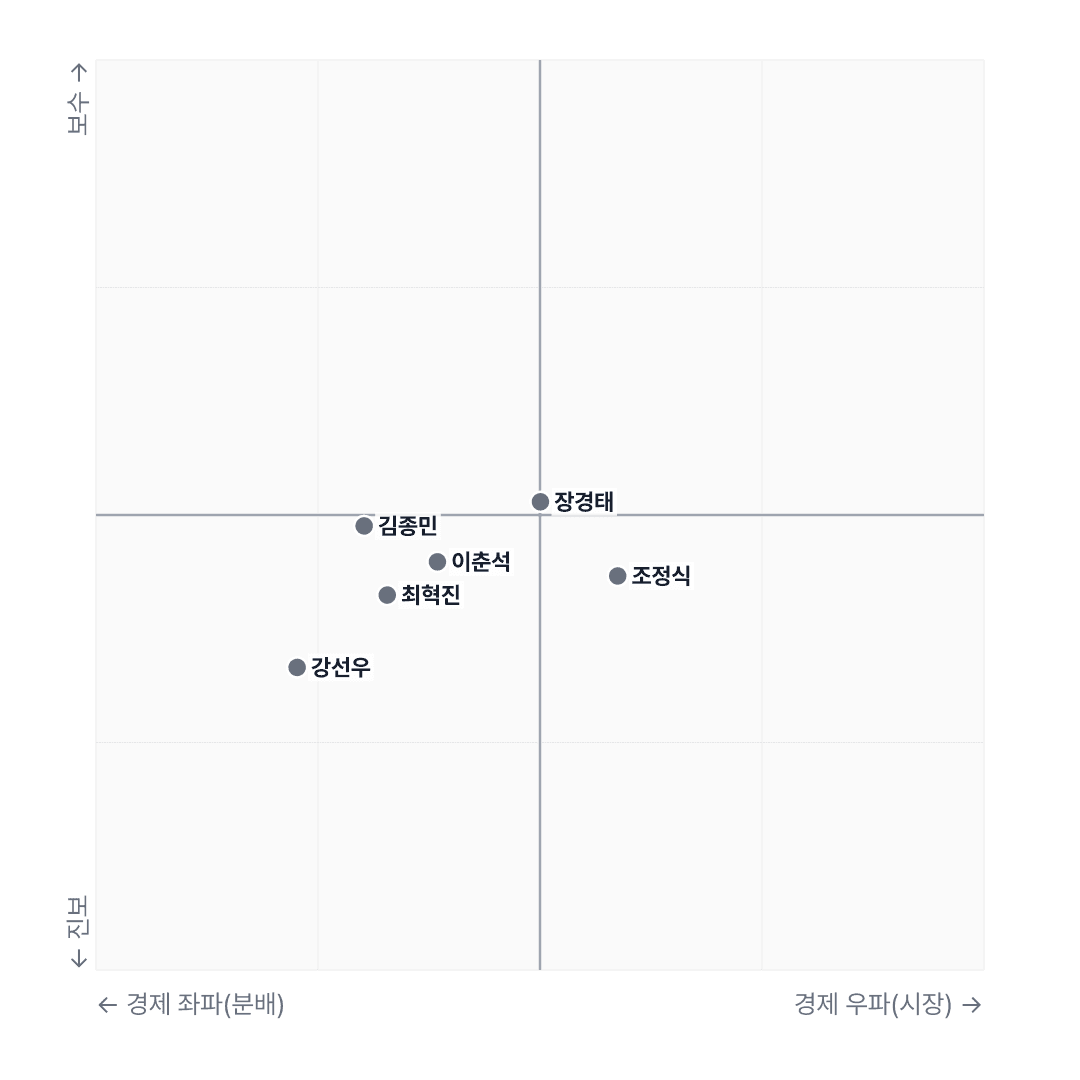
Political Spectrum of the Seven Who Left Their Parties
The political spectrum displayed by the seven independent lawmakers during the plenary voting stage spans a wide range, bridging both progressive and conservative factions. Their ideological coordinates, as they forge an independent path outside the massive two-party system, are not easily unified under a single line. In terms of the overall average, they tend to lean slightly left of center on economic issues while remaining nearly centrist on social issues. A comparison of these two axes reveals that the emphasis on economic equality is far more pronounced than any social conservatism.
A closer look at the individual lawmakers makes this heterogeneity even clearer. Based on standards such as the deregulation of the economy and industry, Rep. Kang Sun-woo holds the most progressive stance. He is followed by Reps. Kim Jong-min, Choi Hyuk-jin, and Kim Byong-gi, who share a distinctly progressive track record, standing in support of chaebol reform and market regulation. In contrast, Rep. Jo Jeong-sik is analyzed as holding a clearly conservative economic perspective within the independent group, closer to a market-friendly stance than the average economic policy platform of the major parties. Rep. Jang Gyeong-tae falls in the center on the economic axis, while Rep. Lee Choon-seok shows only a slight progressive lean. Rep. Kim Byong-gi, while belonging to the progressive camp on economic issues, simultaneously holds a more conservative view on social matters, meaning his political footing is not fixed to a specific faction.
Independent Actions Revealed by Frequency of Deviation from Party Lines
A deeper dive into their voting data reveals that the lack of party affiliation does not equate to perfect neutrality or abstention. Rather, the rate at which they vote against or in favor of bills despite the official stance of a specific party—known as the frequency of deviating from the party line—serves as a key indicator revealing their true political colors. These figures, based solely on voting records, have an inherent limitation in that they may differ from the public's past image of certain lawmakers or the sentiment of their constituencies.
According to the data, Rep. Choi Hyuk-jin maintains an overwhelming independent path, making choices different from the major parties' party lines in 80% of votes. He is followed by Reps. Lee Choon-seok and Jang Gyeong-tae, who recorded deviation rates of 60% each, while Rep. Kim Jong-min also actively reflected his convictions in bill voting at a level of around 50%. These deviation figures quantitatively verify their parliamentary behavior of making decisions that best align with their own ideological coordinates, stepping away from the strategic voting lines of the two major parties. The absence of party discipline or pressure, a hallmark of being independent, is a core factor maximizing volatility in bill voting.
Implications for Market Influence and Industry Oversight
The phenomenon of independent lawmakers distributed across the political spectrum while maintaining a high level of independent voting is expected to form a significant cross-pressure zone in the National Assembly’s future economic and industrial legislative processes. This is because the votes of these seven independents are likely to act as a swing vote on key economic bills or regulatory overhaul proposals where the two parties struggle to achieve unanimity. In particular, on economic issues such as corporate regulations and labor market reforms, how much more pro-business or anti-business these independents are compared to party-affiliated lawmakers will be a key variable determining voting outcomes.
Furthermore, the potential for conflicts of interest related to the industries overseen by the standing committees to which these independents belong warrants scrutiny. If an independent lawmaker on a committee dealing with a specific economic sector holds stock in that industry or has consistently received high political donations from that field, this fact inevitably invites critical scrutiny regarding the transparency of bill voting. While this cannot be definitively labeled a violation of current law, the objective facts revealed by public data and donation records alone demand judgment from voters and the market.
Ultimately, in a parliamentary political environment where the unified voting power of the major parties is weakening, the actions of these independents, who clearly reveal their ideological spectrum, will serve as a factor increasing policy uncertainty. For economic decisions or industrial regulatory bills, it is essential for the market to closely analyze how each lawmaker's ideological coordinates align with the specific provisions of a bill right up until voting day. Corporate investors and the industry sector are at a point where they must proactively manage policy risks by tracking micro-level voting patterns while predicting these macroscopic political moves based on data.
Lawmakers Mentioned in the Article
| Lawmaker | Party | Ideology | Note |
|---|---|---|---|
| Kang Sun-woo | Independent | Economic Left · Social Progressive | In-party Left |
| Kim Jong-min | Independent | Economic Left · Social Progressive | In-party Left |
| Choi Hyuk-jin | Independent | Economic Left · Social Progressive | In-party Left |
| Lee Choon-seok | Independent | Economic Left · Social Progressive | In-party Right |
| Jang Gyeong-tae | Independent | Economic Right · Social Conservative | In-party Right |
| Jo Jeong-sik | Independent | Economic Right · Social Progressive | In-party Right |