Micron Leads Large Caps with PEG Under 1, Followed by ON Semiconductor

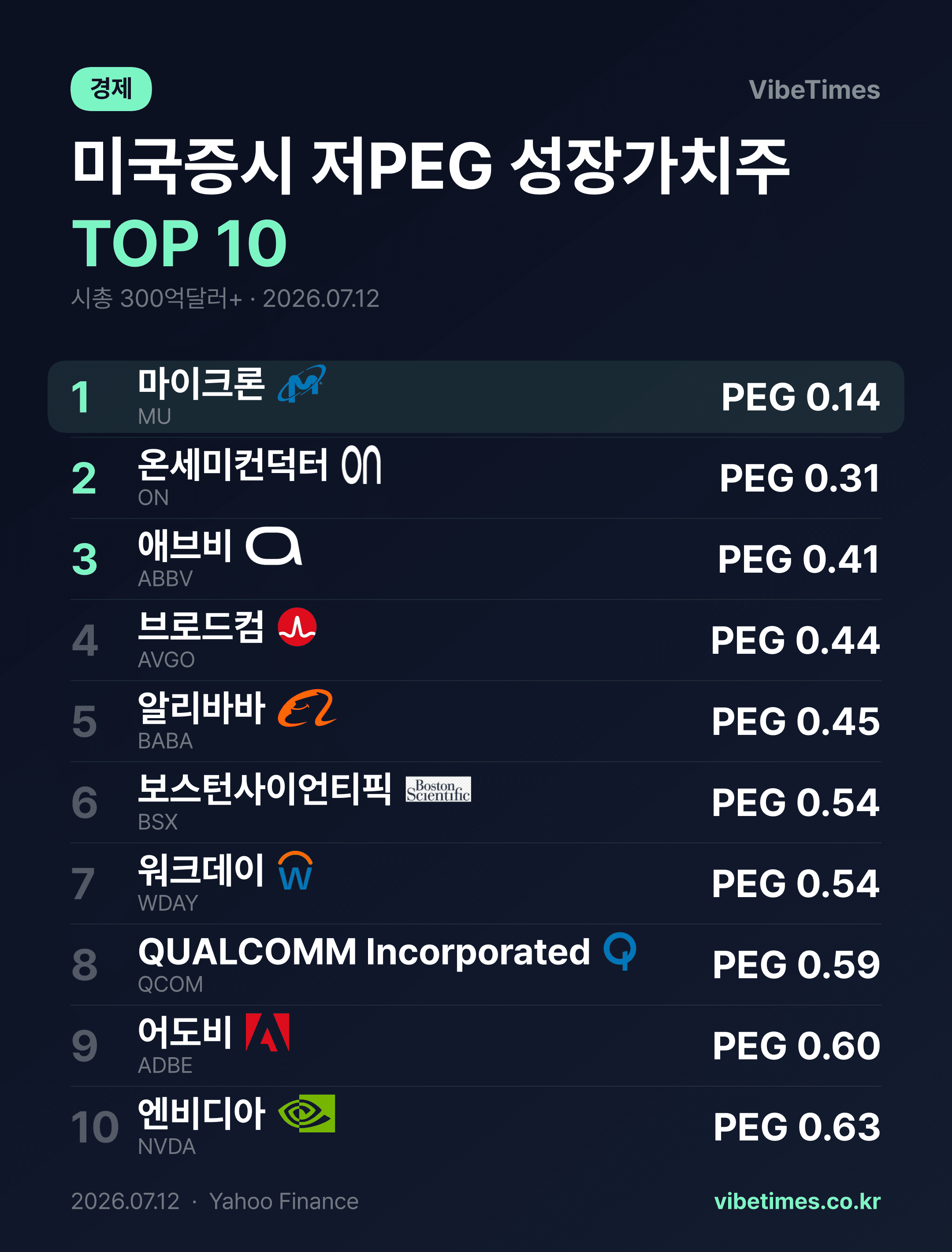
Undervalued Large Caps with PEG Under 1… Led by Semiconductors and Tech Stocks
As of July 12, 2026, companies in the U.S. market with a Price/Earnings-to-Growth (PEG) ratio below 1—a metric indicating future growth relative to the Price-to-Earnings (P/E) ratio—have emerged as undervalued growth stocks. Among the top 10 companies, Micron ranked first with a PEG of 0.14. Despite being a mega-cap with a market capitalization of $1.12 trillion, its P/E ratio stands at just 22.4x. This implies that the company's high earnings growth trajectory is not yet fully reflected in the current stock price. ON Semiconductor, ranked second, also posted a PEG of 0.31, cementing its position as an undervalued quality stock in the semiconductor sector.
The composition of the top rankings is particularly noteworthy. The top five includes key semiconductor and Artificial Intelligence (AI) companies. Broadcom took fourth place with a PEG of 0.44 and a market cap of $1.91 trillion. NVIDIA appeared in tenth place, showing a PEG of 0.63 and a P/E ratio of 31.1x. Given its ultra-large market cap of $4.91 trillion, this is interpreted to mean that the market has still not fully priced NVIDIA's earnings growth speed into its stock.
The Utility of the PEG Ratio in Targeting High P/E Ratios
Looking solely at P/E ratios, second-place ON Semiconductor’s 72.0x and third-place AbbVie’s 123.7x are by no means cheap valuations. AbbVie is a global pharmaceutical blue-chip with a market cap of $441.5 billion. However, their PEG ratios are 0.31 and 0.41, respectively. The PEG ratio divides a company's future expected earnings growth rate by its P/E ratio. A figure below 1 indicates that the company's growth rate is faster than the time it takes for the price to yield diluted earnings.
The cases of Qualcomm and Adobe are also worth noting. Qualcomm shows a PEG of 0.59 with a P/E ratio of 20.5x. It is a powerhouse in mobile and automotive semiconductors with a market cap of $201.4 billion. Adobe, with a PEG of 0.60, proves it is an undervalued software company. Recording a low P/E ratio of 12.7x, it combines the advantages of both value and growth stocks. Meanwhile, Alibaba displays a P/E ratio of 17.2x with a PEG of 0.45, vividly highlighting the undervaluation phenomenon among major Chinese tech stocks.
Outlook for Upward Earnings Revisions and Market Repricing
The large caps with a PEG under 1 highlighted in this statistics are highly likely to see continued upward adjustments in market earnings expectations. In particular, AI semiconductor demand, represented by Micron, Broadcom, and NVIDIA, is driving steep revenue growth in line with data center expansion. The low PEG ratios of these companies are not merely opportunities created by falling stock prices. They represent structural undervaluation created by actual earnings increases surpassing conservative market estimates.
Healthcare and cloud software companies like Boston Scientific and Workday also deserve attention. Boston Scientific recorded a P/E ratio of 18.8x with a PEG of 0.54. Workday achieved a PEG of 0.54 despite a somewhat high P/E ratio of 43.0x, proving strong earnings growth momentum. Ultimately, these top 10 companies are expected to be considered as key inclusion targets for investors' portfolios ahead of the corporate earnings reporting season in the second half.