Tron Tops 1-Year Returns at 7.6%, Ethereum Plunges 35.4%

Deepening Polarization in 1-Year Returns... Resilience of Tron and Monero
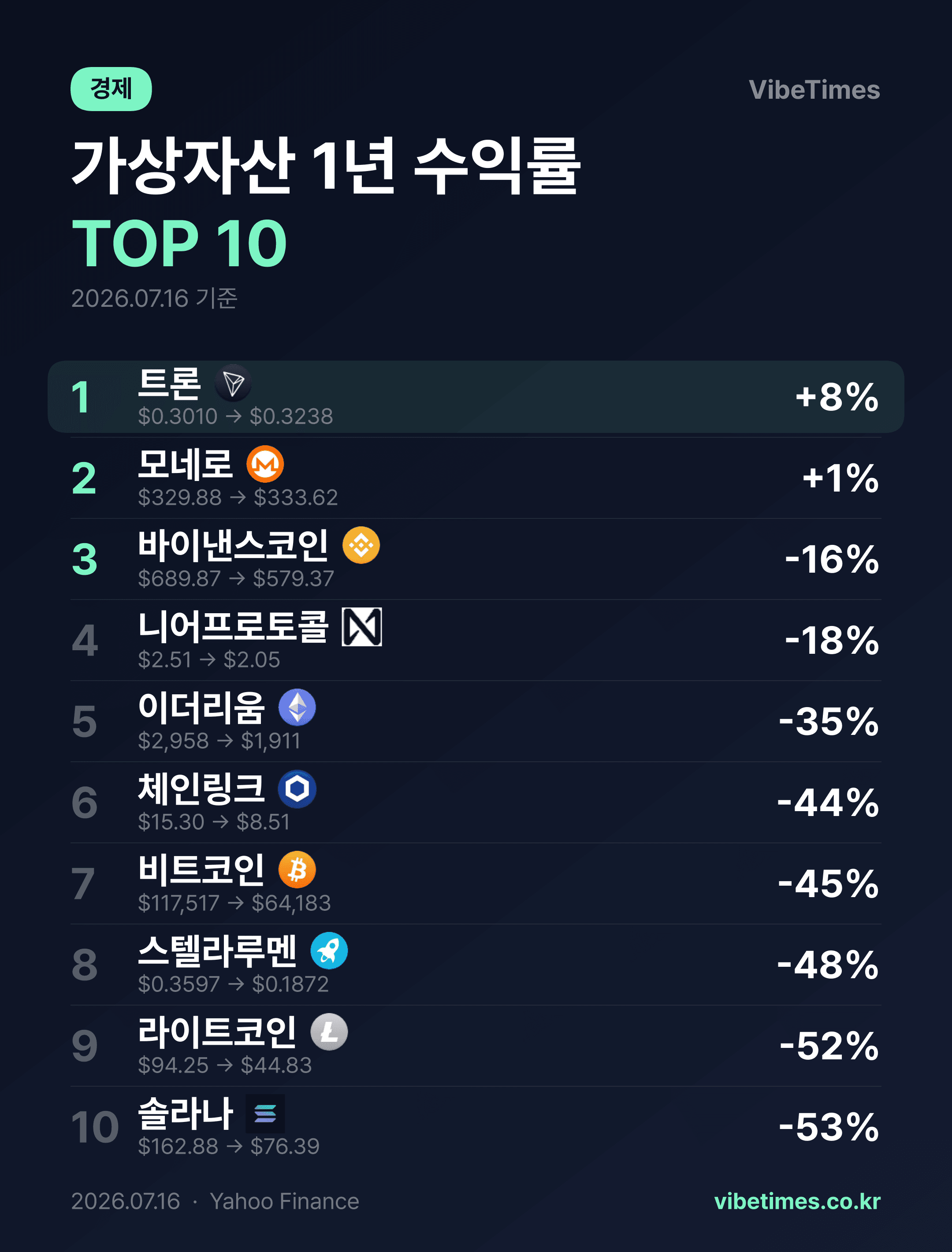
An analysis of major cryptocurrencies' 1-year returns as of July 16, 2026, reveals distinct heterogeneous trends in the market. Tron (TRX) claimed the top spot with a 7.6% return over the past year. Its price rose from $0.3010 to $0.3238, with a current market capitalization of $30.8 billion. Monero (XMR), ranked second, also successfully defended a positive return of 1.1% during the same period. Both assets defied downward price pressures in a traditionally volatile coin market, maintaining a stable upward trajectory.
In contrast, Bitcoin (BTC), a massive asset with a market cap of $1.3 trillion, fell from $117,517 a year ago to $64,183, marking a 45.4% decline. These figures serve as evidence suggesting that market capital is moving away from large-cap assets toward specific alternatives or small-cap value stocks. Although Tron and Monero have market capitalizations of $30.8 billion and $6.2 billion respectively—significantly smaller than Bitcoin—their performance indicates that investment capital is shifting toward less volatile assets as a survival strategy.
Widespread Decline in Large-Cap Altcoins and Capital Flight
The decline becomes starkly evident among major coins below the top rank. Binance Coin (BNB) fell 16.0% to $579.37, while Near Protocol (NEAR) dropped 18.4% to $2.05. The decline in Ethereum (ETH) is particularly noticeable. Its price fell from $2,958 to $1,911, resulting in a staggering negative return of 35.4%. Despite Ethereum's massive market capitalization of $231.7 billion, the drop is interpreted as the result of selling pressure amid stagnating network utilization and fee revenue.
Chainlink (LINK) and Stellar (XLM) also suffered value drops of 44.4% and 48.0%, respectively. The decline is even steeper in the lower ranks. Litecoin (LTC) plunged 52.4%, and Solana (SOL) dropped 53.1%. In particular, Solana's price was nearly halved, falling from $162.88 to $76.39, yet its market capitalization remains at $45 billion. This implies that despite the sharp price decline from its peak, a significant amount of capital remains locked in the market. This is the result of supply and demand failing to materialize as network activity fell short of expectations.
Structural Market Changes and Future Investment Implications
This ranking of 1-year returns highlights a clear paradigm shift in the cryptocurrency market. While large assets like Bitcoin and Ethereum previously dictated the market's overall direction, the past year has shown a stark divergence in resilience between assets. Tron and Monero maintaining positive territory is attributed to their unique ecosystem utilities functioning effectively during the crisis. Tron's stability is backed by consistent demand for payments driven by fast transfers and low fees, while Monero's strong privacy features are seen to have functioned as a means of asset protection for certain investor classes.
The widespread decline in large assets reflects a broad risk-averse sentiment in the market. The phenomenon where specific assets hold value while Bitcoin and Solana show drops of over 45% signifies a selective concentration of market funds. Investors are increasingly rebalancing their portfolios toward assets with clear technical utility rather than simply holding large-cap assets. This trend is unlikely to reverse easily solely through a short-term improvement in investment sentiment.
Looking ahead, the cryptocurrency market is expected to see deepening polarization centered on assets that prove their real network value and cash flow. Large platform assets like Ethereum and Solana will likely require fundamental catalysts, such as DeFi activation within their ecosystems or governance reforms. In particular, market-wide volatility is likely to persist until Bitcoin can escape the impacts of persistent inflation concerns and macroeconomic liquidity contraction. Investors are at a stage where they must maintain a conservative investment strategy based on an asset's intrinsic viability and tangible revenue models.