Analysis of Causes and Market Impact as July Exchange Rate Reverses to 1,489 Won

Reversal of 4-Month Rising Trend and Market Relief
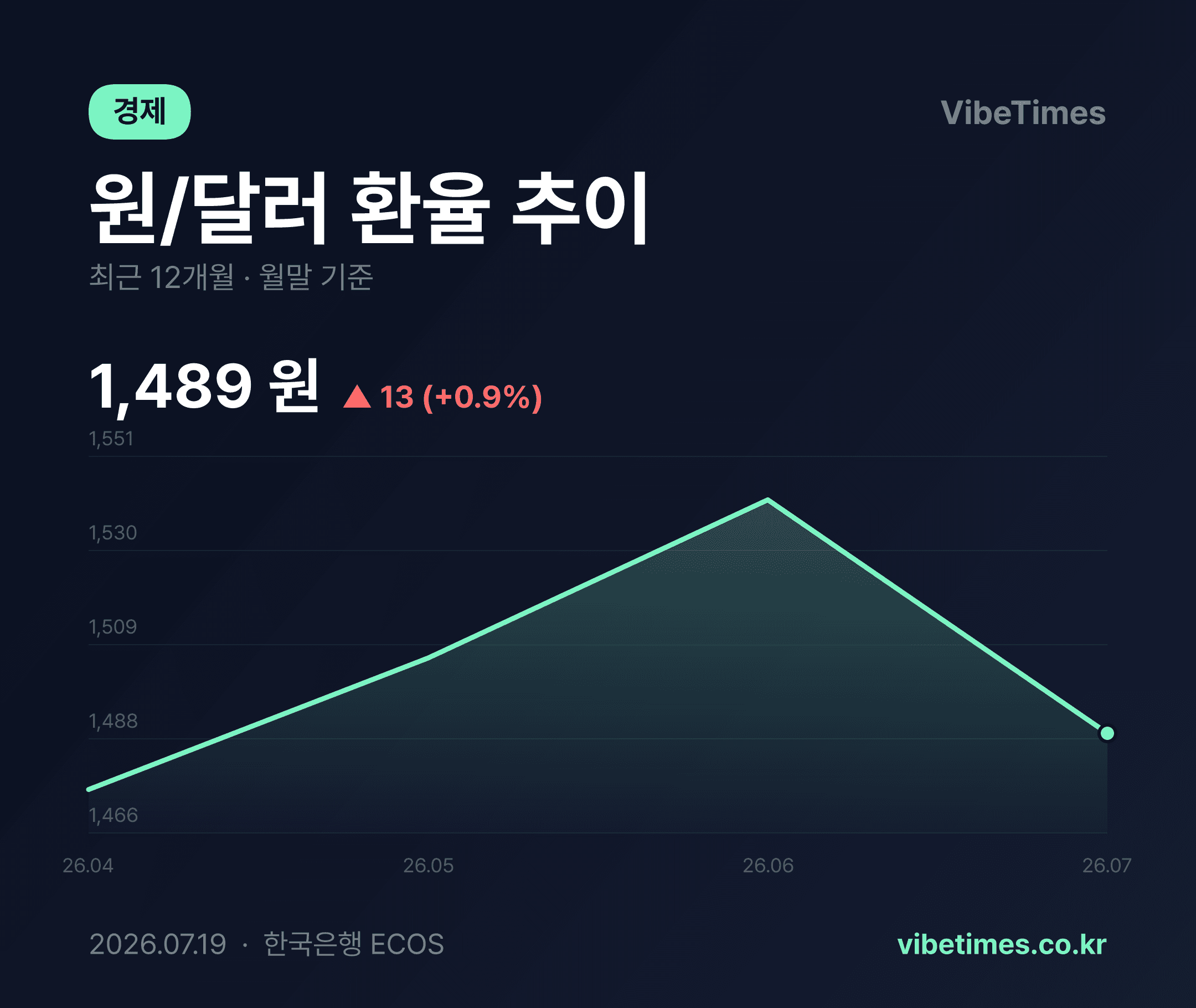
As of the end of July 2026, the Won/Dollar exchange rate recorded 1,489 Won. After rising consecutively from 1,476 Won in April to 1,506 Won in May and 1,542 Won in June, the rate turned downward in July, peaking and then falling. The macroeconomic anxiety, which had surged by 66 Won in just three months, appears to have subsided by one notch. Looking at the overall period change, the rise was limited to 13 Won, from 1,476 Won to 1,489 Won. A detailed analysis of the monthly increases clearly reveals changes in market investment sentiment.
Background of the Surge and Key Factors Behind July's Peak Reversal
The sharp weakness of the Won in May and June was largely due to structural instability in the global macroeconomy. As the U.S. Federal Reserve's high-interest rate policy prolonged, international investment funds predominantly flocked to dollar assets. During this process, capital outflows from the Korean market, classified as an emerging market, accelerated, causing the value of the Won to plummet rapidly. This was the background for the exchange rate soaring to 1,542 Won in June.
However, the trend has reversed in July. Statistics showing that U.S. consumer price inflation came in below expectations led to a strong weakening of the dollar. According to the Bank of Korea, the fact that inflation indicators are being managed stably served as a decisive catalyst for easing investors' risk-averse sentiment. Reflecting market expectations for a benchmark interest rate cut, increased sell-offs of the dollar resulted in the exchange rate recovering to the 1,489 Won level, down 53 Won. It is analyzed that the downward pressure that weighed heavily in May and June has at least concluded for now.
Changes in Export Profitability and Impact on the Domestic Stock Market
The shift in the exchange rate direction has a direct impact on Korea's export-oriented macroeconomy and capital markets. Generally, until June when the Won/Dollar rate fluctuated around 1,520 Won, major export companies such as semiconductors and automobiles were able to expect performance improvements by recording foreign exchange gains. However, with the adjustment to 1,489 Won in July, the possibility of massive foreign exchange gains diminishing has grown. This is because when the exchange rate falls, the scale of revenue and operating profit recognized when converting export proceeds into Won decreases accordingly.
While the trend of Won appreciation raises concerns about deteriorating profitability, it simultaneously brings the positive effect of reducing raw material import costs. As international raw material prices, such as dollar-denominated oil prices and steel, stabilize, a synergy occurs where the overall price burden on the manufacturing industry is alleviated.
The capital flow in the stock market is also changing. During the rise when the dollar was strong, foreign investors withdrawing from the Korean stock market was evident. Conversely, in July, as the exchange rate stabilized, a net inflow of foreign investment was detected. This can be confirmed in recent meta-investment indicators by market formation bodies. Won appreciation has the effect of increasing asset values, serving as a structural background for foreign capital to perceive price attractiveness and flow in.
Future Exchange Rate Outlook and Investment Implications
In the short term, the Won/Dollar exchange rate is expected to move sideways in a box range between 1,480 Won and 1,500 Won. There is a high possibility that large-scale one-sided capital movement will be limited until the detailed direction of U.S. interest rate policy is clearly established. The fact that Korea's trade balance has recorded a surplus for several consecutive months and remains fundamentally stable also acts as a strong defense line against a sharp exchange rate rise.
In conclusion, the implication of this statistic is clear. The fear of a sharp weakening of the Won has been largely resolved as of July. Market participants should interpret this rebound flow not as a simple temporary phenomenon, but as a signal of structural change leading to overall price stability in the macroeconomy. Going forward, an approach from a long-term perspective based on corporate fundamentals and value appreciation is required, rather than investment relying on one-off foreign exchange gains depending on exchange rate fluctuations.