10-Year Treasury Bond Yield Rises to 4.30% for 4th Straight Month... Interest Rates and Inflation as Key Variables

Four-Month Rally and the Pace of Rate Increases
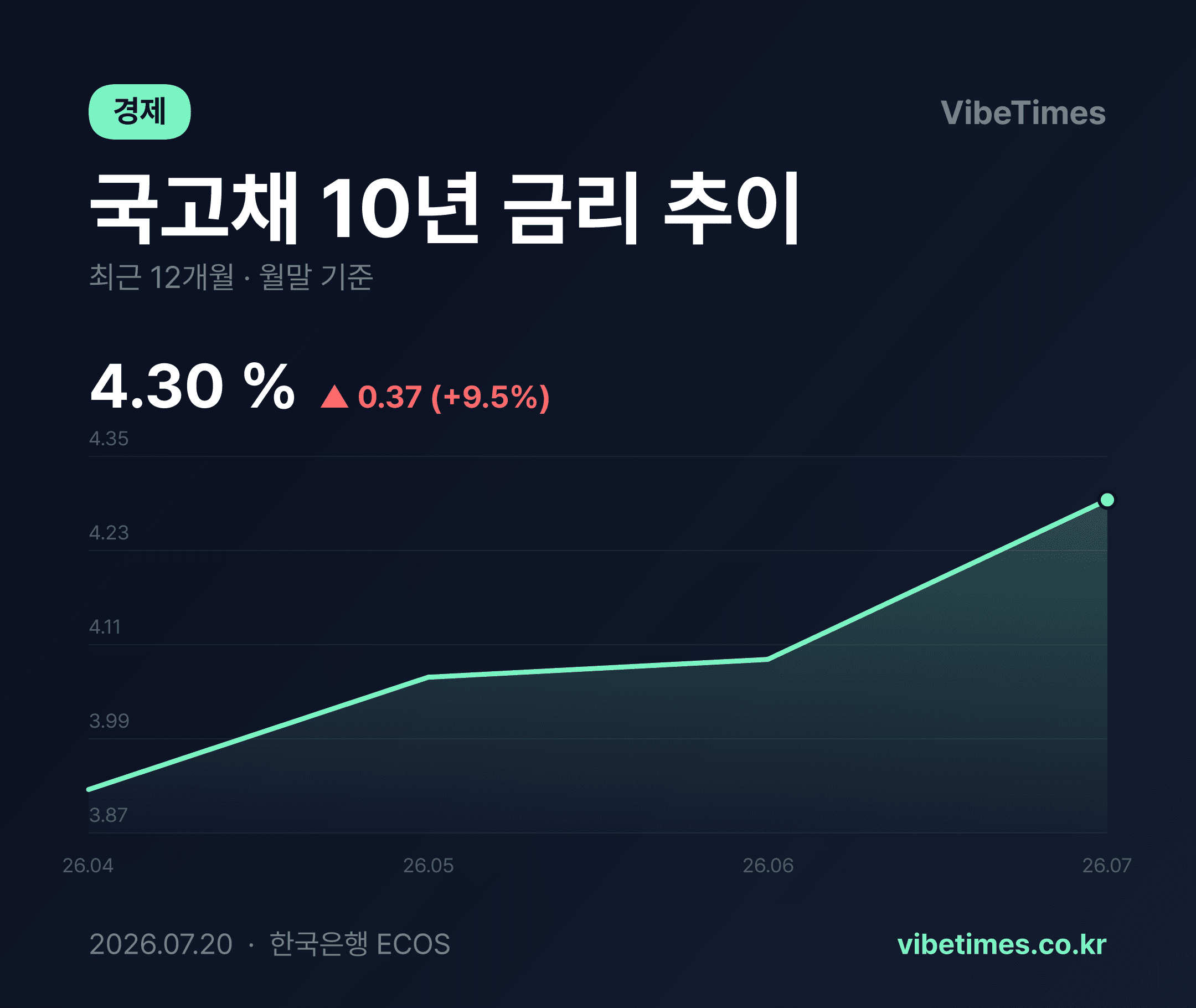
In July 2026, the yield on South Korea's 10-year Treasury bond recorded 4.30%. This marks a surge of 0.37 percentage points in just three months from 3.92% in April. Looking at the monthly changes, the yield entered a full-fledged upward curve in May, rising by 0.15 percentage points. Although it appeared to make a minor adjustment of 0.02 percentage points in June, it rebounded by an additional 0.21 percentage points in July. Notably, July's rise was the largest among the changes seen over the four-month period. The graph showing long-term interest rates rising sharply over a short period signals a distinct shift in market capital flows.
Inflationary Pressures and Central Bank Monetary Policy
The sustained rise in long-term interest rates is interpreted primarily as an indicator reflecting price instability. With the consumer price inflation rate exceeding the central bank's 2% target, market participants anticipate continued high inflation. This phenomenon has led to rising costs of capital. As interest rates rise, companies reduce facility investments and households scale back borrowing. The dampening of investment sentiment acts as a factor threatening the growth momentum of the real economy. Ultimately, market interest rates have raised their own defensive line to defend against the depreciation of currency value.
The Bank of Korea's stringent monetary policy also serves as a core driver encouraging the rise in government bond yields. This reflects market expectations that the benchmark interest rate will remain elevated for an extended period to curb inflation. The policy direction of the U.S. Federal Reserve is also a significant external variable that cannot be ignored. As major central banks refrain from cutting rates, international capital is flocking to higher-yielding safe assets, which has also lifted South Korean Treasury bond yields. The supply-demand imbalance in the bond market is dealing a direct blow to yield pricing.
Impacts by Industry and Future Investment Implications
Capital-intensive industries are prone to direct hits from rising interest rates. In particular, construction and infrastructure companies with high debt ratios face inevitable profitability deterioration as interest expense burdens surge. Conversely, the financial sector, including banks, stands in an environment where performance improvements are expected due to widening loan margins. In the stock market, growth stocks are facing downward pressure on their valuations due to high interest rates. It is predicted that investment flows will shift toward large-cap quality stocks with superior financial flexibility as safe havens.
The slowdown in the real estate market is also analyzed as a direct result of rising interest rates. This is because the surge in mortgage interest rates is dampening the purchasing sentiment of actual buyers. Going forward, the bond market is expected to experience fluctuations depending on inflation indicators and shifts in the central bank's stance. The long-term interest rate, often called the 'temperature' of the macroeconomy, is likely to fluctuate in the low 4% range. Investors are now at a point where they must focus entirely on risk management in an environment of expanded market volatility.