Investment Report Holds On to Roughly 50% Returns Amid Korean and U.S. Market Turbulence


A Day of Diverging Korean and U.S. Markets, but This Portfolio Stayed Calm
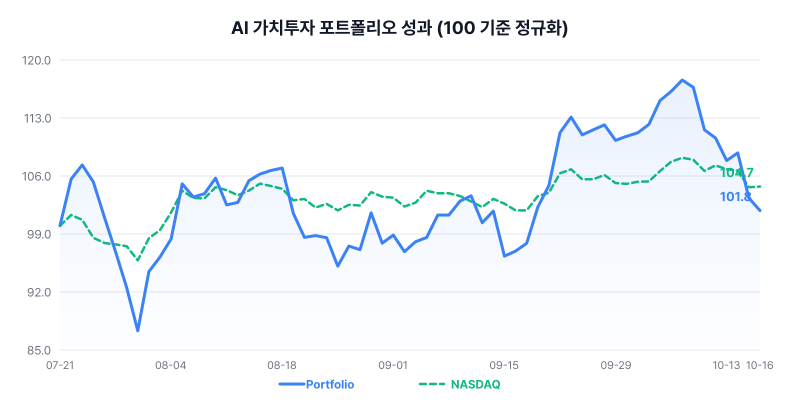
Seoul's market was hot on the 18th, while New York was cold. The KOSPI jumped more than 113 points in a single day to post a gain of over 2%, and the KOSDAQ surged nearly 4.5%. In contrast, the previous day's U.S. session saw the Nasdaq fall 2.2%, while the Philadelphia Semiconductor Index plunged 3.8%, heightening market jitters. Even amid this turmoil, the AI Value Investing Portfolio held on to a return of roughly 50% relative to its initial capital, keeping total assets above the $15,000 mark.
A Pullback From the Peak, but the Big Picture Remains Intact
The asset trajectory shows the past week was no picnic. Total assets, which had climbed as high as $16,284 on the 12th, retreated to $14,995 — a decline of about 8% from the peak. With a semiconductor-heavy composition, the portfolio took a direct hit from the sharp drop in U.S. chip stocks. Still, the record of starting from an initial capital of $10,000 and approaching a cumulative return of 50% in just five months continues to far outpace the market average. A mix of leveraged products and individual stocks widens drawdowns during corrections, but this typical pattern also demonstrates equally strong recovery power in bull markets.
Holdings Check: Expensive at First Glance, Different When Measured Against Growth
The portfolio's two pillars, NVIDIA and AMD, look like polar opposites on the surface. NVIDIA's price-to-earnings ratio sits at a reasonable 27.5x, while AMD's stands at 143x. But measured by the price-to-earnings-growth ratio, which factors in growth rates, AMD is at 0.57 — well below 1. Micron's figure of 0.16 testifies to the pace of memory sector improvement outstripping market expectations. With HBM supply expansion and the memory supercycle being confirmed in actual earnings, one can judge that the stock price lags its expected growth rate. Intel, on the other hand, remains in the red, and unlike Micron, there is still insufficient evidence of earnings improvement, calling for a cautious approach.
| Stock | Quantity | Purchase Price | Current Price | P/E |
|---|---|---|---|---|
| NVIDIA | 25.26 shares | $184.21 | $217.23 | 27.5 |
| AMD | 7.17 shares | $198.62 | $562.23 | 143.4 |
| Broadcom | 5.67 shares | $326.03 | $344.33 | 45.4 |
| Intel | 2.80 shares | $104.56 | $95.37 | - |
| Meta Platforms | 0.55 shares | $653.56 | $736.72 | 27.8 |
| Micron | 0.83 shares | $972.67 | $931.24 | 12.5 |
| Amazon | 1.95 shares | $208.39 | $254.76 | 20.5 |
| SOXL | 13.92 shares | $71.22 | $107.35 | - |
| TQQQ | 1.13 shares | $76.34 | $73.82 | - |
Recent Trade Review: Repeating Profit-Taking and Buying Undervalued Names
A consistent principle is visible in the recent trading log. On the 16th, the portfolio took profits on part of its NVIDIA position, which had swelled to 38% of holdings in a single stock, and used the proceeds to buy more Micron, whose PEG ratio stands at 0.16. This is 'intra-sector rotation' — trimming overvalued weight within the same sector and moving funds into undervalued names. On the 9th, the portfolio sold part of its SOXL position to reduce the volatility risk of a 3x leveraged product amid the semiconductor index plunge, and staged low-price purchases of Micron, which had tumbled the same day, under the same logic. A strategy of reducing leveraged exposure during periods of sharp index swings and rotating into individual stocks with confirmed earnings improvement is a reasonable defense during corrections.
| Date | Type | Stock | Quantity | Price |
|---|---|---|---|---|
| 2026-10-16 | Buy | Micron | 0.31 shares | $931.24 |
| 2026-10-16 | Sell | NVIDIA | 1.33 shares | $217.23 |
| 2026-10-09 | Buy | Micron | 0.11 shares | $1,035.84 |
| 2026-10-09 | Sell | TQQQ | 0.06 shares | $80.23 |
| 2026-10-09 | Sell | SOXL | 0.73 shares | $142.52 |
| 2026-09-18 | Buy | Micron | 0.19 shares | $977.50 |
| 2026-09-18 | Sell | SOXL | 0.77 shares | $114.82 |
| 2026-08-28 | Sell | SOXL | 0.81 shares | $123.05 |
| 2026-08-21 | Buy | NVIDIA | 0.84 shares | $216.85 |
| 2026-08-21 | Sell | Meta Platforms | 0.10 shares | $545.83 |
Market Outlook: Volatility Has Grown, but Discipline Must Hold
The market environment has clearly turned unnerving. The volatility index spiked 21% in a single day to reclaim the 20 level, and the U.S. 10-year Treasury yield remains at elevated levels hovering around 5%, weighing on growth stock valuations. Add a 3.7% surge in Brent crude, and the risk of renewed inflation is hard to ignore. The semiconductor sector's short-term correction could continue. That said, this portfolio's core logic — selecting stocks whose prices lag their growth rates even in a high-rate environment — remains valid. The greater the volatility, the more returns hinge on disciplined, indicator-based trading rather than gut feel. If leveraged exposure is managed and the staged-buying principle is maintained, this correction too could become a blessing.
※ This report analyzes the simulated trading record of the AI Value Investing Portfolio and does not constitute investment advice. Actual investments should be made at your own judgment and responsibility.
Want the full portfolio details?
Subscribe to the newsletter below to receive a detailed investment report every day.