Investment Report: The AI Value Portfolio's Counterattack with a 49% Cumulative Return


[Daily Market Insights] Amidst the Panic, Why Did the 'AI Value Portfolio' Choose a Spear Over a Shield?
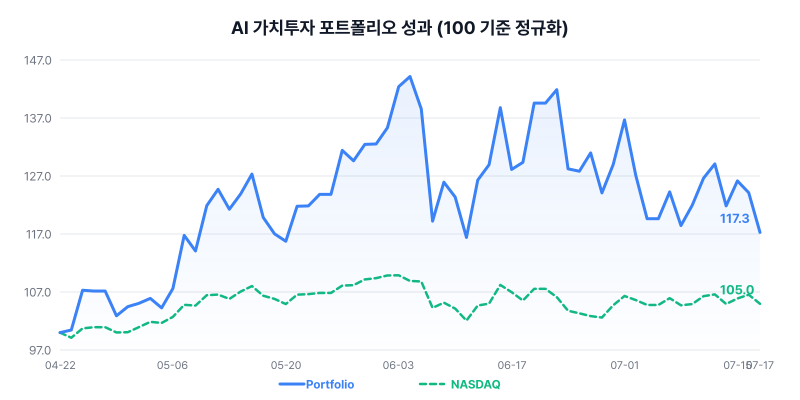
Dark clouds have simultaneously descended on both South Korean and U.S. stock markets. On July 20, 2026, the KOSPI plummeted nearly 4.5%, while the NASDAQ also fell over 1%, shaking even the defensive nature of assets like 'oil' and 'gold'. With the exchange rate recovering to the 1,480-won range and growing concerns over foreign capital outflow, the entire market is gripped by fear. However, amidst these adversities, one flame refuses to be extinguished. This portfolio, which started with an initial investment of $10,000, is currently recording a cumulative return of approximately 49%. The upward-trending graph demonstrates that the current volatility is not merely risk, but an opportunity to accumulate truly valuable technology assets at bargain prices.
The Blueprint of Growth: A Narrative of Returns
An interesting context emerges when examining asset flows over the past 5 days. After peaking at $16,400 on the 13th, assets maintained an upward trend until the 16th despite market adjustments, before some profit-taking began on the 17th. The aggressive decision to buy TQQQ on July 10th, capturing the strong momentum of NASDAQ large-caps, proved highly rewarding. Conversely, for leverage products like SOXL, the portfolio showed discipline in selling into short-term surges to wring out volatility. This is the result of 'active' management that reads market currents rather than simply following the herd.
Sleeping Giants, Awakening Value
The core holdings of this portfolio possess solid earnings and valuation appeal, independent of current market fears. Specifically, Broadcom (AVGO) and Nvidia (NVDA) remain the heart of the semiconductor industry. Nvidia, with an EPS of $6.53, maintains a PEG ratio of 0.65, suggesting the stock remains attractive relative to its growth potential. Micron (MU)'s extraordinarily low PEG ratio of 0.13 serves as proof that the market is underestimating the company's earnings recovery. Amazon (AMZN) and Meta (META) also secure a defensive character, with PER levels stable around 30x despite intense competition in ads and cloud.
| Ticker | Qty | Avg Buy Price | Cur Price | PER | Notes |
|---|---|---|---|---|---|
| AVGO (Broadcom) | 5.67 | $326.03 | $374.45 | 62.1 | High PER but PEG 0.44 reflects growth |
| AMD | 7.17 | $198.62 | $500.94 | 166.4 | Reflects high growth expectations |
| MU (Micron) | 0.25 | $996.00 | $853.20 | 19.3 | Buying undervalued opportunity (PEG 0.13) |
| NVDA (Nvidia) | 25.76 | $183.15 | $207.40 | 31.8 | Momentum: Surge in AI chip demand |
| AMZN (Amazon) | 1.95 | $208.39 | $249.89 | 29.9 | Stable valuation |
| SOXL (Semiconductors) | 16.30 | $61.36 | $142.48 | 24.2 | Additional buying and partial profit-taking |
| TQQQ (Ultra Pro QQQ) | 2.86 | $76.34 | $70.74 | 36.3 | Aggressive buy tracking NASDAQ index |
| META (Meta) | 0.89 | $653.56 | $664.54 | 24.2 | Volatility mgmt and profit-taking |
Sharpening the Edge: Recent Moves
Recent 'rebalancing' was conducted based on thorough value fundamentals rather than mere technicals. The decision to sell part of the Meta holdings on July 17th was a preemptive defensive measure to control risk, considering intensifying competition in the platform ad market. The early June decision to buy Micron (MU) at $996 might look like a short-term loss, but from a long-term perspective—entering at an overwhelmingly undervalued PEG of 0.13—it remains valid. Thus, this portfolio balances boldly only when valuations overheat or risks rise, rather than simply selling on price gains.
| Date | Type | Symbol | Qty | Price | Reason |
|---|---|---|---|---|---|
| 2026-07-17 | Sell | META | 0.047 | $664.54 | Risk control due to expanding volatility & ad competition concerns |
| 2026-07-10 | Buy | TQQQ | 2.865 | $76.34 | Capture sustained strength in tech mega-caps & NASDAQ rise |
| 2026-07-10 | Sell | SOXL | 0.858 | $192.45 | Profit-taking & volatility control after short-term surge |
| 2026-07-03 | Sell | AMZN | 0.103 | $242.67 | Profit-taking to maintain balance amid momentum |
| 2026-07-03 | Sell | META | 0.049 | $582.90 | Maintain portfolio balance after short-term surge |
| 2026-06-26 | Buy | NVDA | 1.288 | $195.74 | Valuation appeal due to AI chip demand surge & low PEG |
| 2026-06-19 | Sell | SOXL | 0.903 | $279.29 | Maintain balance & short-term profit-taking |
| 2026-06-05 | Buy | MU | 0.251 | $996.00 | Low PEG ratio, overwhelming valuation undervaluation |
| 2026-04-27 | Buy | NVDA | 0.593 | $216.61 | Aggressive weighting increase considering AI demand & low PEG |
Fear Drives Madness; Reason Seizes Opportunity
With the VIX index hovering around 18.54 and the 10-year U.S. Treasury yield adjusting to 4.541%, we are at a juncture where a flight to 'safe assets' coexists with buying opportunities in 'growth stocks.' Key variables like interest rates and exchange rates, reflecting macroeconomic uncertainty, hold the key to stock flows more than immediate index dips. However, the structural scarcity of the semiconductor sector and the profitability of the AI industry remain unchanged. By minimizing cash exposure, the current portfolio is taking a defensive stance, ready to catch stocks dropped by market participants lacking the 'endurance' to hold. A market crash is not for panic, but a time to aggressively upgrade holdings in definite value technology assets.
※ This report analyzes the simulated operation history of the AI Value Portfolio and does not constitute investment advice. Actual investment should be conducted under your own judgment and responsibility.
Want to know more about the portfolio details?
Subscribe to the newsletter below to receive detailed daily investment reports.