Democrats Emphasize Constitutional Impossibility to Quell Controversy Over Speaker's Reelection Remarks

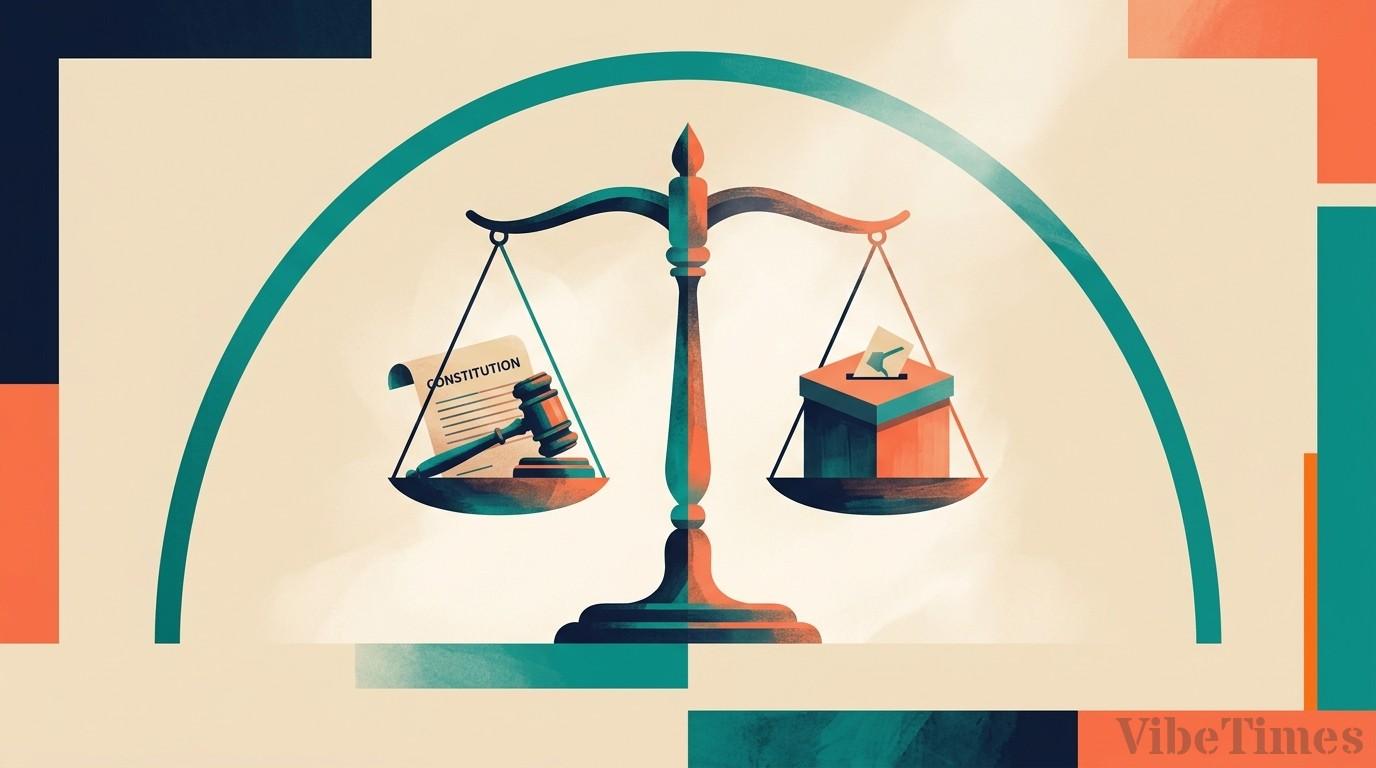
Origins and Spread of the Controversy Over Constitutional Amendment for Presidential Reelection
National Assembly Speaker Cho Jung-sik recently stated in an interview with a media outlet that "the issue of a sitting president's reelection is a matter for the people to decide," expressing the view that the constitutional limit on reelection could be made a subject of constitutional amendment discussions. This remark immediately triggered massive shockwaves across the political spectrum. The current constitution strictly prohibits a president from serving more than one term. The single five-year term system was adopted to prevent the monopolization of power through long-term rule and to guarantee democratic regime change. Therefore, Speaker Cho's remark was assessed as shaking a core principle of Korea's constitutional history that has long been maintained, drawing inevitable strong criticism from the opposition.
The first to react strongly was Reform Party leader Lee Jun-seok. Pointing out that discussing presidential reelection on a day when the stock market plummeted and investors were panicked was out of touch with public sentiment, Lee criticized the political circle on social media for focusing only on extending power while ignoring the daily pain of the people. He used the analogy of "the ultimate in terms of cost-effectiveness and public outrage" to describe the situation. The People Power Party also launched an all-out offensive against the Speaker, calling his remarks "rude words that shake the foundations of the Constitution." Critics from both sides argued that the neutrality required for the Speaker's role, who must lead the smooth operation of the 22nd National Assembly, had been damaged.
Democratic Party's Rapid Damage Control and Resolution of Internal Disagreements
As the political fire spread, the Democratic Party moved immediately to contain it. President Lee Jae-myung has made it clear on numerous occasions in the past that "a sitting president's reelection through constitutional amendment is constitutionally impossible." Riding on this tone, key party figures quickly drew a line. Rep. Kang Hoon-sik emphasized that since the President has stated his position that direct reelection is impossible, he regrets the reckless political debate surrounding it. Rep. Hong Ik-pyo also repeatedly emphasized the party's official stance prohibiting the reelection of a sitting president, blocking the spread of controversy.
However, there were subtle temperature differences among potential contenders for party leadership. According to media reports, Rep. Song Young-gil pointed out that even mentioning reelection at this point is highly inappropriate. Conversely, Rep. Jeong Cheong-rae showed a relatively open attitude, saying it could be a necessary discussion, only to face crossfire from the opposition and public opinion. Ultimately, the Democratic Party leadership chose a strategy to completely control internal opinion and unify it with the President's official stance to avoid political arrows. The Blue House also announced that "reelection is clearly impossible under the Constitution" in an effort to stabilize the situation.
The Essence of Political Conflict and Constitutional Implications
This controversy over reelection goes beyond mere slogans or slips of the tongue, with political calculations lying underneath. The dominant interpretation is that Speaker Cho's remark was intended to set the stage for weighing other constitutional amendment proposals, such as a four-year term with re-election, in future discussions. It is also analyzed that by revealing a card for extending the current president's term, there was a political intention to bolster solidarity within the ruling Democratic Party and prepare for the next power transition. However, this could end up being a burden for the ruling party, as attempts to extend the president's term stimulate voters' instinctive wariness of power monopolization.
The constitutional provision limiting the reelection of a sitting president guarantees the most important constitutional value of democratic change of power. If this is recklessly undermined, it could result in fatal economic and social costs, such as a loss of trust in the political system.
The opposition parties seized this opportunity to secure a justification for criticizing the ruling party's unchecked advance, accusing it of being non-ideological and obsessed only with elections. Both the People Power Party and the Reform Party diagnosed it as a dangerous sign that the political circle is discussing institutional devices for extending power while neglecting livelihood issues such as drug crimes and rising prices. Consequently, this incident has served as a new reference point for the political landscape heading into the next general and presidential elections.
Impact on Future State Administration and Political Schedule
Although the controversy is entering a stabilization phase, its ripple effects are expected to continue. To quell criticism from the opposition sparked by the reelection remarks, the Democratic Party is likely to roll out comprehensive economic stabilization measures immediately. For instance, President Lee recently officially requested the continuation of the oil price ceiling system and a cut in fuel taxes during a Cabinet meeting; this is interpreted as a measure emphasizing the will to defend livelihoods directly linked to the economy of ordinary people. Instructing supplementary measures to mitigate the volatility of single-stock leveraged ETFs in response to stock market crashes falls under the same context.
Ultimately, this controversy over reelection, triggered by a single remark from Speaker Cho, is expected to serve as an opportunity to reaffirm the scope and direction of constitutional amendment in Korean political history. As the consensus between the ruling and opposition parties solidifies that the reelection of a sitting president is a clear taboo, future constitutional discussions are likely to converge toward restructuring the balance of power rather than extending the president's term. To calm political confusion, it is assessed that the ruling party's only breakthrough is to immediately halt discussions on extending power and focus on effective economic policies, such as resolving household debt issues and the timely supply of industrial sites. The macroeconomy and investment market will be heavily influenced by the speed of this political stabilization.
