AI Investment Report: 36% Return Defies Market Downturn


AI Value Investment Portfolio Maintains 36% Return Amidst Turbulent Market Swings
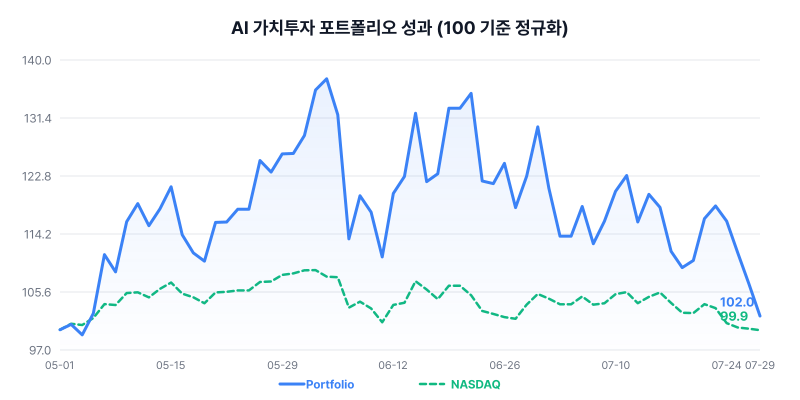
On July 29, 2026, global financial markets experienced sharp volatility, unsettling investors. The Korean stock market saw its KOSPI and KOSDAQ indices plummet by 5.98% and 6.12% respectively, with the 5600 and 660 levels coming under pressure. The US market was not spared, with the Dow Jones Industrial Average falling 2.19%, reflecting a broad downward trend. Despite these fierce market headwinds, the 'AI Value Investment Portfolio' proved its resilience, achieving a solid return of approximately 36.27%, growing from an initial $10,000 to $13,626.637. Notably, over the past five highly volatile trading days, assets fluctuated, dropping from the $13.6 million to $14.8 million range before rebounding, mirroring market swings but maintaining a positive trajectory throughout.
Return Resilience Amidst Asset Fluctuations
The AI Value Investment Portfolio navigated a rollercoaster over the last five trading days, with assets ranging from the $13.62 million to $15.80 million mark. After exceeding $15.80 million on July 23rd, assets saw a consistent decline, falling to $13.62 million by the 29th. This downturn is attributed to the broader global market decline. However, this correction underscores the portfolio's unwavering commitment to its core value investing philosophy. Even with the Volatility Index (VIX) surging by 13.45%, the portfolio's drawdown was relatively contained compared to the overall market crash, marking a commendable performance.
Holdings Combining Solid Valuation and Growth Potential
The stocks comprising the AI Value Investment Portfolio were meticulously selected, balancing undervalued assets with future growth prospects. Nvidia (NVDA) continues to offer attractive valuations with a P/E ratio of 28.5 and a PEG ratio of 0.54, projecting consistent growth based on its EPS of $6.54. Broadcom (AVGO) shows a P/E of 63.3 and a PEG ratio of 0.43, appearing relatively undervalued against its EPS of $6.02. Micron (MU) boasts a P/E of 18.6 and a low PEG ratio of 0.13, signaling strong growth potential with an impressive EPS of $44.23.
Meanwhile, AMD (AMD), despite a high P/E of 151.5, maintains a PEG ratio of 1.16, indicating that its growth potential offsets valuation concerns. Its EPS of $3.00 suggests room for further expansion. Amazon (AMZN) maintains stable growth with a P/E of 27.6 and a PEG ratio of 1.24, reporting an EPS of $8.36. Meta (META) presents a reasonable valuation at a P/E of 21.6 and a PEG ratio of 0.87 against its EPS of $27.47. However, a recent partial reduction in Meta's holdings is interpreted as a strategic decision driven by concerns over intensifying competition in the advertising market and delays in AI monetization.
Leveraged products, TQQQ and SOXL, are also part of the portfolio. TQQQ has a P/E of 31.6 and a PEG ratio of 1.40, while SOXL shows a P/E of 18.6 and a PEG ratio of 0.65. The recent significant buying activity in SOXL suggests a strategy to capitalize on the undervalued semiconductor sector and maximize returns through leverage.
Strategic Trading: Flexibility in Response to Market Volatility
Recent trading activities highlight the portfolio's flexible strategy in adapting to market changes. The purchase of SOXL on July 24th was a leveraged investment strategy based on the semiconductor sector's attractive valuation and growth prospects. On the same day, partial sales of Meta and TQQQ were made, interpreted as a reallocation of funds considering AI monetization concerns, the relative undervaluation of semiconductors compared to the Nasdaq, and the potential for sector rotation. Further selling of Meta on July 17th was a risk management measure amidst increasing volatility. Aggressive buying of TQQQ on July 10th aimed to capture the upward momentum in large-cap tech stocks, while a partial sale of SOXL on the same day served to realize short-term gains and adjust portfolio volatility. The purchase of Nvidia in late June was a response to the strong growth momentum driven by soaring AI chip demand and its attractive valuation indicated by a low PEG ratio.
Outlook: Finding Opportunities Amidst Volatility
The market is expected to continue experiencing high volatility due to complex factors including interest rates, oil prices, and geopolitical uncertainties. The rise of the Won-Dollar exchange rate to over 1443 KRW raises concerns about potential foreign capital outflows. The surge in oil prices exceeding 6% and rising gold prices suggest a growing preference for safe-haven assets. In this environment, the AI Value Investment Portfolio will maintain its stable investment strategy focused on undervalued blue-chip and growth stocks to navigate market volatility. The strategy is underpinned by a belief in the fundamentals of key companies involved in AI technological advancements, aiming for long-term value appreciation amidst short-term market fluctuations.
※ This report analyzes the simulated performance of the AI Value Investment Portfolio and does not constitute investment advice. All investment decisions should be made at your own discretion and risk.
Curious about detailed portfolio breakdowns?
Subscribe to our newsletter below to receive detailed investment reports daily.