Rep. Han Ki-ho Tops Conscience Voting List with 3.4% Deviation Rate
The Significance of the Top-Tier Monopoly on Deviation Rates
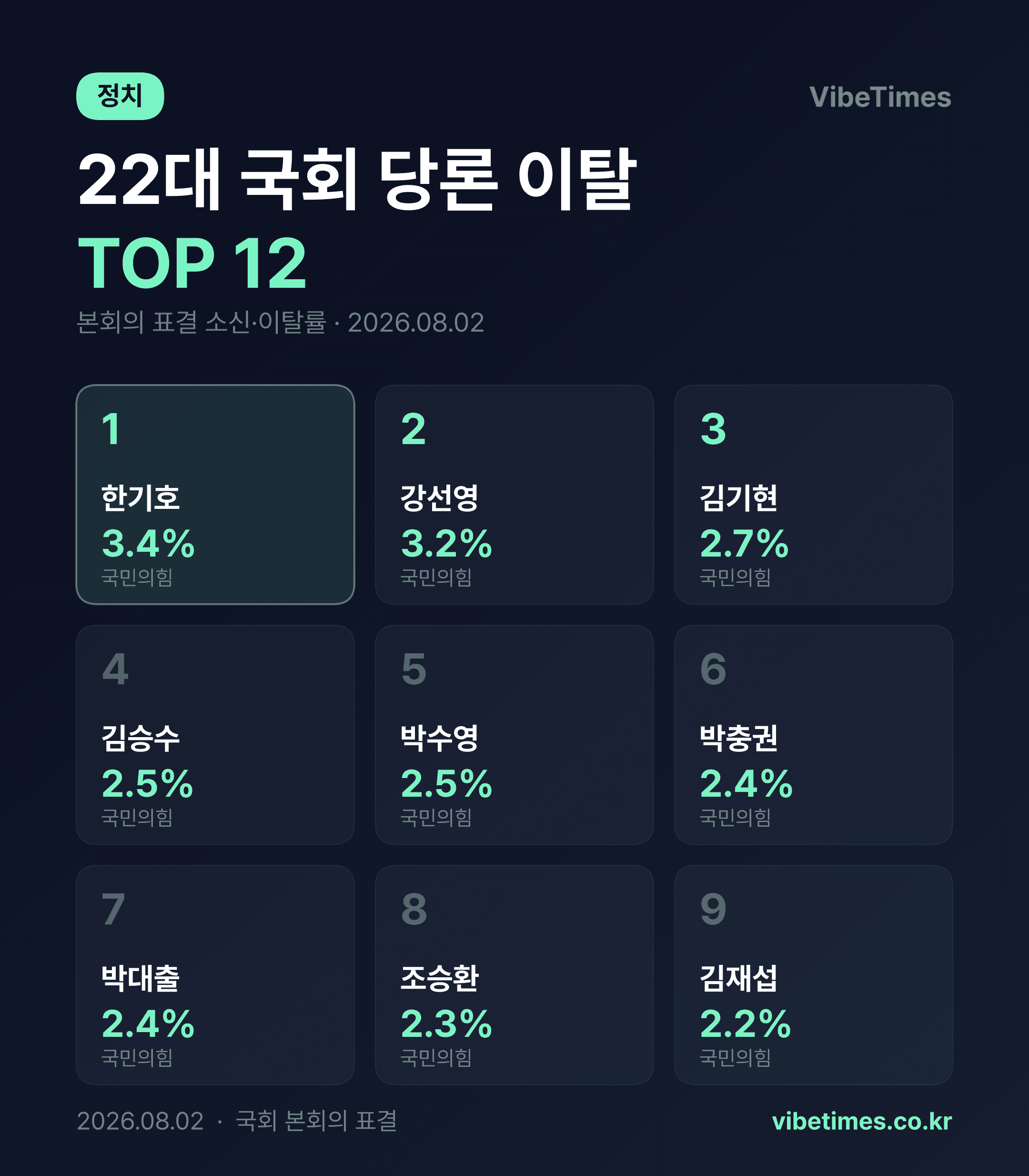
An analysis of National Assembly plenary voting statistics as of August 2026 reveals a clear trend: lawmakers from a specific party dominate the upper ranks of party-line deviation rates. Rep. Han Ki-ho of the People Power Party (PPP) ranked first with a deviation rate of 3.4%. He was closely followed by Rep. Kang Seon-yeong in second place with 3.2%. Rep. Kim Gi-hyeon took third with 2.7%, while Reps. Kim Seung-su and Park Su-young tied for fourth with 2.5% each. Following them, Reps. Park Chung-kwon and Park Dae-chul recorded 2.4%, and Rep. Jo Seong-en recorded 2.3%. The lower ranks, from 9th to 12th, were also filled without exception by PPP lawmakers—Kim Jae-seop, Kim Min-jeon, Choi Su-jin, and Lee Cheol-gyu—with figures ranging between 1.9% and 2.2%. The fact that all top twelve spots are occupied by members of the same party serves as a significant indicator of the power dynamics within the current 22nd National Assembly, going beyond mere statistical curiosity.
Strong Party Discipline and Political Implications Hidden in Low Figures
The most striking aspect of these statistics is that every deviation rate, including the top score of 3.4%, remains below 4%. In Korean politics, parties hold strong legal and institutional disciplinary authority over their members, making adherence to the party line paramount. This is backed by severe penalties, such as the loss of committee assignments or exclusion from future candidate nominations. As a result, lawmakers are extremely reluctant to vote against their party's official stance. Therefore, while 3.4% may appear negligible to the public, it is interpreted as a highly unconventional move given the unique political environment of the National Assembly.
The phenomenon of the entire ranking consisting solely of ruling party lawmakers sends a clear signal to voters and the political market. It suggests difficulties in maintaining a unified voice within the ruling party on key national agendas. It is highly likely that some lawmakers voted cautiously on recent major economic and industrial bills, reflecting the opinions of interest groups or their constituencies. This implies a subtle disconnect between the party's top decision-making structure and the sentiment on the ground.
Risks of Policy Drift and Outlook for the Upcoming Legislative Schedule
The increasing frequency of conscience voting within the ruling party directly impacts capital markets and the industrial sector. If dissenting votes appear during the legislative process for key economic bills, tax reforms, or labor market overhauls led by the government or ruling party, the passage of such bills will inevitably be delayed or amended. This acts as a negative variable for the investment schedules of companies subject to regulations and market expectations. Institutional investors inherently dislike macro-policy uncertainty. The voting behavior of those with high deviation rates is expected to serve as a risk indicator for gauging the government's policy momentum during future bill deliberations.
As the National Assembly begins to handle large-scale budget proposals and tax revision bills in the latter half of the year, internal differences are likely to become even more pronounced. Current ranking data is analyzed not merely as temporary statistics but as a harbinger of the ruling party's weakening negotiating power during future dealings with the opposition. The future legislative activities and voting patterns of the lawmakers on this list will be critical factors determining the speed and direction of policy legislation.