Top Low-P/E Large-Cap Stocks: Comcast, Pinduoduo, Honeywell Lead the Pack

Media and E-commerce Sectors Face Undervaluation, Comcast and Pinduoduo Emerge
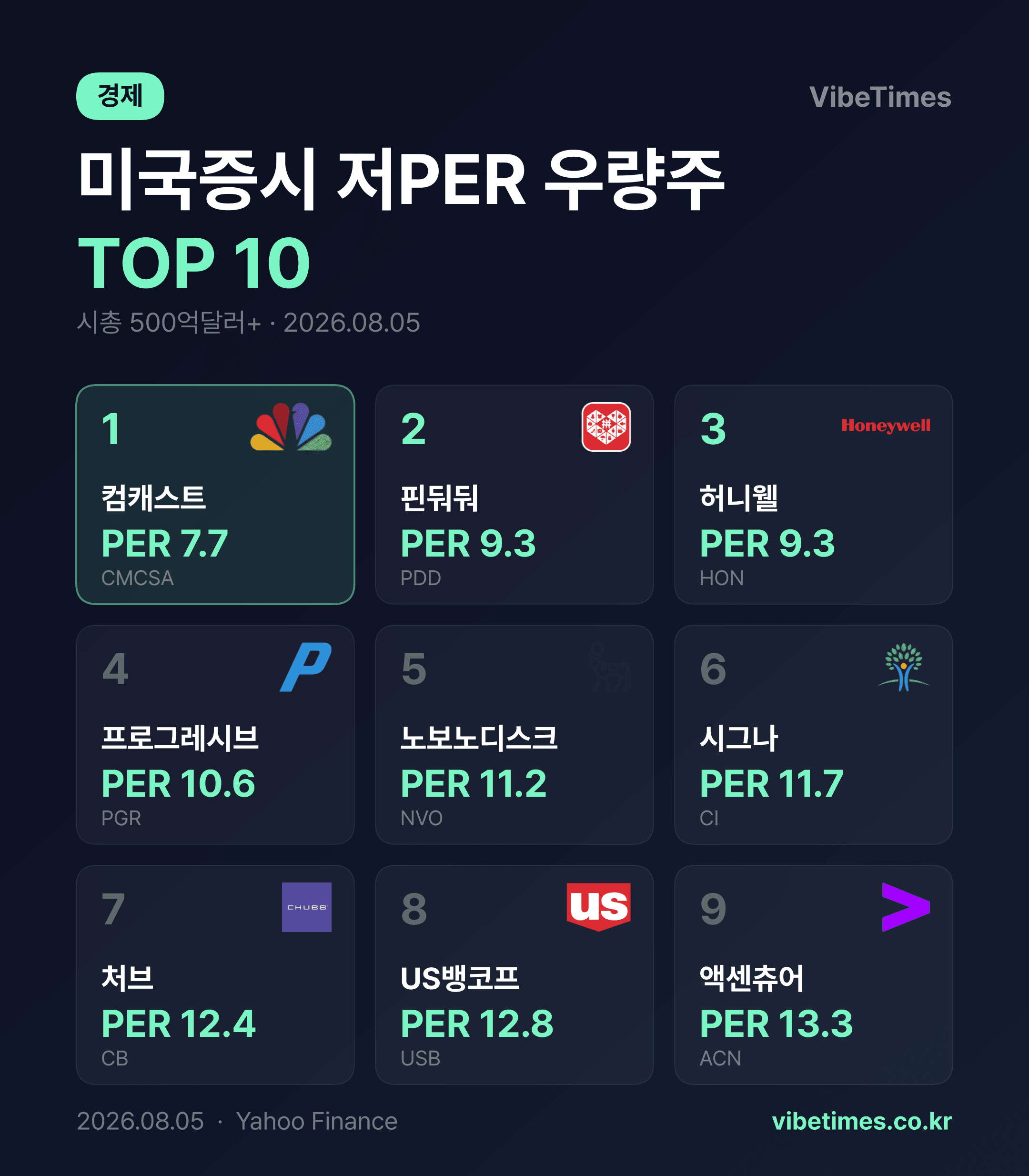
As of August 5, 2026, global media and telecommunications giant Comcast stands out with the lowest valuation among large-cap, high-quality stocks, boasting a Price-to-Earnings (P/E) ratio of 7.7x. Comcast, with a market capitalization of $87.2 billion, maintained a stable stock performance with a 0.03% daily change. This low P/E trend for Comcast indicates that despite the stagnation in its traditional cable broadcasting business, diversification of its revenue streams through high-speed internet and its streaming service, Peacock, is generating stable profits. The market analyzes that Comcast's stock has entered a period of relative undervaluation compared to its robust cash flow.
Chinese e-commerce platform Pinduoduo (PDD) followed, with a P/E ratio of 9.3x and a market capitalization of $128.3 billion. Despite recording high revenue growth driven by Temu's aggressive global expansion, Pinduoduo is trading at a lower multiple relative to its earnings due to geopolitical risks and regulatory uncertainties. Honeywell, also with a P/E ratio of 9.3x and a market cap of $78.2 billion, demonstrated unique price competitiveness within the industrial sector. Considering Honeywell's technological prowess in aerospace and automation control systems, a P/E below 10x suggests an attractive entry point for value investors.
Insurance and Financial Sectors Show Solid Performance and Defensive Valuations
Large-cap stocks in the financial and insurance sectors also posted low P/E ratios in the low double digits, dominating the top rankings. Property and casualty insurer Progressive recorded a P/E of 10.6x, maintaining a market capitalization of $122.4 billion. Progressive has maximized profitability through sophisticated data analytics in its underwriting capabilities, and this earnings advantage, combined with a low P/E, enhances its investment value. Similarly, Chubb (CB) further supported the undervalued appeal of the insurance sector with a P/E of 12.4x and a market cap of $134.3 billion. Chubb closed the trading day flat with a -0.01% change.
In the banking sector, U.S. Bancorp ranked eighth with a P/E of 12.8x and a market capitalization of $99.6 billion. This figure for U.S. Bancorp, one of the largest regional banks in the U.S., reflects sustained profit improvement due to expanding net interest margins in a high-interest rate environment. Cigna (CI) led the undervalued trend in the healthcare services sector with a P/E of 11.7x. Cigna's market cap was $74.5 billion, interpreted as stable profitability in the managed healthcare services market being reflected in its stock's earnings ratio. The low P/E ratios for these financial and insurance stocks serve as a key factor in securing downside protection during times of economic uncertainty.
Performance-Based Revaluation of Tech and Healthcare Large-Caps
Undervalued stocks relative to their earnings are also noticeable in the IT and pharmaceutical sectors, traditionally classified as high-growth areas. Notably, Danish pharmaceutical company Novo Nordisk, despite its substantial market capitalization of $208.2 billion, ranked fifth with a P/E of 11.2x. This phenomenon arises as Novo Nordisk's profit generation pace, driven by the explosive growth in the obesity treatment market, outpaces its stock price appreciation. This is considered an unusual situation where a growth stock with strong fundamentals, rather than a slow-growth stock, remains in the value stock territory.
In the large-cap market, a low P/E ratio signifies that the market's valuation is conservative relative to a company's earnings-generating capacity, which can serve as a basis for stock price increases driven by mean reversion principles over the medium to long term.
IT solutions and consulting firm Accenture recorded a P/E of 13.3x and a market capitalization of $101.4 billion. Amidst soaring demand for cloud migration and artificial intelligence (AI) adoption consulting, Accenture's P/E in the low 13s is relatively low for a technology services company. Furthermore, Adobe, a leader in digital content creation software, narrowly made the top 10 with a P/E of 14.4x and a market capitalization of $99.9 billion. Trading at a P/E below 15x is a significant contraction compared to its historical average multiples, demonstrating that the stability of its subscription-based revenue model is firmly reflected in its earnings.
Market Impact and Outlook from a Value Investing Perspective
Summarizing the data from the top 10 companies, as of August 2026, the market is applying a sober assessment to large-cap, high-quality stocks with clear earnings substance, regardless of their sector. The fact that mega-cap companies with market capitalizations around $100 billion are trading at P/E ratios of around 10x suggests that market liquidity is concentrated in specific themes or that a high risk premium is being applied to high-quality companies due to concerns about an economic slowdown. Specifically, the mere 6.7x P/E difference between the top-ranked Comcast and the tenth-ranked Adobe indicates that the undervaluation of stock prices relative to earnings is broadly spread across large-cap stocks.
If the future interest rate path becomes clearer and confidence in a soft economic landing strengthens, there is a high probability of significant capital inflows centered around these low P/E large-cap stocks. Companies like Novo Nordisk, possessing both high market share and earnings growth, are expected to be the top priority for multiple expansion. Investors should look beyond simple numerical comparisons and examine each company's position within its industry and the quality of its earnings. The current low P/E ratios serve as a safety margin during downturns and are expected to be a key driver for stock price recovery based on earnings performance during future market rebounds.