Ranking of Large Caps with Low PEG Ratios: Micron, ON Semiconductor, AbbVie

Undervalued High-Quality Stocks with PEG Ratios Below 1... AI and Essential Consumer Goods in Focus
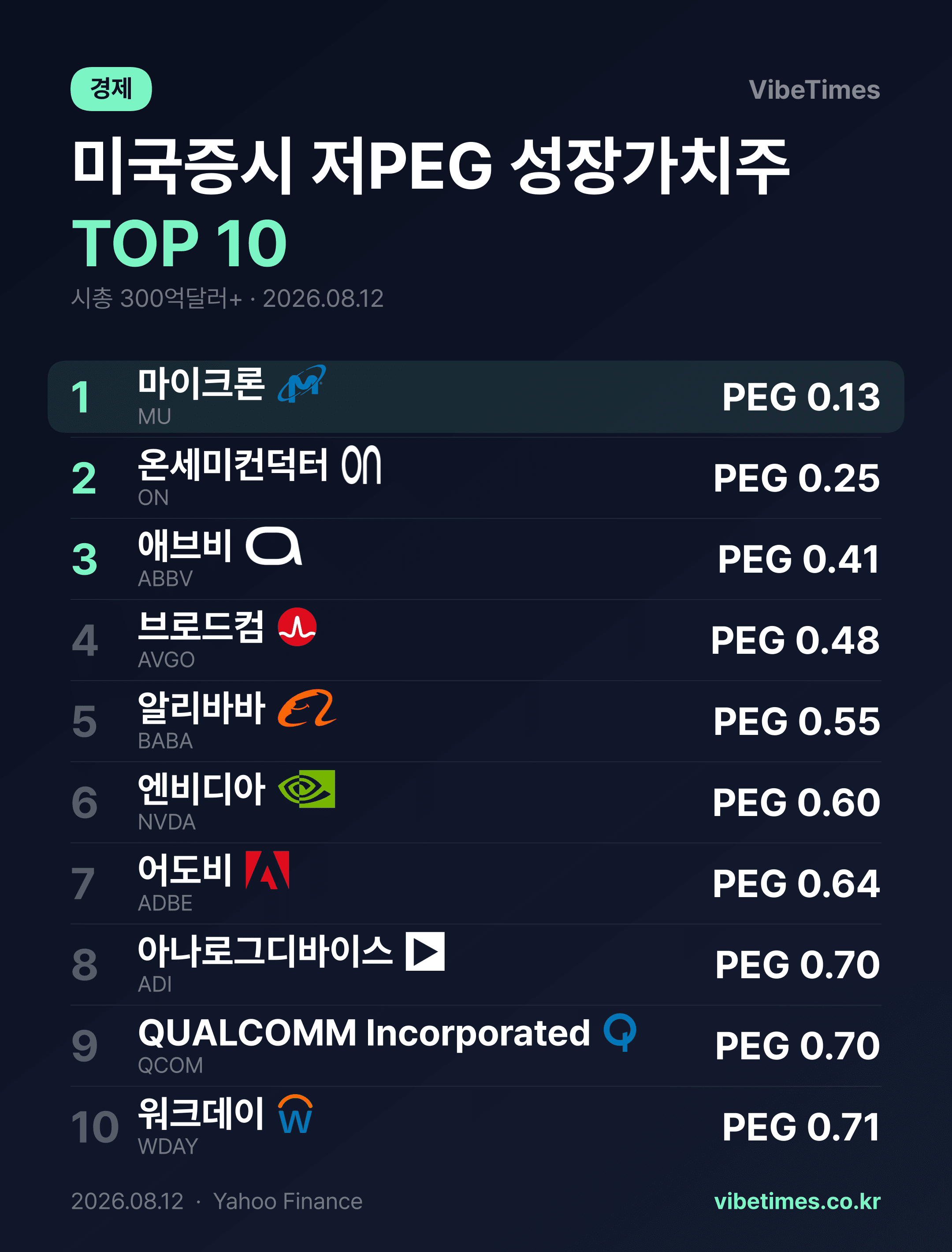
According to the most recent data for the U.S. stock market, the rankings of large-cap growth stocks with a PEG ratio—a measure of net income growth relative to the Price-Earnings Ratio (PER)—below 1 have been reshuffled. Micron Technology, a memory semiconductor company, took the top spot. The firm recorded a PEG ratio of 0.13, a PER of 19.8, and a market capitalization of approximately $972.4 billion. A figure below 1 indicates that the current stock price has not yet fully reflected the company's future net profit growth rate in the market. In other words, it can be interpreted that the stock is theoretically undervalued relative to future performance.
Nvidia, an AI semiconductor designer with a market cap of $527 billion, ranked 6th with a PEG ratio of 0.60 and a PER of 33.3. Meanwhile, Broadcom, a network chipset manufacturer with a market cap of $201 billion, recorded a PEG ratio of 0.48, securing the 4th spot overall. The fact that these mega-caps, exceeding $100 billion in market value, are showing cheap growth metrics serves as evidence that specific technology trends are driving profitability across the industry. It is not vague market expectations, but actual data center build-out orders that are driving the earnings boom for these companies.
Semi Industry Upward Cycle Drives Top-Tier Dominance
Nearly half of the top 10 companies are semiconductor and related equipment manufacturers, highlighting a clear concentration within the industry. ON Semiconductor, ranked 2nd, achieved a PEG ratio of 0.25 and a PER of 52.1, driven by demand for automotive and industrial power chips. Although the stock itself belongs to a high PER group exceeding 50, its growth metrics remain very stable as annual net income is expanding rapidly.
Qualcomm and Analog Devices both showed an identical PEG ratio of 0.70, forming a joint 8th place group. Qualcomm maintains a relatively low PER of 18.5, satisfying both value and growth criteria simultaneously. This structural strength is attributed to the fact that demand for automotive communication modems and edge computing chipsets is acting as a growth engine, even amid the stagnation of the traditional smartphone market. This indicates that the semiconductor sector as a whole is achieving diversified earnings improvements, not just through AI servers, but through the expanded supply of customized chipsets for various devices.
Rise in Value of Pharma and Software Firms with Stable Cash Flows
Significant growth indicators are also being detected in the essential medical supplies and enterprise software industries. Major pharmaceutical company AbbVie ranked 3rd with an attractive PEG ratio of 0.41, despite a high PER of 69.5. This figure is based on specific numerical evidence that the company will achieve earnings growth rates far exceeding market averages, through successful cross-complementation between its new product pipeline and follow-up new drugs, despite concerns over declining sales of its core drug. Workday, an enterprise HR and finance software company, also joined the top 10 with a PEG ratio of 0.71.
Meanwhile, e-commerce platform Alibaba and creative software leader Adobe appear to be retaining their investment appeal in the market. Alibaba recorded a PEG ratio of 0.55 with a PER of 20.3, while Adobe posted the lowest valuation with a PER of 15.2 and a PEG ratio of 0.64. In particular, Adobe, with a market cap of $108.5 billion, is highly regarded by the market for its ability to defend operating margins as a software company. This is because its thorough subscription-based revenue model guarantees robust cash flows.
Market Valuation Reassessment and Future Investment Implications
This data clearly reveals that market participants are currently selecting investment targets based on the PEG ratio, which combines corporate growth speed with simple stock price levels (PER). In particular, the fact that mega-cap companies are competitively recording cheap growth metrics in the upper ranks suggests that market funds are flocking to high-quality stocks. At the core of the capital exodus from companies that were once considered to have abundant growth potential but had excessively high valuations lies the ability to generate sustainable profits.
The strength of the semiconductor sector is expected to continue for a considerable time, coinciding with the full-scale investment in AI infrastructure. As major technology companies announce large-scale capital expenditure plans, the earnings growth trend of related component suppliers is expected to become visible. Additionally, in a macro environment where high-interest rates persist, pharmaceutical sectors like AbbVie that are less sensitive to economic fluctuations, and subscription software models like Adobe, are likely to increase their weight in investment portfolios as defensive investments. It is a time for investors to maintain a strategy focusing on stocks backed by tangible earnings growth rates, rather than overly hyped theme stocks.