Samsung Electro-Mechanics Surges 900%, Leading Korean Market Cap Stocks in 1-Year Returns

Overwhelming Strength of Semiconductor and Electronic Component Stocks and Samsung Electro-Mechanics' Record Surge
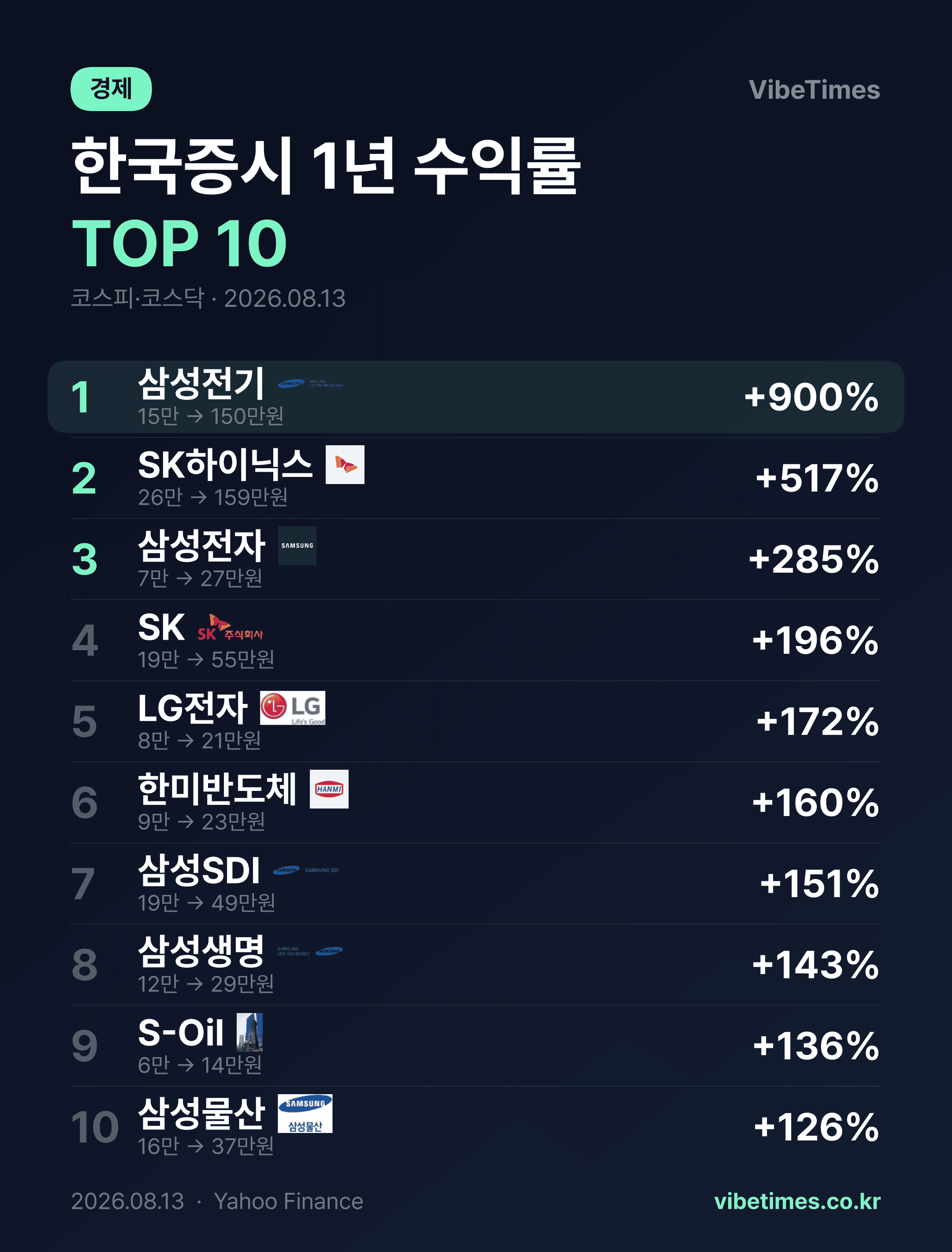
As of August 13, 2026, top-tier stocks by market capitalization on the Korean stock market (KOSPI) have achieved record returns over the past year, demonstrating a fundamental shift in the domestic market landscape. In particular, Samsung Electro-Mechanics saw its stock price soar from the 150,000 won range a year ago to 1.5 million won, recording a remarkable return of 900.0%. This upward trend served as a driving force that elevated Samsung Electro-Mechanics' market capitalization to 100.86 trillion won, going beyond mere stock price inflation. The fact that a component stock has ushered in the era of a 100 trillion won market cap signifies that the value of the core supply chain in the electronics industry has been elevated to a level incomparable to the past.
Samsung Electro-Mechanics' explosive growth is attributed to its strengthening dominance in the high-value-added multilayer ceramic capacitors (MLCC) and next-generation semiconductor substrate markets. This is interpreted as the result of a sophisticated profit structure for component manufacturers, who were previously undervalued, amidst a surge in demand for artificial intelligence (AI) servers and automotive components. The tenfold increase in stock price over a year shows that the capital market is re-evaluating Samsung Electro-Mechanics not as a simple hardware manufacturer, but as a core technology platform enterprise.
The Era of a 1,000 Trillion Won Market Cap Created by the Competition for Memory Semiconductor Supremacy
The two pillars of the memory semiconductor industry, SK Hynix and Samsung Electronics, also displayed growth trends exceeding market expectations. SK Hynix recorded a 1-year return of 517.4%, with its stock price vertically rising from 260,000 won to 1.59 million won. Consequently, its market capitalization has reached 1,067.62 trillion won, ushering in an era of 'quadrillion-unit' market capitalization. This result is attributed to the concentration of investment funds as the first-mover effect in the high-bandwidth memory (HBM) market was proven in performance figures. SK Hynix's growth suggests that the semiconductor industry is transforming from a cyclical structure into a strategic asset capable of sustained upward trends.
Samsung Electronics rose by 284.5% from the 70,000 won range a year ago to the current 270,000 won, solidifying its status as a market leader. Its market capitalization stands at 1,677.76 trillion won, maintaining an unrivaled position as the top domestic listed company. Although its yield lagged behind that of Samsung Electro-Mechanics or SK Hynix, the fact that it recorded triple-digit returns while maintaining such a massive market scale serves as an indicator of how strongly liquidity in the market has flowed into large-cap quality stocks. The advancement of these semiconductor companies has had the effect of normalizing the valuation of the entire Korean stock market upward.
Synergistic Rise of Core Supply Chains including Back-end Process Equipment and Secondary Batteries
Strong return indicators are also confirmed in the rear industries of the semiconductor and electronics sectors. Hanmi Semiconductor recorded a 1-year return of 160.4%, with its stock price jumping from 90,000 won to 230,000 won. Its market capitalization surpassed 20.63 trillion won, establishing its position as a specialized semiconductor equipment company. As the importance of semiconductor miniaturization and packaging technology grows, the corporate value of equipment suppliers is rising in tandem with that of manufacturers. This can be used as evidence that the entire semiconductor ecosystem is achieving systematic growth.
Samsung SDI in the energy and materials sector is also maintaining a robust trend. Samsung SDI's stock rose from 190,000 won to 490,000 won, yielding a return of 151.4%. Behind the market capitalization of 38.21 trillion won lies market trust in the company's next-generation battery technology. Despite demand volatility in electric vehicles, the analytical outlook that demand for high-performance batteries will continue has been reflected in the stock price. LG Electronics also recorded a return of 172.4%, gaining recognition for both improved profitability in its home appliance business and growth in its automotive components business.
Profitability Improvement in Non-Manufacturing Sectors and the Outlook for the Korean Stock Market in the Second Half
Meaningful changes are being detected not only in tech stocks based on manufacturing but also in traditional industries such as finance and energy. Samsung Life Insurance saw its stock price rise from 120,000 won to 290,000 won, achieving a return of 142.5%. Its market capitalization reaches 54.32 trillion won. Analysts suggest that changes in the interest rate environment and the maximization of asset management efficiency have increased the appeal of financial stocks. S-Oil in the oil refining sector also recorded a return of 136.0%, forming a market capitalization of 16.47 trillion won. Securing solid refining margins amid international oil price volatility is cited as the main reason for the stock price increase.
The advancement of holding company SK is also notable. SK recorded a 1-year return of 196.2%, with its stock price rising from 190,000 won to 550,000 won. The improvement in performance of affiliates and the re-evaluation of subsidiary equity value have pulled up the holding company's stock price. SK's growth, with a market capitalization of 29.73 trillion won, supports the view that the group's portfolio optimization strategy is receiving positive market assessment. Samsung C&T also recorded a return of 125.7% with a market capitalization of 58.5 trillion won, demonstrating a steady stock flow as the core axis of the group's governance structure.
In summary, the current Korean stock market has entered a phase where the value of entire industries is being reestablished, based on strong upward momentum centered on tech stocks. Samsung Electro-Mechanics' 900% surge and SK Hynix's breakthrough of a 1,000 trillion won market cap hold significance beyond mere figures. Experts believe that for this high-return trend to continue, export performance based on global demand must be supported in the second half of the year. In particular, the fact that a majority of the top 10 market cap stocks are affiliates of the Samsung and SK groups suggests that the management strategies of large conglomerates will serve as key variables determining the future direction of the domestic stock market.
While the future outlook for the domestic stock market is positive, analysis prevails that preparing for volatility is necessary. The sharp rise over the past year has largely pre-empted expectations for corporate performance improvements. Therefore, rather than simply relying on past returns, investors need to closely observe the technological moat held by each company and changes in their share within the global supply chain. Despite debates over the semiconductor sector's peak, as long as the expansion of the AI industry does not stop, the dominance of top-tier market cap companies is expected to continue for the time being.