August 15 Investment Report: AI Value Portfolio +56.4%


Nasdaq Uncertainty vs. K-Tech's Reversal
On August 14, 2026, global financial markets are wavering amidst rising U.S. long-term interest rates and adjustments in technology stocks. While the Nasdaq and S&P 500 fell together, the Philadelphia Semiconductor Index also dropped 0.89%, dampening investor sentiment. However, in stark contrast to the shadow of this global downturn, the South Korean market is showing a strong rebound centered on the KOSPI, displaying an interesting 'Decoupling' phenomenon. Despite such market uncertainty, the AI Value Portfolio, which captures both valuation and growth, has recorded a rise of 56.44% to date, maintaining a solid upward trajectory.
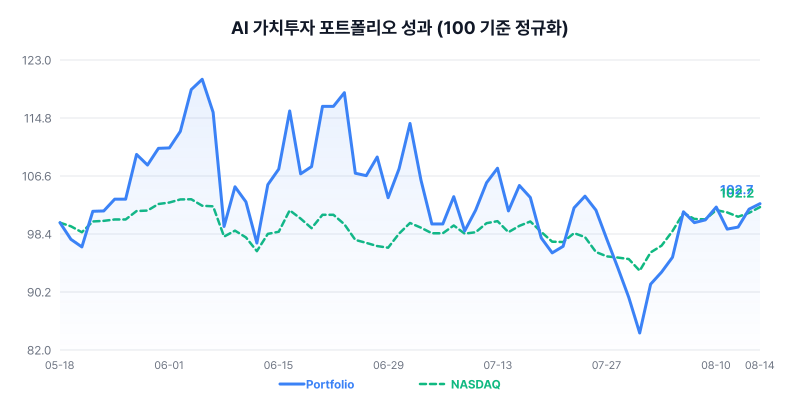
Solid Momentum in Returns
This portfolio has proven its durability against external shocks. Looking at asset flows over the past 5 days, net assets firmly defended the $15,000 range even as U.S. market volatility widened, before tracing an upward curve again to $15,644.35. This is interpreted not as a mere trend-following momentum, but as the result of a strategy that absorbs market volatility through the revaluation of individual stock valuations. A return exceeding 50% on initial capital is not simply luck, but the result of synergy between leverage and the alpha of individual stocks.
Valuation Diagnosis of Holdings
The core of the current portfolio lies in finding 'undervalued growth'. Nvidia (NVDA) and Broadcom (AVGO) remain the twin pillars of the portfolio. particularly for Broadcom, despite Earnings Per Share (EPS) reaching $6.02, the stock is trading at $417.82, resulting in a PER (Price-to-Earnings Ratio) of 69.4x. While this figure may seem somewhat high due to the large price base, converting it to a PEG ratio of 0.47 reveals that the stock is still undervalued relative to its EPS growth rate. Micron (MU), the leader in semiconductor shares, is showing overwhelming performance with an EPS of $46.07, yet its PER is a mere 20.6x, indicating a remarkably undervalued PEG of 0.13. On the other hand, Advanced Micro Devices (AMD) is recording a high PER of 123.5x, but reflecting high growth, its PEG is balanced at 1.01. Intel (INTC), recently purchased, has surged on momentum, yet with a forward PER of 51x based on future performance improvements, it suggests the market has not yet fully reflected expectations.
| Ticker | Qty | Purchase Price | Current Price | PER |
|---|---|---|---|---|
| Nvidia (NVDA) | 25.76 | $183.15 | $225.30 | 34.5 |
| Broadcom (AVGO) | 5.67 | $326.03 | $417.82 | 69.4 |
| AMD | 7.17 | $198.62 | $483.01 | 123.5 |
| Micron (MU) | 0.25 | $996.00 | $949.83 | 20.6 |
| Amazon (AMZN) | 1.95 | $208.39 | $265.13 | 21.3 |
| Meta (META) | 0.64 | $653.56 | $594.97 | 22.4 |
| TQQQ | 1.19 | $76.34 | $77.15 | 35.1 |
| SOXL | 17.09 | $71.22 | $145.36 | 51.2 |
| Intel (INTC) | 2.80 | $104.56 | $104.56 | N/A |
The Art of Sector Rotation and Risk Management
This portfolio recently demonstrated sophisticated trading logic capitalizing on valuation gaps between sectors. The decision late last month and early this month to reduce weight in the Nasdaq100 ETF (TQQQ) and concentrate on the Semiconductor Leverage ETF (SOXL) was decisive. At the time, the valuation of the semiconductor index (SOXX) was notably undervalued compared to the Nasdaq index, and this strategy actually yielded explosive returns at a PEG level of 0.64. Specifically for Meta (META), while the PEG of 0.86 was not terrible, funds were rotated to the semiconductor sector, where growth is more clearly defined, by reducing weight due to concerns over delayed AI monetization and intensifying competition. This flow is confirmed in today's trading details. By selling part of the surged SOXL (sold at $145.36) to realize profits and simultaneously buying Intel (INTC) at $104.56, where recovery expectations are visible, the portfolio simultaneously secured risk diversification and revaluation potential.
| Date | Type | Ticker | Qty | Price | Reason |
|---|---|---|---|---|---|
| 2026-08-14 | Buy | Intel (INTC) | 2.80 | $104.56 | Reflecting surging momentum, low PEG, and expectations for AI supply chain recovery |
| 2026-08-14 | Sell | SOXL | 0.90 | $145.36 | Realizing gains amidst semiconductor strength and reallocating funds to surged stocks (INTC) |
| 2026-08-07 | Sell | SOXL | 0.95 | $132.33 | Daily volatility management and risk adjustment |
| 2026-08-07 | Sell | TQQQ | 0.51 | $72.03 | Fund reallocation due to valuation superiority of semiconductors over Nasdaq |
| 2026-07-31 | Buy | SOXL | 1.57 | $114.72 | Maximizing leverage returns based on semiconductor PEG (0.625) undervaluation |
| 2026-07-31 | Sell | TQQQ | 0.30 | $63.30 | Reflecting the superior valuation and growth of the semiconductor sector |
'Value' Orientation Amidst Volatility
Today's market indicators show the 10-year U.S. Treasury yield soaring to 4.696%, eyeing the 4.7% mark, while the VIX index has actually fallen, suggesting investors are focusing more on individual stock fundamentals than interest rate risk. Gold futures jumping 1.51% and the Won/Dollar exchange rate stabilizing around 1,415 Won act as a regulator for the financial markets. In this macro environment, the portfolio's response is clear. By boldly clearing out overheated sectors and concentrating capital on the high-growth semiconductor sector, which remains attractive in terms of PER and PEG, it maintains a relative edge even during market declines. As long as the AI trend remains unshaken, this strategy is highly likely to maintain high scores even under interest rate hike pressure.
※ This report analyzes the simulated operation history of the AI Value Portfolio and is not investment advice. Actual investments should be made at your own discretion and responsibility.
Curious about portfolio details?
Subscribe to the newsletter below to receive detailed daily investment reports.