National Assembly Data Analysis: Democratic Party's Economic Progressivism 1.5 Times Stronger

Legislative Data Proves Entrenched Internal Ideological Spectrum
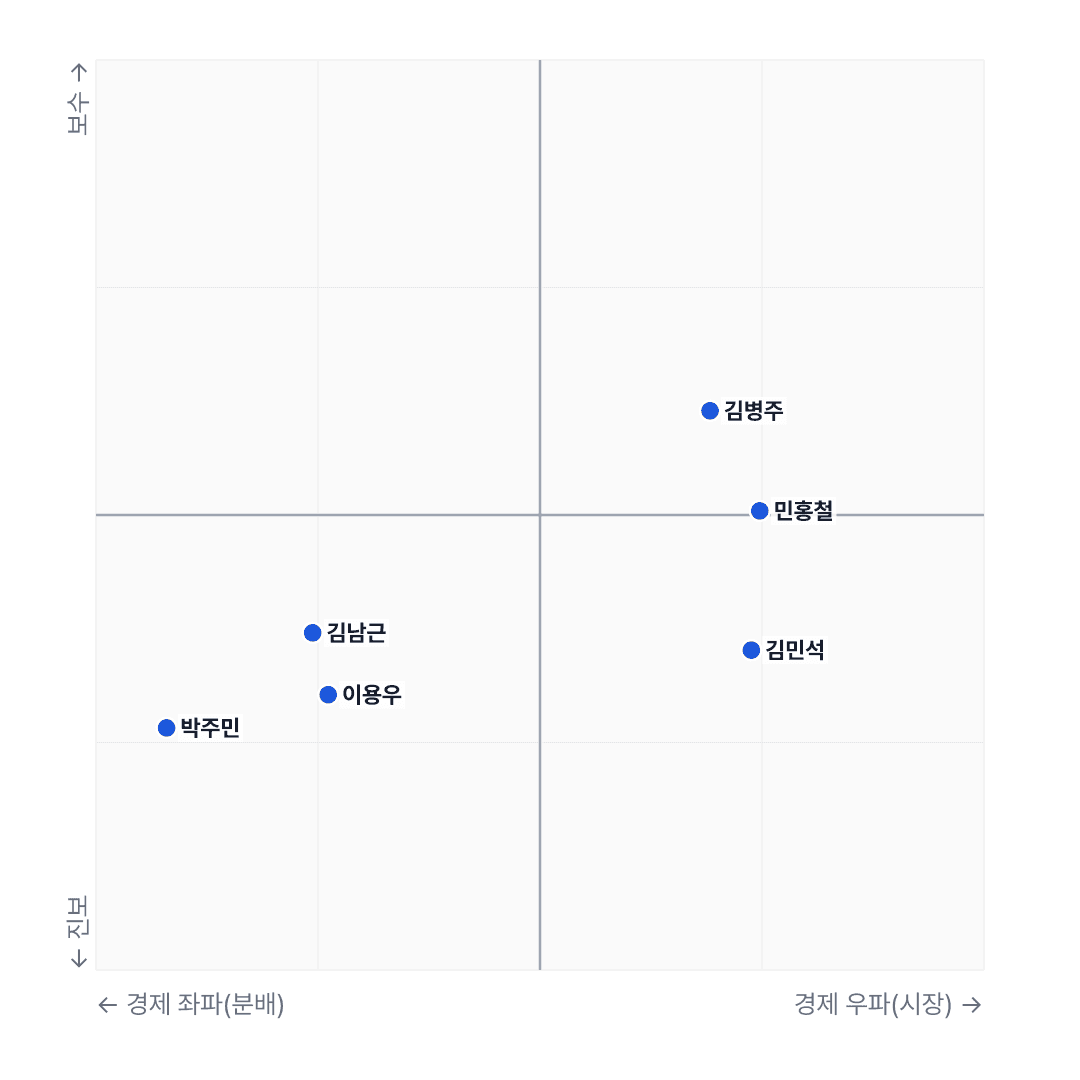
Examining the average legislative trajectory of Democratic Party lawmakers reveals a progressive inclination in both economic and social spheres, albeit with varying degrees of intensity. In the economic domain, legislative tendencies prioritizing state intervention and distributive justice over market autonomy were approximately 1.5 times stronger than those concerning social issues. This suggests that economic discourse, such as recovering livelihoods or strengthening regulations on large corporations, forms the core of the party's legislative activities. Notably, the overwhelming proportion of lawmakers exhibiting clear progressivism, rather than a moderate stance on economic policy, indicates the party's policy line is strongly anchored in economic democratization.
Representative Park Ju-min stands out as the individual with the most pronounced ideological clarity. Park occupies the most progressive position within the party across all economic and social indicators, demonstrating a unique commitment to labor and human rights legislation. Following him, Reps. Kim Nam-geun and Lee Yong-woo, both from civil society backgrounds, also introduced numerous bills emphasizing economic fairness, forming the party's left wing. Rep. Lee Ju-hee, a proportional representative, also focused on protecting social minorities and bridging economic divides, positioning herself significantly more progressive than the party average. Their activities serve as key indicators of the values underpinning the Democratic Party's major legislative initiatives.
Challenging Perceptions: Right-Wing Positions and Internal Diversity
The composition of the group voicing relatively more conservative opinions within the party differs somewhat from public perception. Four-term veteran lawmaker Min Hong-cheol occupies the most right-leaning position within the party across economic and social issues, exhibiting a pragmatic moderate stance. Rep. Kim Min-seok, who oversees party strategy, and Rep. Kim Byung-joo, a former military general, also conducted their legislative activities closer to the party's center than the average. The inclusion of Rep. Lee Eon-ju, who previously belonged to a conservative party, within the party's right-wing group, further substantiates a correlation between a lawmaker's past history and their current legislative conduct. This distribution reveals the Democratic Party not as a monolithic ideological bloc but as a major party characterized by politicians from diverse backgrounds seeking policy compromise.
Precise Analysis of Party Line Deviations and Conflicts of Interest
While the rate of deviation from the party line, a measure of party cohesion, remains extremely low, significant figures are observed among specific lawmakers. Rep. Lee Kwang-hee recorded a deviation rate of 1.8%, most frequently diverging from the party's overall direction, followed by Reps. Park Sun-won and Park Hong-bae. Rep. Lee So-young, known for her high policy flexibility, also showed a deviation rate of 1.1%, indicating that she approached her vote with her own grounds for judgment. These few deviations serve as indicators of the functioning of intra-party democracy and simultaneously suggest the potential for them to become variables in future key legislative processes.
A legislator's legislative orientation is closely linked to the nature of their standing committee, which at times presents the challenge of establishing relationships of interest with the industries they oversee.
A comparative analysis of public asset declarations and standing committee assignments reveals areas requiring a more critical perspective. In the cases of some lawmakers, data indicates stock ownership in industries supervised by their assigned standing committees or receipt of substantial donations from those sectors. While not legally prohibited, these instances necessitate continuous public scrutiny to ensure policy objectivity. Particularly for lawmakers actively involved in proposing economic legislation, maintaining distance from industries with vested interests is expected to be a critical factor in determining policy credibility.
Legislative Outlook for Markets and Industries
As the Democratic Party's economic progressivism solidifies, legislative efforts concerning corporate regulation and labor market-related bills are expected to gain further momentum. The data indicating a strong leftward bias in economic policy suggests a higher probability that policies such as reforms to the corporate tax system or strengthening regulations on large-scale distribution businesses will be adopted as mainstream party opinions. Industries are advised to enhance their preparedness for policy risks as the influence of lawmakers voicing moderate opinions within the Democratic Party diminishes. Especially if economic indicators worsen, a surge of strong market intervention bills, spearheaded by the party's progressive faction, is highly probable.
In conclusion, the Democratic Party is anticipated to drive policy forward based on its confirmed economic progressivism, as evidenced by its legislative conduct. While its relative moderation in social policy may serve as a tool for expanding its appeal, its clear stance on economic matters will act as a key driver for consolidating its support base and differentiating its policies. Investors and business stakeholders should pay close attention to the standing committee activities of lawmakers positioned at the ideological edges of the party and the casting vote roles of those with high deviation rates from the party line. Such quantitative data will serve as the most objective compass for predicting future legislative directions amidst a complex political landscape.
Legislators Mentioned in the Article
| Lawmaker | Party | Ideological Stance | Notes |
|---|---|---|---|
| Park Ju-min | Democratic Party | Economic Leftist · Social Progressive | Party Left Wing |
| Kim Nam-geun | Democratic Party | Economic Leftist · Social Progressive | Party Left Wing |
| Lee Yong-woo | Democratic Party | Economic Leftist · Social Progressive | Party Left Wing |
| Kim Byung-joo | Democratic Party | Economic Rightist · Social Conservative | Party Right Wing |
| Kim Min-seok | Democratic Party | Economic Rightist · Social Progressive | Party Right Wing |
| Min Hong-cheol | Democratic Party | Economic Rightist · Social Conservative | Party Right Wing |