Holding Power, Lee Jae-myung Sets Out on Constitutional Reform to Shrink It

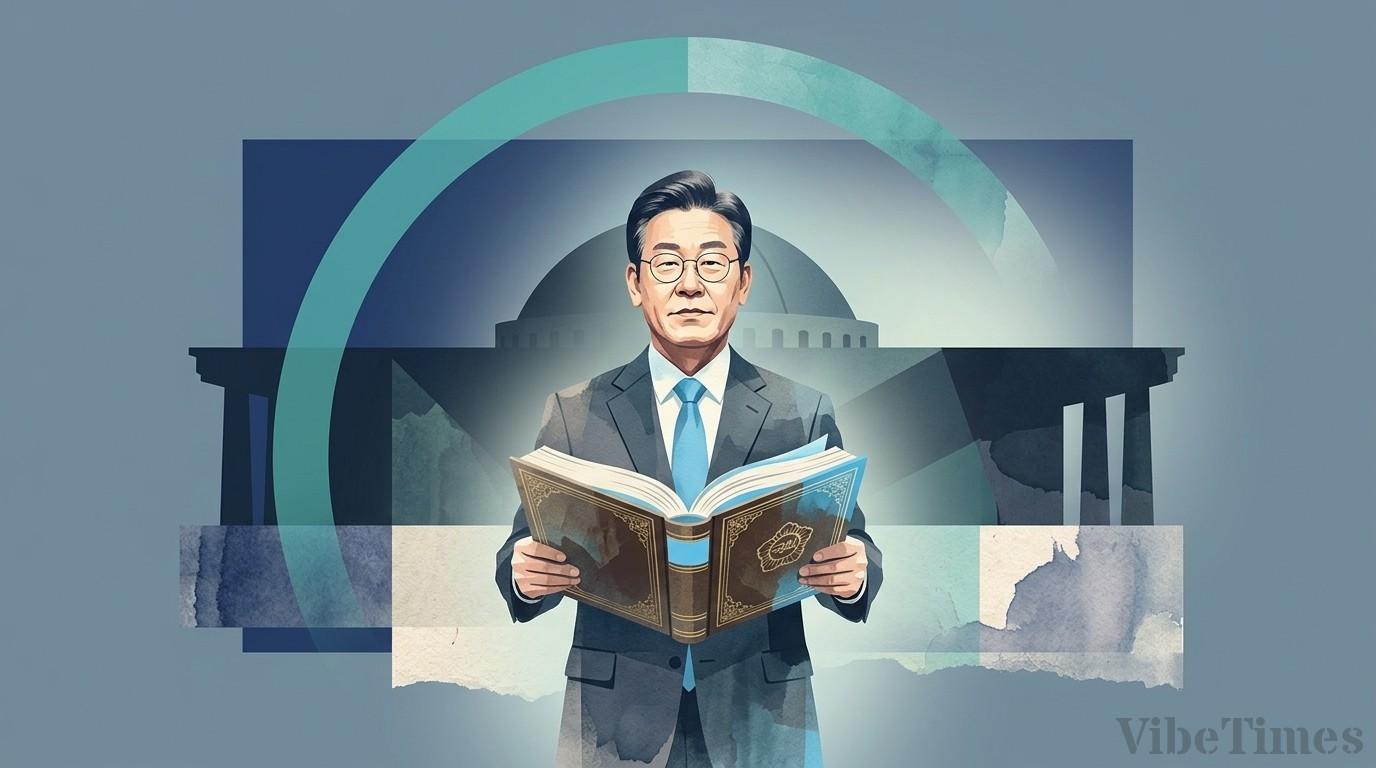
A Power That Shrinks Itself: An Unfamiliar Starting Point
President Lee Jae-myung has taken a scalpel to the presidential system with his own hands. The president has formally endorsed the need for a so-called power-dispersing constitutional amendment that would split the authority now concentrated in the presidency between the prime minister and the National Assembly. He also laid out a plan for South Korea to serve as a "facemaker"—a broker that breaks the ice—if North Korea–U.S. talks resume.
"Constitutional amendment needed to disperse presidential powers… will facilitate North Korea–U.S. dialogue as 'facemaker'"
For the holder of power to take the lead in shrinking it is an unfamiliar sight in the nation's constitutional history. With politics long holding that power never empties itself, the statement is likely to be recorded as a weighty variable in the political schedule ahead. Declaration and completion, of course, are different matters. A constitutional amendment only becomes reality after clearing a double gate: approval by two-thirds of the National Assembly's membership—200 of 300 seats—and ratification through a national referendum.
'No Second Term' Held Out as a Negotiating Precondition
The biggest obstacle is less the arithmetic than the political calculus. Speculation that the amendment could restructure the term system toward a four-year presidency with re-election—opening a door to a second term for the incumbent—has rattled the opposition. People Power Party leader Jang Dong-hyuk urged on Facebook that Kim Moon-soo extract from President Lee a declaration of "no re-election." In effect, the demand is that the incumbent forgo re-election as the price of cooperating on the revision.
Within the ruling camp, the dispersal experiment is moving first through administration. President Lee ordered the creation of a police reform body under the Office of the Prime Minister. At a Cabinet meeting, he ordered police reform, saying, "The lax discipline and irresponsibility within the police are serious." The move shifts the axis of oversight over public safety out of the presidential office, and it is being read as a message that he intends to prove power dispersal through administrative procedure before changing the law. His roughly two-hour-and-20-minute meeting with the Democratic Party leadership—including new party chairman Kim Min-seok and floor leader Han Byung-do—at a Blue House dinner on the 25th likewise appears to have been a review of the party-government cooperation framework in step with the revision phase.
North Korea–U.S. Diplomacy Interlocking with the Revision
Diplomacy is the other pillar of the plan. President Lee said he hopes President Trump's push to scale back joint military exercises and his pursuit of a summit will lead to the resumption of North Korea–U.S. dialogue—remarks aimed at a moment when the situation on the Korean Peninsula is stirring again. In his Liberation Day address earlier, he also touched on the question of a formal end to the Korean War. Concerns exist as well: some point out that Article 1 of the Armistice Agreement defines the Military Demarcation Line and the Demilitarized Zone, so a war-end declaration could shake the legal basis for inter-Korean management of the front line.
A calculation that bundles diplomacy and constitutional revision into a single package is discernible. Establishing a broker's standing between Washington and Pyongyang would thicken the political assets built up since taking office, and those assets could be used as fuel to push the referendum along. Given a current approval rating of 37.4 percent in Viewpping polling, some interpret securing diplomatic momentum as less a choice than a near necessity.
The 200-Seat Mountain and the Timetable
The ruling bloc's own seats fall short of the 200-vote threshold needed to initiate an amendment. Structurally, without the People Power Party's consent, no negotiating table exists at all. As long as the opposition holds out a renunciation of re-election as its precondition, the wording of the amendment, the timing of implementation, and whether President Lee may seek a second term are likely to be negotiated as a single package. For the referendum, coinciding with an existing election day is advantageous for securing turnout, and designs pairing it with the 2028 general election or the 2030 local elections are cited as the natural options.
Confucius said that the person who first reckons with the difficulties to be overcome is the one who arrives at success. The fate of President Lee's revision plan, too, is expected to hinge less on the grandeur of the vision than on how he handles the twin challenges of securing 200 seats and the "no re-election" demand. Whether this declaration of self-restrained power matures into an institution or remains a mere declaration will be foreshadowed by the intensity of ruling-opposition contacts over the coming months.