Triple Central Bank Meetings Pile Up as Oil Nears $100

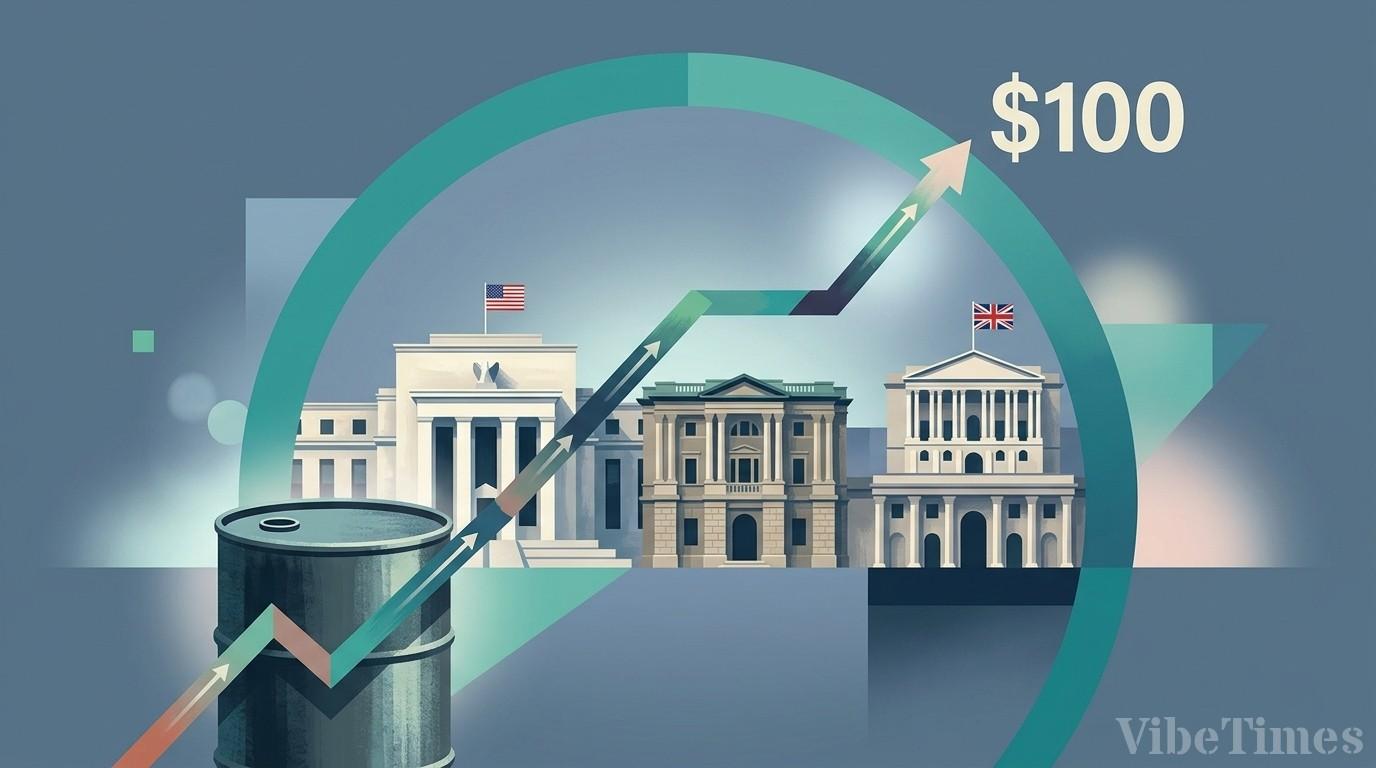
Next week brings back-to-back monetary policy meetings at the US, Japanese and British central banks to set interest rates, while international oil prices approach $100 a barrel amid the Middle East conflict, piling multiple variables onto the domestic stock market.
The KOSPI closed at 6,909.91 on the 11th, down 1.76% from the previous session, according to the financial investment industry on the 12th. Rising US Treasury yields and oil prices fueled aversion to assets that promise high returns but carry the risk of losses, with caution ahead of the release of the US Consumer Price Index (CPI), a key gauge of inflation, adding further pressure. With the war between the United States and Iran dragging on and Saudi Arabia's August crude output plunging, West Texas Intermediate (WTI) futures surged, breaking through the $100 mark. Lee Kyung-min, an analyst at Daishin Securities, diagnosed that "the spike in international oil prices stokes inflation concerns and weighs on investor sentiment."
The KOSPI posted a weekly gain of 3.33% this week, with the 4.61% surge on the 7th more than offsetting Middle East-driven headwinds. The rally was driven by expanded AI investment following the unveiling of OpenAI's latest model, "GPT-6 Astra." On the 9th, the KOSPI crossed 7,000 for the first time in 33 trading days. Lee Sang-jun, an analyst at NH Investment & Securities, said, "The unveiling of OpenAI's latest model, Astra, has built expectations of expanded semiconductor demand." He noted that Astra is expected to sharply enhance AI's agent capabilities, such as operating computers, broadening the range of AI applications, and that advances in AI performance raise the need for infrastructure investment — making the model a positive for the domestic semiconductor sector.
With AI tailwinds and Middle East-driven headwinds intersecting, next week could mark an inflection point for the market, bringing a series of global monetary policy events: the US Federal Open Market Committee (FOMC) meets on Sept. 15–16 (local time), followed by policy meetings at the Bank of Japan and the Bank of England. Daishin Securities' Lee Kyung-min called "the September FOMC the most important event of next week," forecasting that confirmation of cooling inflation in the August CPI would reduce the need for further Fed tightening and help restore appetite for risk assets. He cautioned, however, that "the CME FedWatch currently puts the probability of a rate hike at the September FOMC at 71.14%," stressing that "excessive optimism should be avoided."
Lee expects the Bank of England to most likely hold rates steady, while a Bank of Japan rate hike appears likely. There are concerns that a BOJ rate hike could, through a stronger yen and higher Japanese government bond yields, push up government bond yields across major economies and raise fears of a yen carry trade unwind, heightening short-term volatility in the domestic market. Still, he added that the passage of these major central bank events could also serve as an inflection point toward resolving monetary policy uncertainty.