Micron Leads Growth-Adjusted Undervaluation With a PEG of 0.14

An Undervaluation Ranking Half Populated by Semiconductors
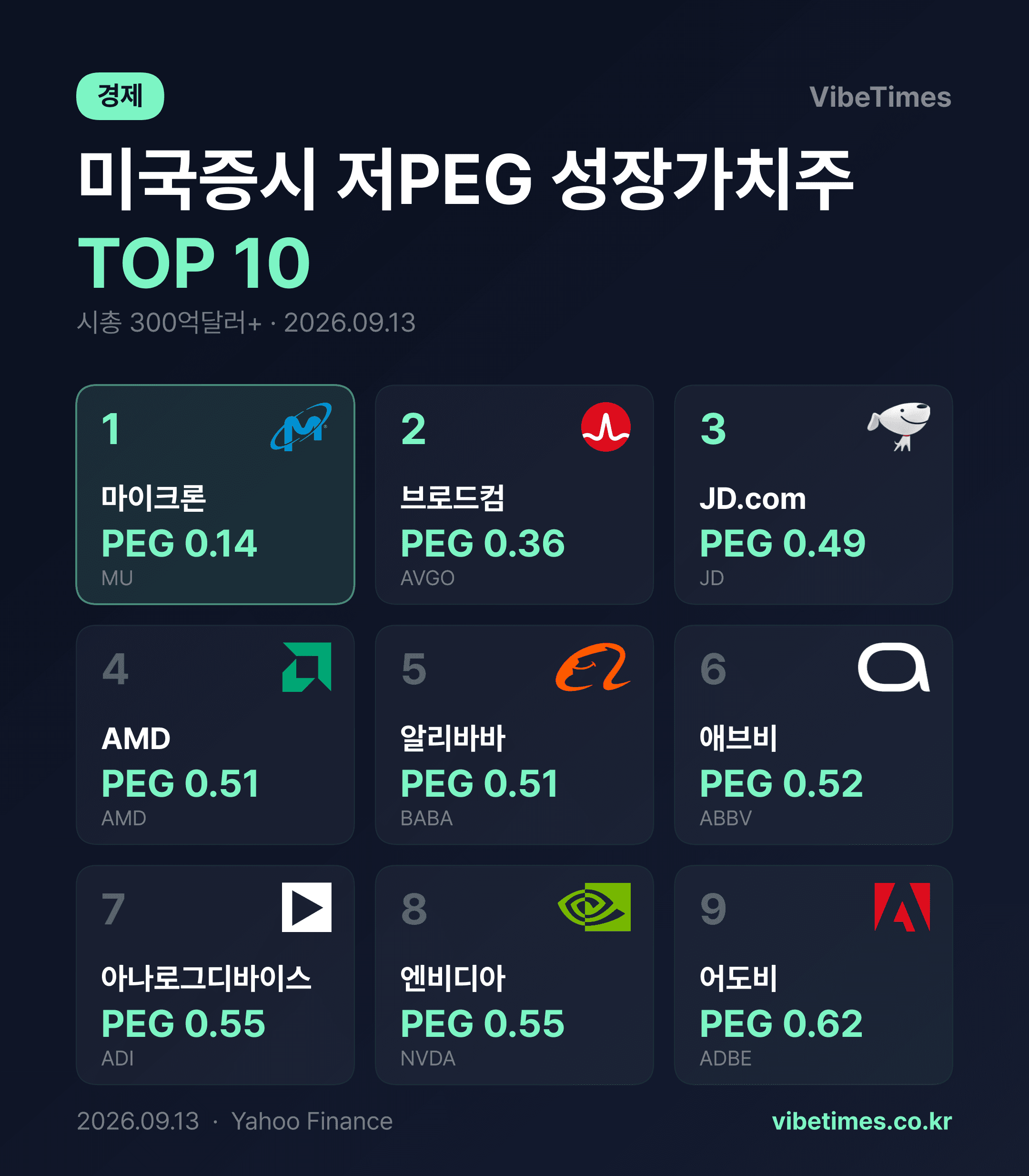
The cheapest growth stocks in the U.S. market turned out to be semiconductors. Five of the top 10 low-PEG growth stocks in the U.S. market, compiled as of September 13, 2026, came from the semiconductor sector: Micron, Broadcom, AMD, Analog Devices, and Nvidia. Top-ranked Micron posted a PEG of 0.14, a gap of more than double to second-place Broadcom at 0.36. The PEG ratio—calculated by dividing the price-to-earnings ratio (PER) by expected earnings growth—is generally read as meaning a stock trades cheaply relative to its growth pace when it falls below 1. All 10 names on this list came in under 1. A simple sum of the top 10's market capitalizations approaches $10 trillion, proof that the discount list was drawn largely from large caps.
What Micron's PEG of 0.14 Says About Its Growth Rate
The PEG of 0.14 is the result of dividing a PER of 22.1 by the growth rate. Run the calculation in reverse, and it implies the market expects Micron's annual earnings growth to exceed 150%. That such expectations have attached to a large cap worth $1.1 trillion signals that earnings estimates have been revised upward far faster than the stock price. The interpretation is that earnings outlooks have been steadily raised as AI demand flows into high-performance memory.
The same formula applies to neighboring names. AMD looks the most expensive on the list at a PER of 128.1, yet its PEG stops at 0.51—the math points to a hidden growth rate approaching 250%. That is how wide an earnings improvement the market has priced in for a company worth $822.1 billion. Nvidia, despite boasting overwhelming scale at $5.27 trillion in market value, maintained a PEG of 0.55 and a PER of 28.2, displaying a growth-stock profile that belies its mega-cap size. Broadcom (market cap $1.72 trillion) likewise sank to 0.36 once its PER of 46.1 was divided by its growth rate.
The Shape of the Discount Differs From Stock to Stock
The ranking is home to discounts of different origins. Adobe recorded the lowest valuation on the list, with a PER of 13.9, a PEG of 0.62, and a market cap of $98.9 billion. Given that the implied growth rate stops in the 20-percent range, the low PER itself is the source of the discount. AbbVie, by contrast, turned the burden of a PER of 72.0 into a PEG of 0.52. One reading is that the market has priced a sharp earnings rebound into the stock at a growth rate above 130%. It is a textbook case of explosive earnings improvement offsetting a high multiple.
The sector mix is worth a read, too. JD.com (PER 18.0) and Alibaba (PER 24.6) landed at Nos. 3 and 5 with PEGs of 0.49 and 0.51, respectively. Growth estimates for the two Chinese e-commerce companies have been raised to around 40%, with market caps of $36.5 billion and $269.8 billion—combined, still only about one-seventeenth of Nvidia's. Analog Devices (PEG 0.55, market cap $175 billion) and Boston Scientific (PER 17.4, PEG 0.63) represented the earnings recovery now underway in analog chips and medical devices.
A Low PEG Is a Starting Point, Not a Conclusion
The PEG's weakness is its dependence on expected growth rates. When estimates get cut, the ratio balloons in an instant. Even Micron's 0.14 could see its growth premise shaken if the memory price cycle turns down. For AMD and AbbVie in particular—where the gap between PER and PEG is wide—verifying the earnings guidance the companies themselves put out remains the key investment question.
Hasty conviction is the enemy of truth. — Nipsey Hussle
In the end, this ranking is less a settled conclusion than a checklist for verification. Even so, a lineup in which semiconductors claim half of the 10 slots carries the weight of the AI demand cycle intact. A re-rating is expected to unfold sequentially, starting with stocks whose growth estimates are backed by actual results, and that pattern is likely to continue.