National Assembly Data Analysis: The Rebuilding Korea Party Was Not One Color

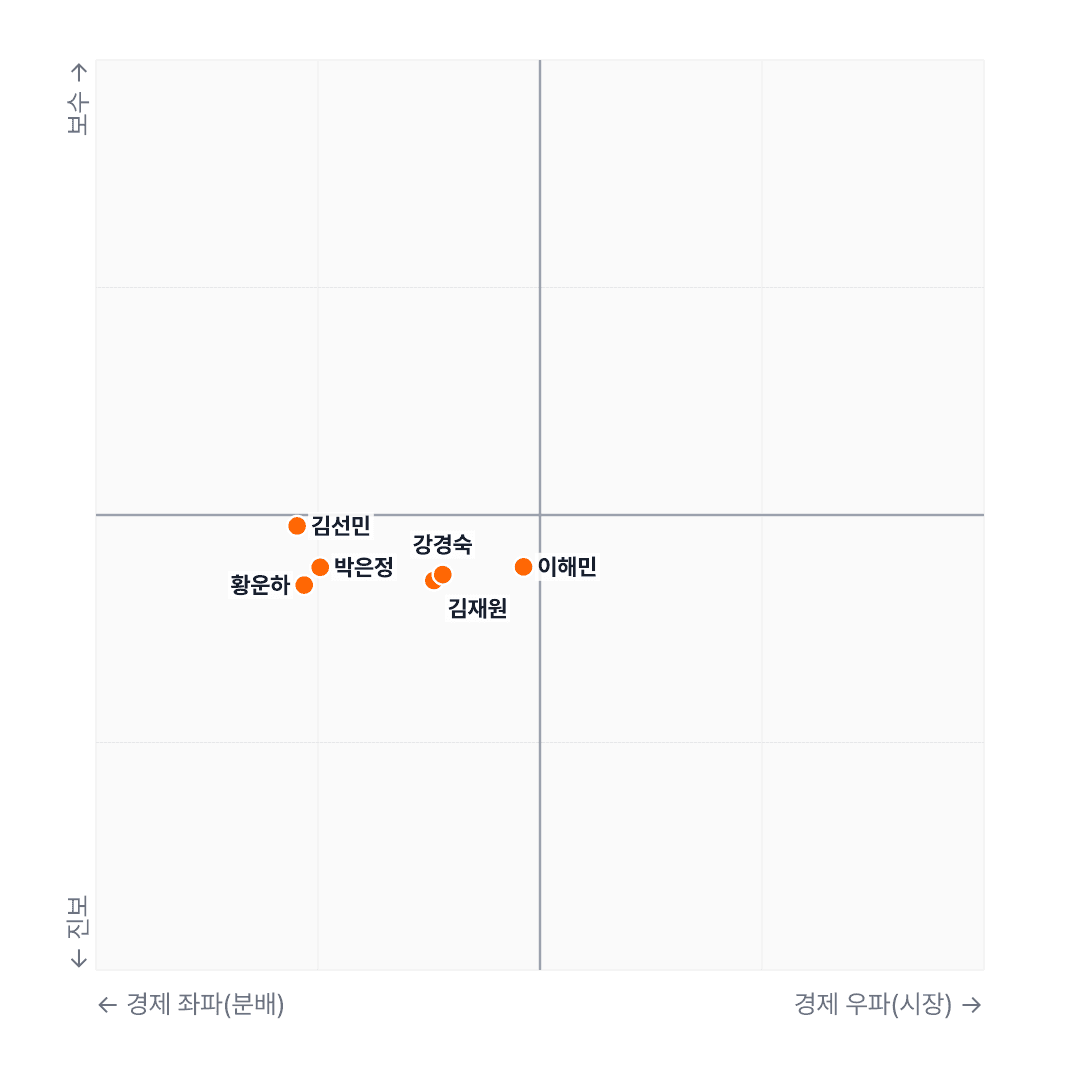
A deep dive into the bill sponsorship and voting records of the 12 lawmakers of the Rebuilding Korea Party reveals that it was not a party of a single ideological color.
The ideology coordinates dataset is a map drawn by cumulating the actual content of bills sponsored and voted on by lawmakers. It weighs judgments about the nature of each bill and measures each lawmaker's relative position, calibrated so that the centers of the two major parties, the Democratic Party and the People Power Party, sit at the origin. What is striking is that clear deviations among members emerge even in a minor party barely two years old. Reps. Kim Seon-min, Hwang Un-ha, and Park Eun-jung sit unmistakably at the left end of the party, while Rep. Lee Hae-min is positioned so close to the center of the two major parties that he is nearly indistinguishable from them.
The Gap Between the 'Hard-Line Progressive' Image and the Data
In the public imagination, the Rebuilding Korea Party has been consumed as a party of strong progressive hues. Yet on economic issues, there is considerable room to interpret the conventional wisdom as more left-leaning than the data. To be sure, the party's average leans clearly progressive relative to the centers of both major parties, with the tilt especially pronounced in economic orientation. What stands out is the consistency of direction: on the economy, the entire party clusters in progressive territory, while on social and cultural issues the left-right spread is relatively narrow. In other words, internal disagreement widens more over social issues than over economic agendas like wealth taxes or labor. The party unites on income redistribution debates but splits over gender and welfare issues.
What a 0.5% Party-Line Defection Rate Says
The list of the highest party-line defection rates contains some unexpected names. The most frequent defectors are Reps. Park Eun-jung and Kim Jun-hyung, who cast votes against the party on close to half of every 100 roll calls. The interesting point is that these two sit at opposite ends of the party's ideological spectrum. Rep. Park, with a defection rate of 0.5%, belongs to the most progressive wing, but the relative positions of Rep. Kim Jun-hyung, who has the same rate, and of Reps. Kim Seon-min and Kim Jae-won differ from hers. Defection, in other words, does not flow in only one direction. The political science logic of cross-pressures—that the further a member sits from their party's average, whether to the left or right, the greater the pressure to defect—holds just as firmly within a minor party.
It is difficult to draw firm conclusions, however. Defection rates do not reveal the content of the votes cast. Whether a member broke with the party line for progressive reasons or due to issue-specific interests cannot be separated from voting records alone.
The Politics of the Spectrum's Edges and Middle
Rep. Lee Hae-min's position is the most fascinating case of divergence from conventional wisdom. He has long been cast with a 'conservative image' simply because he is the son of former UN Secretary-General Ban Ki-moon, but his voting behavior shows the actual position the data captured. Conversely, Reps. Hwang Un-ha and Kim Jun-hyung appear further left in the record than in their images. Herein lies the power of data journalism: if we view bill sponsorship and voting as statements with the mask off, repeated roll-call votes leave a more honest portrait than a lawmaker's media image.
The limitations of this metric are also clear. Because it rests solely on legislative behavior—sponsorship and voting—it cannot capture issue orientations revealed in televised debates or constituency work, nor political activity outside the party. It should always be kept in mind that the color the public perceives in a lawmaker may differ from the color in the numbers.
Variables After Next Year's General Election
That a 12-member parliamentary party spans such an ideological spectrum is a meaningful signal for the coming phase of party politics. If talk of realigning the progressive camp resurfaces, whether ideologically centrist members and those at the progressive edge can remain under one flag will emerge as a practical variable. The party's high cohesion on economic issues but divergence on social ones could surface as internal competition in candidate selection and nomination processes. What the data shows is not a conclusion but a starting point. Where these 12 lawmakers land on their next votes will redraw this map.
Lawmakers Mentioned in This Article
| Lawmaker | Party | Ideological Orientation | Notes |
|---|---|---|---|
| Kim Seon-min | Rebuilding Korea Party | Economic left · Social progressive | Party's left wing |
| Hwang Un-ha | Rebuilding Korea Party | Economic left · Social progressive | Party's left wing |
| Park Eun-jung | Rebuilding Korea Party | Economic left · Social progressive | Party's left wing |
| Kim Jae-won | Rebuilding Korea Party | Economic left · Social progressive | Party's right wing |
| Kang Kyung-sook | Rebuilding Korea Party | Economic left · Social progressive | Party's right wing |
| Lee Hae-min | Rebuilding Korea Party | Economic left · Social progressive | Party's right wing |