Decision on Strait of Hormuz Deployment Comes as Approval Rating Hits Low of 37%

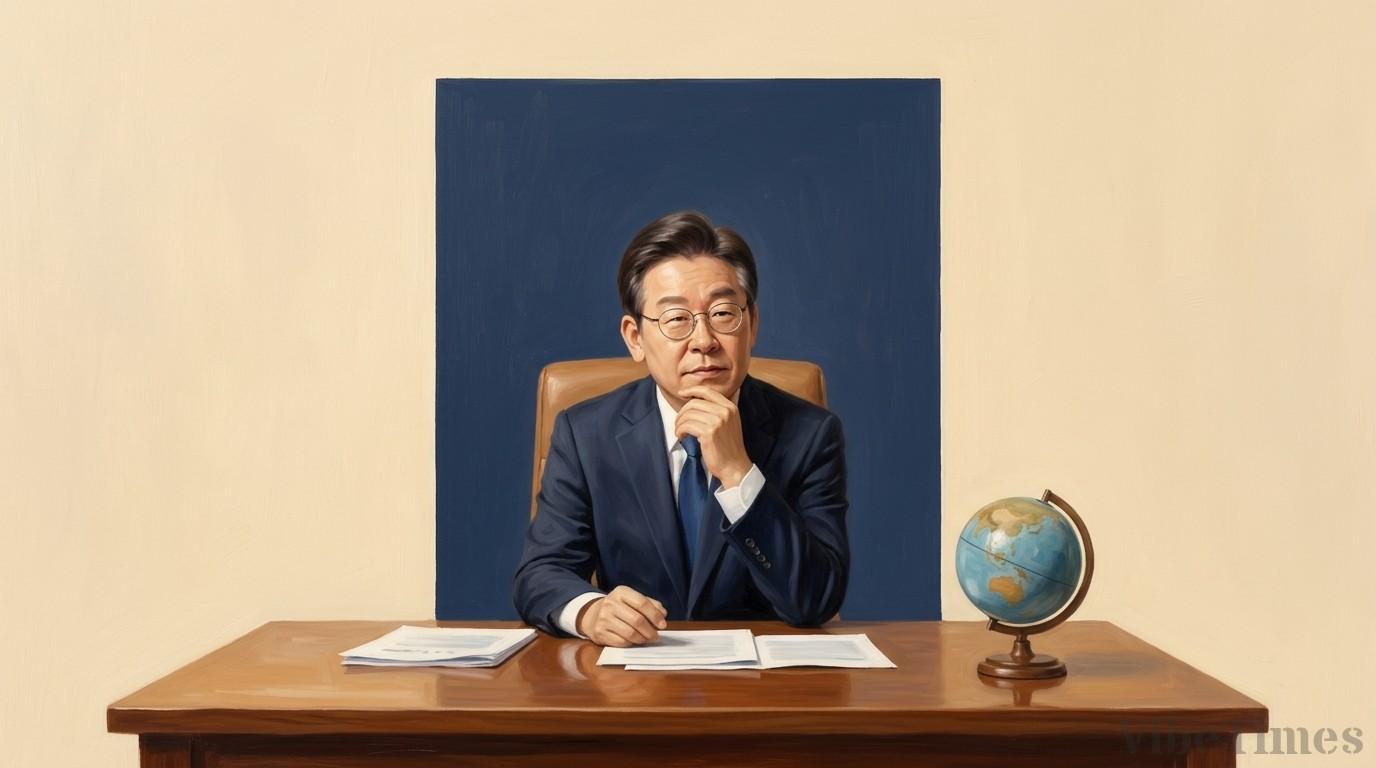
At a session reopening negotiations on the $350 billion investment in the United States, President Lee Jae-myung found himself saddled with another daunting task: a deployment to the Strait of Hormuz.
A Diplomatic and Security Decision Amid Record-Low Approval Ratings
At his seventh press conference since taking office, held at 10 a.m. on the 18th at the Yeongbin Hall of the presidential office, President Lee laid out his positions on pressing issues including constitutional revision, personnel controversies, and the Hormuz deployment. According to Yonhap News, he announced plans to restart negotiations on the $350 billion investment in the United States, while stating that semiconductor matters would be coordinated between corporate judgment and national interest. The remarks were interpreted to mean that the key challenge lies in how to balance the burden on companies against security demands over the scale and timing of the investment.
The weight of this decision is heavier than ever. In opinion polls, President Lee's approval rating for his handling of state affairs fell to 37%, his lowest since taking office, marking a fourth consecutive week of decline. Negative assessments rose 5 percentage points to 56%, an all-time high. With his support base eroding, the calculation is unavoidable: pulling out a burdensome card like a military deployment at such a moment could accelerate the slide in his ratings.
Deployment and Investment Talks: An Inseparable Structure
The core issue is that the two security matters are effectively bundled into a single package. The United States has been pressing allies simultaneously to expand investment in the U.S. and to participate in deployments to strategic chokepoints such as the Strait of Hormuz. President Lee's move to "restart" the investment negotiations is read as a signal that he intends to adjust the terms of the existing agreement to fit domestic conditions.
Semiconductors are the biggest sticking point in that adjustment. Mega-scale investments are primarily a matter of corporate profitability, yet they are also an area where the government cannot stay on the sidelines, given entanglements with national security and trade friction. President Lee's invocation of both "corporate judgment" and "national interest" shows he is well aware of this tension. Considering his administration's push for mega special economic zones covering semiconductors, physical AI, and AI data, the ripple effects of any renegotiation of U.S. investments on the domestic industrial ecosystem cannot be ignored.
Political Fallout and the Road Ahead
The deployment issue is likely to become a rallying point for opposition attacks. Sending troops abroad requires National Assembly consent and public support, so wielding it as a bargaining chip while at a vulnerable 37% approval is a political risk in itself. Opposition voices could emerge within the ruling camp as well. On the other hand, refusing the deployment could weaken Seoul's leverage in renegotiating the U.S. investment — a trade-off that cuts both ways.
President Lee is also reported to have emphasized his commitment to domestic reform at the press conference, urging the government to respond to confusion over implementation guidelines, remarking that "conflict is coming from all directions." He appears to believe he must demonstrate both a diplomatic-security decision and a normalization of domestic governance. Whether his admission that he has "fallen short" can become a springboard out of his approval-rating crisis is another point to watch.
Ultimately, the pace of the renegotiation table will determine how things unfold. If investment terms are settled in a way that eases the burden on domestic companies, there will be more room to manage the burden of a deployment as well. Conversely, if negotiations drag on, the pressure to deploy could materialize first. This round of negotiations is set to confirm once again that while the leverage of alliance is great, a price always hangs at the end of it.
