September 21 Market Report: Intel Leads Semiconductor Downturn Rally

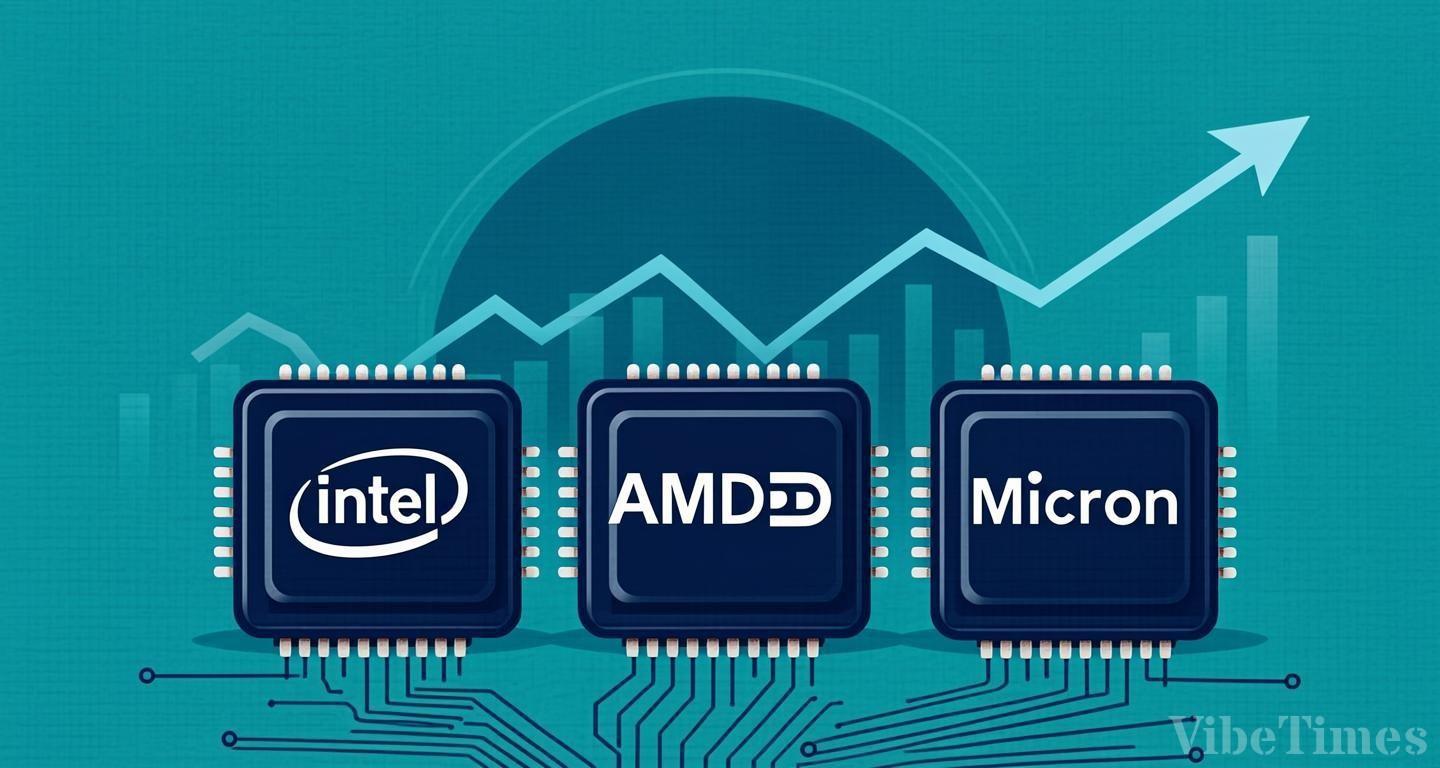
Intel led the semiconductor sector's upward move, posting the largest gain of 0.08% among the top 20 stocks by market capitalization amid a weak semiconductor market.
As of September 18, 2026, semiconductor-related stocks among the top U.S. stocks by market capitalization all recorded gains. Intel rose from 101.05 won to 108.8 won, while Micron climbed 0.05% from 926.55 won to 977.5 won. AMD also gained 0.06%, rising from 512.5 won to 545.09 won. This shows that buying momentum in semiconductor stocks remains intact despite the burden of high interest rates and elevated oil prices.
| Stock | Current Price | Change | Market Cap | P/E | EPS Growth |
|---|---|---|---|---|---|
| Intel | 108.8 won | +0.08% | 0.58 trillion won | - | 9865.5% |
| AMD | 545.09 won | +0.06% | 0.89 trillion won | 139.1 | 16435.6% |
| Micron | 977.5 won | +0.05% | 1.10 trillion won | 22.1 | - |
| NVIDIA | 219.34 won | +0.03% | 5.30 trillion won | 27.7 | 6599.3% |
| Taiwan Semiconductor (TSM) | 430.26 won | +0.03% | 2.23 trillion won | 32.1 | 4430.2% |
The Valuation Gap Exposes a Fault Line in the Semiconductor Sector
Even within the same sector, valuations diverge widely. Micron's P/E ratio of 22.1 is the lowest in the sector, and NVIDIA's sits at just 27.7. By contrast, AMD trades at 139.1, ASML at 55.6, and Broadcom at 44.2, maintaining demanding valuations. Intel's P/E is not reported, which can be read as a signal that the company's net income base remains unstable.
Growth metrics partly justify this gap. AMD's EPS growth rate stands at 16435.6% and Intel's at 9865.5%, reflecting extremely large earnings improvements from their lows. NVIDIA posted a growth rate of 6599.3%, while Taiwan Semiconductor came in at 4430.2%. However, it should be noted that these explosive figures reflect a base effect, as the prior year's earnings were at rock bottom.
Big Tech Edges Higher While Value Stocks Stand Still
Platform big tech also joined the modest advance. Microsoft rose 0.02% to 497.75 won, and Amazon posted the same gain at 251.19 won. NVIDIA, the largest company by market cap, edged up 0.03% to 219.34 won, while second-ranked Apple rose a mere 0.01% to 337 won. Alphabet's dual-listed shares (GOOGL and GOOG) each closed 0.01% higher while trading at low valuations with P/E ratios of 17.2 to 17.4.
Traditional value stocks, meanwhile, lost direction. Berkshire Hathaway fell 0.02% to 509.2 won, and Walmart slipped slightly from 107.5 won to 106.79 won. Visa, Mastercard, and Exxon Mobil hovered near flat. Johnson & Johnson managed only a 0.01% rise to 270.22 won. Growth-oriented capital flows were the market's clear defining feature of the day.
Tesla and Meta Lag as the Market Looks Ahead
The exodus from stocks with weak earnings is also evident. Tesla, with a P/E of 345.5 and an EPS growth rate of -4709.0%, carries the double burden of high valuation and deteriorating fundamentals. Meta also posted a negative EPS growth rate of -256.0%, while AppLovin showed a profit decline of -125.0%. Chevron and Exxon Mobil recorded earnings slowdown indicators of -3186.5% and -1454.1%, respectively, signaling profitability pressure in the energy sector.
The broader market remains stable. VOO and SPY, which track the S&P 500, each rose 0.01%, and QQQ, the flagship Nasdaq-100 ETF, gained 0.02%. Off-market risks nonetheless linger. As the market moves through the first week after the Federal Reserve's rate hike, the benchmark rate remains in the 3.75–4.00% range, while the U.S.-China summit, Treasury yields, and oil prices could act as short-term volatility factors. The possibility of risk-averse selling ahead of the holiday weekend cannot be ruled out either.
From an investment perspective, attention should be paid to the valuation gaps across sectors. Alphabet at a P/E of 17 and Micron and Amazon in the low 20s offer relatively ample margins of safety, while AMD, Palantir (151.9), and Tesla (345.5)—all trading above a P/E of 100—face the challenge of earnings improvement catching up with their stock prices. Whether the semiconductor rally continues will likely depend on the sustainability of Intel's and AMD's earnings recovery and the pace at which interest rate pressures ease.