October 2 Legislative Report: Lee Jun-seok Signs North Korean Landmine Resolution

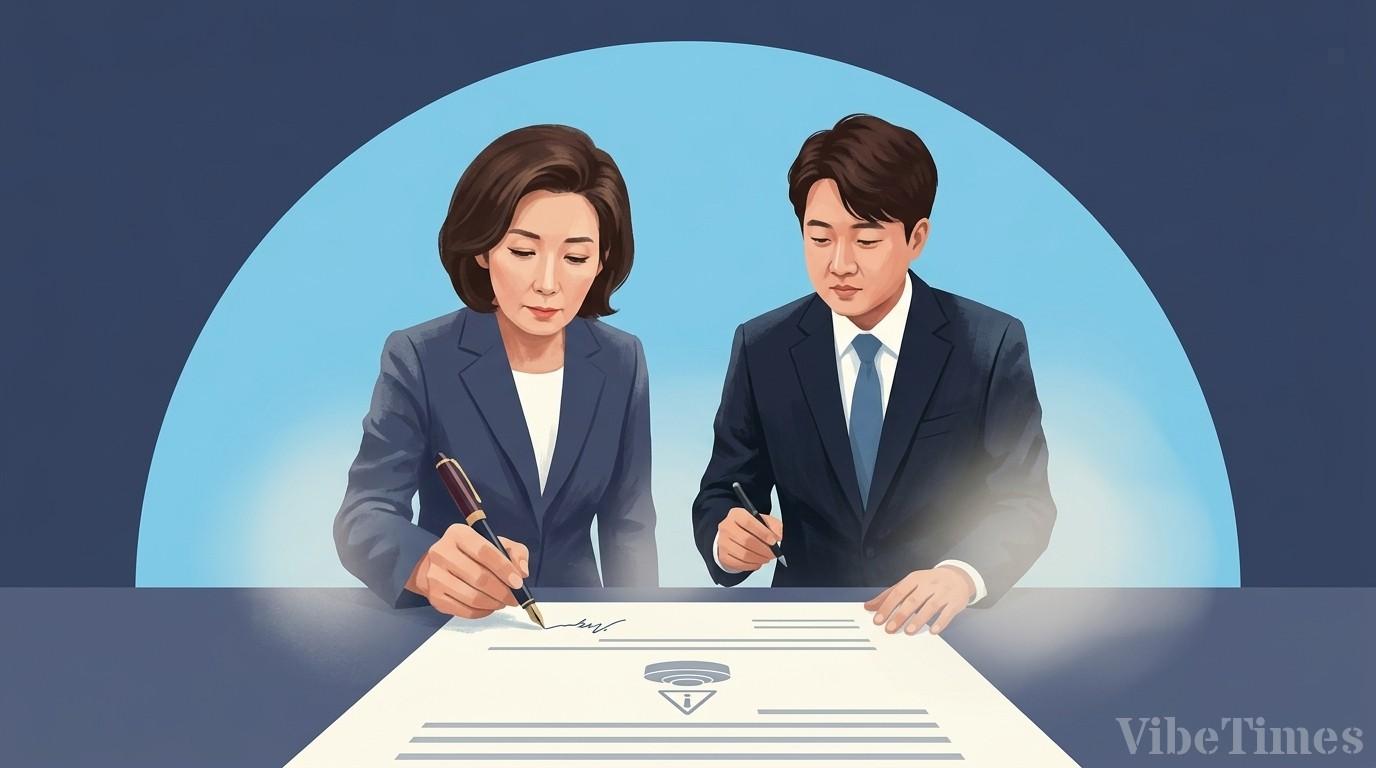
The names of Na Kyung-won and Lee Jun-seok appeared side by side on a resolution condemning North Korea's landmine provocations.
A look at legislative trends in the National Assembly reveals cross-party alliances forming in various quarters. Lee Jun-seok, leader of the Reform Party, signed as a lead sponsor a resolution on the North Korean landmine incident led by Rep. Na Kyung-won. It is a rare move for the leader of a third-zone opposition party to put his name on a bill driven by the ruling party, and it is interpreted as a convergence of interests between the two on a hardline stance toward North Korea. As Rep. Na shapes the resolution into a bipartisan response to North Korean provocations, Rep. Lee can be seen to have calculated that participation would secure the Reform Party's presence on security issues.
Lee Jun-seok Requests State Audit Witnesses... Housing Innovation Forum Also Launched
Rep. Lee's activities in the Assembly do not stop at signing the resolution. At the request of his office, Ku Kyo-woon, chairman of Daebang Construction, was adopted as a witness for the state audit. With real estate development issues such as reconstruction-redevelopment and association corruption emerging as core political concerns, placing a businessman regarded as a hands-on executive on the witness list confirms the Reform Party's strategy of targeting housing and real estate as legislative battlegrounds. The launch of the Metropolitan Area Housing Innovation Forum, joined by lawmakers from both the People Power Party and the Reform Party alongside Rep. Cho Jeong-hoon, stems from the same logic. The formation of ruling and opposition lawmakers in a single forum shows that housing has become a bipartisan issue transcending party lines. The forum is expected to potentially lead to concrete housing-related bill proposals.
The Scale of Intra-Party Defections Revealed in Plenary Votes
The results of the October 1 plenary votes revealed considerable internal fractures on both sides. On the partial amendment to the Special Account Act for Rural Community Improvement, the Democratic Party recorded 86 in favor and 16 against. Sixteen members, including Jeong Cheong-rae, Min Hong-chul, Eoh Ki-gu, and Kim Jun-hwan, voted against the party line. With roughly 16% of the ruling party's 102 members defecting, this suggests sharp internal divisions over regional and class interests surrounding the allocation of rural funds.
On the same bill, the People Power Party showed 4 in favor and 40 against. Only four members—Kim Yong-tae, Kwon Young-se, Lee Man-hee, and Lee Sang-hwi—refused to join the opposition vote. Though the defection was small given the overwhelming opposition stance, it is notable that both parties recorded defections in opposite directions on the same bill.
On the partial amendment to the Emergency Medical Care Act (alternative bill), the People Power Party split 14 in favor and 10 against. Ten members, including Lee Jong-bae, Yu Young-ha, Kim Tae-kyu, and Park Chung-kwon, crossed over to support the bill. Considering that the bill, aimed at easing 'emergency room rotations,' passed the plenary and established the legal basis for 119 services to designate receiving hospitals, one interpretation is that on medical gaps directly tied to citizens' lives, even the opposition found it difficult to sustain grounds for opposition.
On the partial amendment to the Broadcasting Act (56 in favor, 3 against) and the Environment-Friendly Agriculture Promotion Act alternative (61 in favor, 3 against), Reps. Kim Min-jeon, Choi Soo-jin, and Lee Jin-sook, and Reps. Song Eon-seok, Han Ki-ho, and Lee Jin-sook cast opposition votes, respectively. Rep. Lee Jin-sook voted against both bills, showing a stubbornly defiant streak. Given that the Assembly Operations Committee previously passed an expulsion motion against Rep. Kim Tae-kyu over his denial of the Chun Doo-hwan insurrection, some observe that controversies over historical views are influencing voting patterns as well.
Committee Assignments Reveal the Education and Budget Fronts
The 22nd Assembly's committee composition is also worth noting. According to publicly available Assembly information, members of the Rebuilding Korea Party—Park Seo-yoon, Yun Eo-gein, Park Jin-seok, Choi Chan, Song Min-hyuk, Choi Chan-do, Kim Kyung-im, and Sung Young-taek—serve on both the Education Committee and the Special Committee on Budget and Accounts. The concentration of many members of one party on the same two fronts of education and budget reads as an intent to make legislative and budget battles over education finance a core party strategy. Liberty Korea Party members Yang Jong-hee and Won Jong-pil also sit on both committees, making it highly likely that bipartisan cooperation and clashes will unfold simultaneously during reviews of the education budget.
Education legislation continues to move. Rep. Park Hong-bae of the Democratic Party sponsored a bill to expand support aimed at resolving recurring regional conflicts in the relocation of aging correctional facilities. The idea is to address conflicts between the areas losing facilities and those receiving them through a legal support framework.
Prosecution Reform and the Legislative Outlook
Legislative competition over investigative and prosecutorial institutions is also heating up. People Power Party floor leader Jeong Jeom-sik announced at a state audit preparation meeting, "We will push forward by first proposing the Act to Restore the Prosecution's Supplementary Investigation Powers." He cited the lengthening of the average criminal case processing time from 140 to 312 days—a 2.2-fold increase—after the police-prosecution investigative authority adjustment as evidence of an investigative gap. At the inauguration ceremony of the Corruption Investigation Office for High-ranking Officials, Assembly leaders made official appearances, with Kim Young-jin, chairman of the Public Administration and Security Committee, and Seo Young-kyo, chairwoman of the Legislation and Judiciary Committee, delivering congratulatory speeches. Follow-up legislation related to the CIO and the People Power Party's restoration bill are expected to clash head-on in the Legislation and Judiciary Committee.
Local governments' competition for national funding also intertwines with the Assembly's schedule. Wonju requested additional funding for 16 projects omitted or only partially reflected in the government's budget proposal, and the mayor of Uijeongbu met with the chairwoman of the Assembly's Budget Committee to propose three key priorities. With the current Assembly featuring many members on the Budget and Accounts Special Committee, how local priorities are reflected during budget deliberations will serve as the de facto scorecard for the Assembly in the latter half of the year. Whether the bipartisan cooperation opened by the resolution signing expands to livelihood issues such as housing, healthcare, and budgets, or whether confrontation over prosecution reform narrows all room for cooperation, will be the variables that shape the future legislative landscape.