Comcast Tops Undervalued Large-Cap List With a P/E of 7

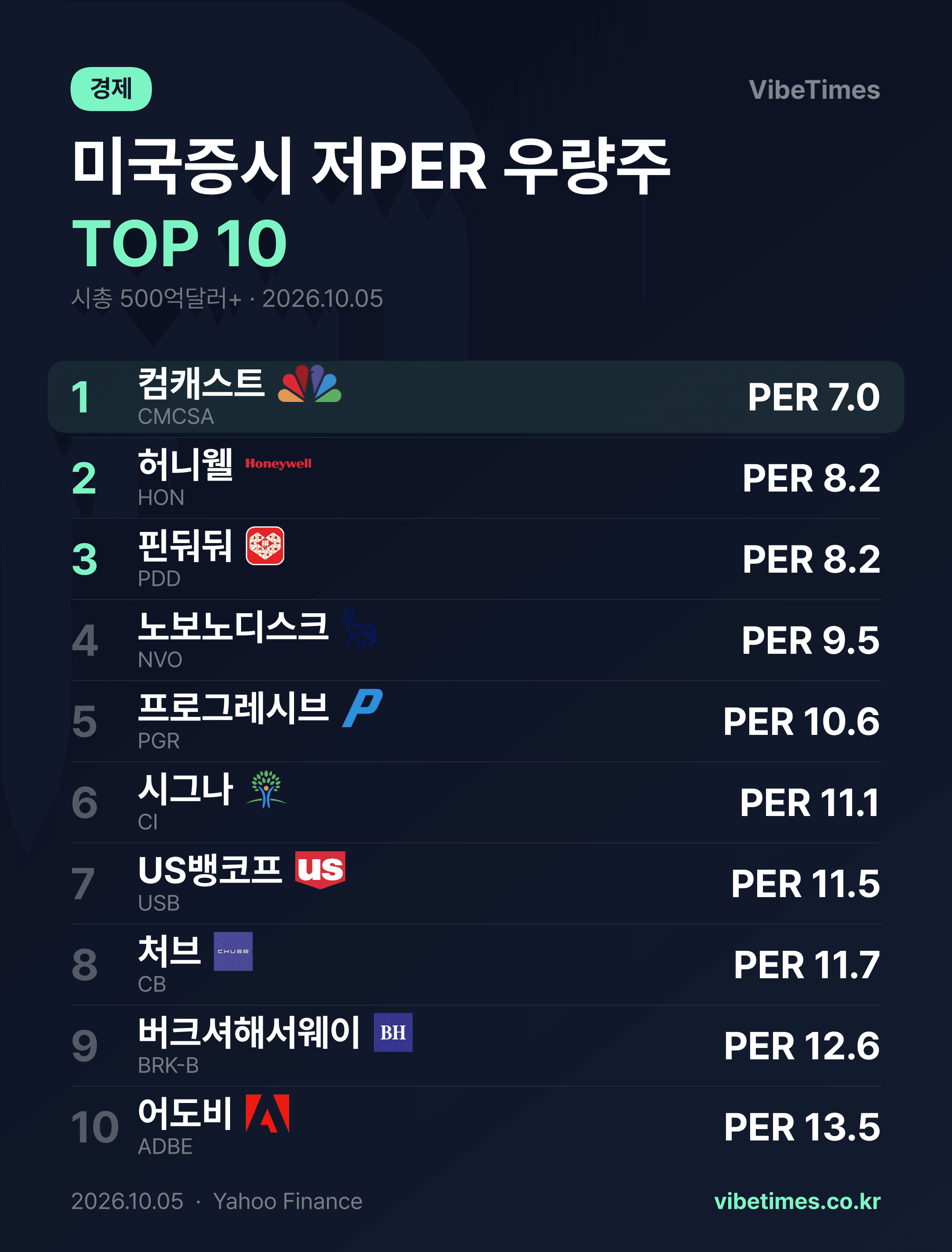
Comcast topped the ranking of undervalued U.S. large-cap stocks with a price-to-earnings ratio of 7.0.
What the Composition of the Low-P/E Leaders Tells Us
According to a table of the largest U.S. stocks by market capitalization, ranked from lowest P/E ratio (share price divided by earnings per share) as of October 5, 2026, Comcast came in first with a P/E of 7.0 and a market cap of $77 billion. Honeywell ranked second at a P/E of 8.2 with a $67.8 billion market cap. Third-place PDD Holdings also posted a P/E of 8.2, but with a market cap of $108.9 billion, it is larger than both companies.
What stands out is the sector mix among the top-ranked names. Comcast is in cable and telecom, Honeywell in industrial equipment, PDD Holdings in Chinese e-commerce, Novo Nordisk in pharmaceuticals, Progressive, Cigna, and Chubb in insurance, and U.S. Bancorp in banking. In other words, this is not a cheap-stock list dominated by a single sector, but one that blends telecom, financials, and industrials evenly. Given that the broader market remains concentrated in high valuations centered on growth stocks, the fact that these traditional industrial giants trade at 7 to 12 times earnings is evidence that the valuation gap within the market remains wide.
Berkshire's Significance and the $1 Trillion Class of Bargains
Ninth-ranked Berkshire Hathaway is a different breed in this ranking. With a market cap of $1.07 trillion, it is the only company above the trillion-dollar mark, yet its P/E stands at just 12.6. Novo Nordisk ($165.1 billion, P/E 9.5), Progressive ($122.4 billion, P/E 10.6), and Chubb ($127.8 billion, P/E 11.7) are also hundred-billion-dollar-class companies. The key takeaway from this table is that massive assets, not penny stocks, are trading at low multiples.
Berkshire's appearance among the low-P/E leaders shows that Warren Buffett-style value investing remains a valid yardstick in the market. Like the old baseball player's joke about hoping for luck in trying to do a little better, returns on undervalued stocks ultimately hinge on timing — when the market finally recognizes their value.
A Quiet Market With Price Changes Near Zero
The price changes of all the stocks in this ranking clustered between -0.02% and 0.02% — essentially flat. This suggests the data was compiled right after the market close or during off-hours, while also showing that, unlike volatile thematic stocks, the low-P/E group is maintaining a stable trading pattern. Any shifts in the ranking will likely depend on upcoming earnings releases and the trajectory of interest rates in the next trading session.
Investment Implications and Outlook
A P/E range of 7 to 13 is historically below the average valuation of U.S. large-cap stocks. Comcast's 7.0 is interpreted as reflecting concerns about declining cable subscribers, while Novo Nordisk's 9.5 is seen as weighed down by worries about slowing growth in obesity treatments. PDD Holdings' 8.2 carries a discount due to uncertainty over the pace of China's consumption recovery.
Each stock's low P/E is not mere cheapness but a risk premium set by the market. Accordingly, this ranking is best used not as a buy signal but as a starting point for asking which concerns are already priced in. Once fourth-quarter earnings season begins, whether these companies deliver earnings improvements will determine how quickly the valuation gaps close.