Samsung Electronics Solidifies Its Lead with Market Cap of 1,812 Trillion Won

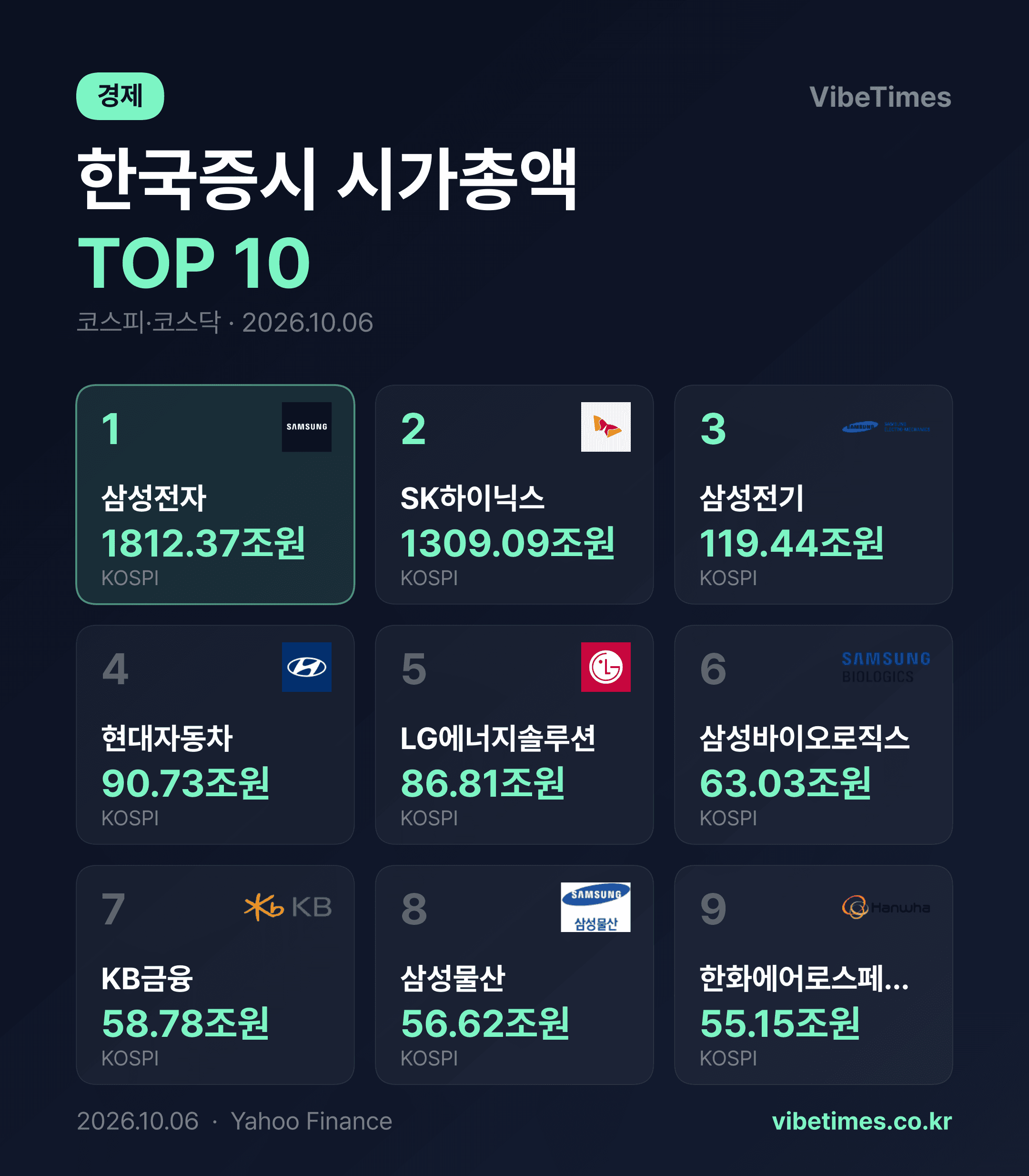
Samsung Electronics defended its position atop the domestic stock market with a market capitalization of 1,812 trillion won. In the market cap rankings compiled at the close of trading on October 6, 2026, Samsung Electronics confirmed its unshakable No. 1 status, holding a gap of more than 500 trillion won over second-place SK Hynix. With individual stocks moving less than 0.05% in either direction, this ranking reads less as a story about price movements and more as a statement about the structural hierarchy across industries.
A Twin-Engine Semiconductor Race, with a 'Cliff' Among the Top Ranks
The structure at the top of the rankings is stark. Samsung Electronics (1,812.37 trillion won) and SK Hynix (1,309.09 trillion won) split the top two spots. Their combined market capitalization of roughly 3,121 trillion won is more than five times larger than that of the eight companies ranked third through tenth combined (about 542 trillion won) — a telling figure that shows just how deeply the Korean market leans on its two semiconductor pillars.
Even more striking is the fault line between second and third place. Dropping from SK Hynix at 1,309 trillion won to Samsung Electro-Mechanics at 119.44 trillion won means a plunge of more than tenfold. In effect, there is virtually no middle tier between 'ten-trillion-won-class' and 'hundred-trillion-won-class' companies. The Korean market's heavy concentration in specific sectors and companies is a feature investors should clearly recognize from a diversification standpoint.
Rankings 3 to 10: Greater Industry Diversity
From third place onward, the sector mix becomes far more varied: Samsung Electro-Mechanics in auto components (119.44 trillion won), Hyundai Motor in autos (90.73 trillion won), LG Energy Solution in secondary batteries (86.81 trillion won), Samsung Biologics in biotech (63.03 trillion won), KB Financial and Samsung Life in finance (58.78 trillion won and 51.90 trillion won), Samsung C&T in construction and trading (56.62 trillion won), and Hanwha Aerospace in defense (55.15 trillion won). Excluding semiconductors, key industries are spread fairly evenly across electronic components, autos, batteries, biotech, finance, construction, and defense.
The presence of Samsung Group affiliates also stands out. Five of the top ten — Samsung Electronics, Samsung Electro-Mechanics, Samsung Biologics, Samsung C&T, and Samsung Life — belong to the Samsung camp. Their combined market cap of roughly 2,103 trillion won underscores how overwhelmingly dominant a single group remains across the entire market.
Stagnant Prices, a Signal Worth Reading
On this day, all ten top stocks moved within roughly ±0.05% — a range so narrow it could be mistaken for ETF quotes. KB Financial and Samsung Electro-Mechanics each managed gains of just 0.01%, while Samsung Biologics posted the largest move at -0.05%, which still amounts to essentially flat trading. The session reads as one in which large-cap stocks are sitting on the fence, unable to pick a direction.
Even when prices stand still, the rankings draw the map of capital. As Gerald Ford once said, the quality of the ordinary and steady is what creates stability — and today's Korean market leaders are showing where the market's center of gravity lies through structure rather than volatility.
What to Watch Going Forward
In the short term, the key variable is the gap between Samsung Electronics and SK Hynix. The current difference of roughly 503 trillion won could narrow depending on SK Hynix's share of high-value products during the memory chip boom. Conversely, if Samsung's foundry and non-memory competitiveness recovers, the gap would widen again.
Over the longer term, the question is whether a middle tier can emerge. Hanwha Aerospace (55.15 trillion won) is banking on global defense demand, while LG Energy Solution is watching for a recovery in the EV battery market. Whether a new company can break into the 100-500 trillion won middle tier will likely determine whether the Korean market's concentration eases.