October 10 Investment Report: AI Value Investing Portfolio +71.8%


After a Long Rainy Season, 70% Returns Despite a Shaky Market
The KOSPI plunged more than 2.6% in a single day on the 9th, falling back to the 6,600 level. The direct trigger was a sharp selloff in U.S. semiconductor stocks. The Philadelphia Semiconductor Index had tumbled 3.4% the previous session, and the Nasdaq closed down around 1%, carrying tech-led correction pressure straight into Asian markets. Yet despite the market's gasps, the AI Value Investing Portfolio maintained a cumulative return of +71.85%, continuing its steady performance. It was a day that underscored anew how a strategy's durability only truly reveals itself in a crash.
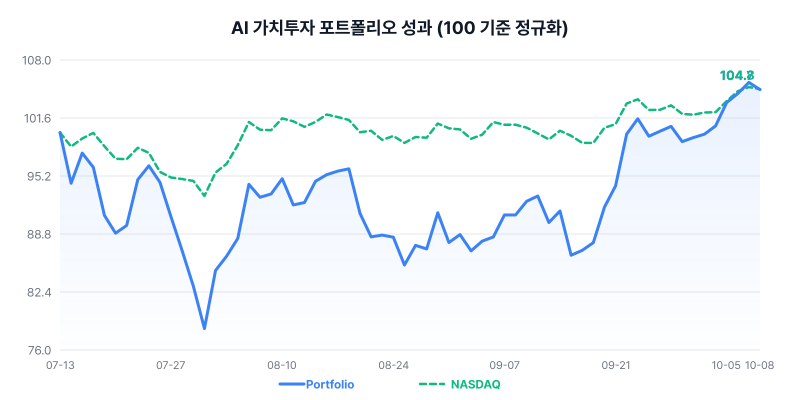
A Growth Curve That Added 650,000 Won in Just One Week
Looking at the asset trajectory, this portfolio's climb actually peaked recently. Total assets, which stood at $16,527 on the 2nd, briefly surpassed $17,300 within three days, and despite a slight pullback the previous day, they stand at $17,185. That is more than $7,000 in gains on top of the initial $10,000 in capital. Of course, given that the portfolio includes numerous semiconductor leveraged stocks, short-term corrections could well continue after the KOSPI's 2.6% plunge. Still, the key to this performance lies in a valuation-driven stock composition that secures both upside power in bull markets and a firm footing in downturns.
A Victory for Undervaluation, But Leverage Needs Managing
Unfolding the valuation map of holdings makes the source of these gains clear. Measured by PEG ratio, which weighs value against growth, Nvidia sits at 0.29, Micron at 0.16, and Broadcom at 0.37. That is a signal that share prices remain cheap relative to growth rates. Micron in particular, with a P/E of just 15, combined with HBM demand, has fully priced in the memory supercycle narrative. AMD's price-to-earnings level of 165x is daunting, but its PEG of 0.66, reflecting expected future growth, leaves some breathing room. Intel, meanwhile, still posts negative earnings, leaving little to salvage from the metrics; acknowledging that its worth hinges on expectations of an AI supply chain recovery, the portfolio has kept its weight in check. Notably, cash balance is at zero, meaning full investment, which poses a short-term risk in a correction and warrants caution.
| Stock | Quantity | Purchase Price | Current Price | PER |
|---|---|---|---|---|
| Nvidia | 26.59 shares | $184.21 | $237.47 | 30.0 |
| AMD | 7.17 shares | $198.62 | $645.86 | 164.8 |
| Broadcom | 5.67 shares | $326.03 | $376.51 | 46.4 |
| Micron | 0.42 shares | $987.48 | $1,088.00 | 14.6 |
| Intel | 2.80 shares | $104.56 | $113.12 | - |
| Amazon | 1.95 shares | $208.39 | $259.92 | 20.9 |
| Meta | 0.55 shares | $653.56 | $721.31 | 27.2 |
| SOXL | 14.65 shares | $71.22 | $158.91 | - |
| TQQQ | 1.19 shares | $76.34 | $83.62 | - |
Trimming the Leverage, Building the Value
The keyword in the trade review is 'rebalancing.' From late July through August, the portfolio sold the 3x semiconductor leveraged ETF SOXL in five tranches, steadily sidestepping the overheated sector rally. The freed-up capital moved into individual names like Intel and Nvidia, as well as Micron, purchased on September 18. Given that the rationale for the Micron entry was future earnings at roughly 6x expected growth and an extremely low PEG, this was not reckless expansion of leverage but a qualitative shift into undervalued quality names. The partial sale of Meta was likewise a defensive weight reduction, factoring in competition concerns in the ad market, done without upsetting sector balance. Trading without stop-losses, clearing risk purely through profit-taking, can be described as a straightforward principled approach that never chases momentum.
| Date | Type | Stock | Quantity | Price |
|---|---|---|---|---|
| 2026-09-18 | Buy | Micron | 0.19 shares | $977.50 |
| 2026-09-18 | Sell | SOXL | 0.77 shares | $114.82 |
| 2026-08-28 | Sell | SOXL | 0.81 shares | $123.05 |
| 2026-08-21 | Buy | Nvidia | 0.84 shares | $216.85 |
| 2026-08-21 | Sell | Meta | 0.10 shares | $545.83 |
| 2026-08-21 | Sell | Micron | 0.03 shares | $974.33 |
| 2026-08-21 | Sell | SOXL | 0.85 shares | $122.21 |
| 2026-08-14 | Buy | Intel | 2.80 shares | $104.56 |
| 2026-08-14 | Sell | SOXL | 0.90 shares | $145.36 |
| 2026-08-07 | Sell | SOXL | 0.95 shares | $132.33 |
Safe Havens Are on the Move; Is the Correction an Opportunity?
Macro indicators are catching their breath. The U.S. 10-year yield eased slightly from the 5.2% range and found stability, and the VIX remains low in the low-teens, leading most to judge that this is not a market collapse scenario. Instead, gold futures rose 1.4%, signaling a clear flight to safety, while the won-dollar exchange rate is hovering in the 1,339-won range. With Nasdaq 100 futures up modestly in pre-market pricing, the day's domestic market plunge may have been an overreaction. Even if the semiconductor correction lasts a week or two, the AI infrastructure investment cycle itself remains intact. Valuation-backed holdings will buy time to recover losses, and a correction is more likely than not to serve as a chance to reaffirm undervalued levels.
※ This report analyzes the simulated performance of the AI Value Investing Portfolio and is not investment advice. Actual investment decisions should be made at your own discretion and responsibility.
Want the full portfolio details?
Subscribe to the newsletter below to receive a detailed investment report every day.